
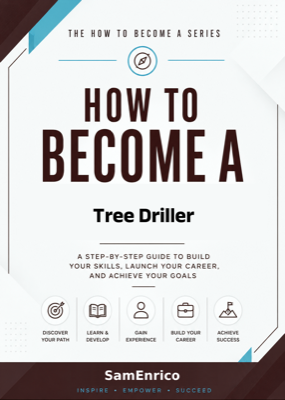
How to Become a Tree Driller Paperback
How to Become a Tree Driller
How to Become a Tree Driller
Formats
Free sample
Chapter 1: The Day I Killed a 300-Year-Old Oak--–- I remember the sound precisely. Not the screech of an auger biting into wood—that’s a clean, predictable noise. No, this was a low, wet crack, like a knuckle being bent backward until something inside gave way. Then came the silence. Then the slow, almost graceful descent of a branch the size of a small car, crashing through the canopy and burying itself in the wet April mud three feet from where I stood.The homeowner, a kind-faced retired schoolteacher named Margaret, watched from her kitchen window.
She didn’t scream. She didn’t run outside. She just stood there, coffee cup frozen halfway to her lips, watching her 300-year-old white oak lose a limb that had shaded three generations of her family. I was twenty-two years old, six months into my self-appointed career as a “tree driller,” and I had no idea what I’d just done wrong.I had drilled that oak two weeks earlier. A neighbor had mentioned that Margaret was worried about the tree—some deadwood in the upper crown, a few mushrooms growing at the base.
I offered to “take a look” with my brand-new increment borer, a beautiful Swedish-made tool I barely knew how to use. I drilled a single 12-inch core sample at chest height, perpendicular to the trunk, just like a You Tube video had shown me. The core came out dark in the center—heart rot, I later learned—but I didn’t know how to read it. I pulled the borer out, admired the neat hole I’d made, and told Margaret the tree looked “pretty healthy overall.”Two weeks later, the limb broke. The hole I’d drilled—that neat, innocent-looking hole—had opened a pathway for rainwater and decay fungi directly into the tree’s structural heartwood.
The oak’s own compartmentalization defenses, remarkable as they were, couldn’t seal a wound that deep that fast. Spring rains had done the rest, turning sound wood into mush from the inside out.Margaret didn’t sue me. She didn’t even yell. She just asked me to leave and never come back. That was worse.
That was the kind of quiet failure that follows a man into his dreams.I spent the next three years learning what I should have known before I ever touched a tree. I studied under a retired forest pathologist who drilled trees for the U.S. Forest Service. I tapped ten thousand maples on a commercial sugarbush in Vermont, learning by feel when a bit was sharp and when it was dull, when a tree was healthy and when it was hollow. I shadowed a municipal arborist in Portland who used a resistograph—an electronic drill that graphs wood density—to diagnose decay in historic elms.
I broke bits, got stuck in trees, drilled into wasp nests, and once, memorably, hit a buried horseshoe that sent metal shards flying past my face.This book is what I wish I’d had on that rainy April morning. Not a You Tube video. Not a forum post. Not a sales catalog full of expensive tools with no instructions. A real, ground-truth guide to becoming a tree driller—someone who understands that drilling a tree is not construction work.
It’s surgery. And like any surgery, it requires anatomy, tools, diagnostics, ethics, and the humility to know when not to pick up the drill.The Unspoken Trade Before we go any further, let me tell you what a tree driller actually is, because it’s not a job title you’ll…
This is the end of the free sample. Get the Paperback to keep going. Buy now
About this book
Details
- Author
- Weatherford Alethia
- Publisher
- SamEnrico
- Language
- English
- ISBN
- 9781506054247
- Genre
- Non-Fiction, Informative, Educational
- Released
- 2026-04-26
- Pages (approx.)
- 143
- Available as
- eBook, Paperback, Audiobook

Read better in the ZLOADR app
Your eBooks on your phone or tablet. Sign in with your SamEnrico account and start reading.
More by Weatherford Alethia
 Vegan Weight Loss Science CourseWeatherford Alethia$11.99
 Remote Worker Goal SettingWeatherford Alethia$11.99
 Disappointment After Moving GuideWeatherford Alethia$11.99
 The Hiker Leg StretchWeatherford Alethia$11.99
 William Henry Harrison Shortest TermWeatherford Alethia$11.99
 The Knot That Binds the Universe: A Mathematician’s Journey Through Central Asia’s Hidden TheoremsWeatherford Alethia$11.99
 The Crown's Shadow: How a Royal Nepotism Scandal Rocked the British MonarchyWeatherford Alethia$11.99
 Patent Term Extension FeesWeatherford Alethia$12.99
 Sales Script PsychologyWeatherford Alethia$12.99
 Understanding Crow–fukase SyndromeWeatherford Alethia$17.99
 Service SuperintendentWeatherford Alethia$11.99