

Non-FictionInformativeEducational
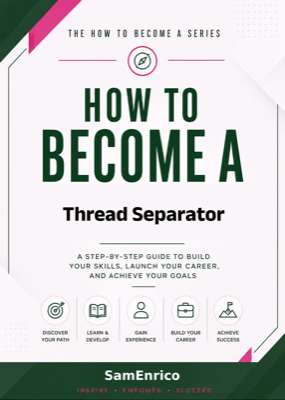
How to Become a Thread Separator eBook
How to Become a Thread Separator
by Wolfrum Shea
How to Become a Thread Separator
Formats
Free sample
Chapter 1: The Tangled Millennium--The email arrived at 2:47 AM. Four hundred and twelve unread messages. Three calendar invites for meetings that could have been emails. A Slack channel with 1,847 notifications. Two separate project management tools with conflicting deadlines.
A voicemail from a client who "just wanted to touch base quickly." And somewhere in the middle of all this, buried like a needle in a stack of digital needles, was the one piece of information actually required to move forward.This is not an exaggeration. This is Tuesday.If you are reading this book, you already know the feeling. It is the feeling of being pulled in seventeen directions simultaneously while somehow moving nowhere. It is the sensation of your attention fracturing into smaller and smaller pieces until you are no longer a person with a goal but a collection of reflexes responding to the latest notification, the newest request, the most urgent-sounding subject line. It is the quiet dread of opening your laptop each morning knowing that the day will slip through your fingers like water, leaving behind nothing but exhaustion and a longer to-do list than when you started.You have been told that the solution is better time management.
You have tried the Pomodoro Technique, the Eisenhower Matrix, the 1-3-5 Rule, and the Getting Things Done methodology. You have color-coded your calendar, blocked out deep work sessions, and installed apps that promise to block distracting websites. You have woken up at 5 AM to get a head start, only to find that the head start was immediately consumed by the same endless tide of demands.None of it has worked. Not because you are lazy or undisciplined or somehow deficient. It has not worked because you have been trying to solve the wrong problem.The problem is not that you have too much to do.
The problem is that you have too many threads tangled together.The Hidden Architecture of Overload Every task, every project, every commitment, every relationship, every obligation, and every aspiration in your life is a thread. Some threads are thick and heavy, requiring significant attention and resources. Others are thin and light, easily managed with minimal overhead. Some threads are short, lasting only a few minutes before they terminate naturally. Others are long, stretching across weeks, months, or even years.
Some threads are independent, capable of running entirely on their own without any interaction with other threads. Others are deeply entangled, depending on inputs, approvals, or actions from multiple other threads before they can proceed.Your brain, unlike a computer, has no natural mechanism for managing these threads. It can only hold one conscious thought at a time. When you try to hold more, the result is not parallel processing but rapid serial switching—jumping from one thread to another so quickly that it feels like multitasking but actually destroys productivity.Here is what the research actually shows: when you switch between two tasks, you lose time and accuracy on every switch. The more complex the tasks, the greater the loss.
After a switch, it takes an average of twenty-three minutes and fifteen seconds to return to full focus on the original task. Multiply that by the average number of times you switch per day—estimated at eighty-seven for knowledge workers—and you have lost more than thirty-three hours per week to context switching alone.You are not working forty hours and losing eight to distraction. You are working forty hours and losing thirty-three to switching costs, leaving seven hours of actual productive work.This is not a personal failing. This is a structural failure of how we organize work.The Two Faces of Separation In the summer of 1985, in a textile mill in Greenville, South Carolina, a man named Raymond Hollis did something that the engineers at the mill's parent company said was impossible. The mill had just installed a new winding machine capable of spinning thread at 500,000 yards per hour—nearly double the speed of the previous generation.
But the machine kept jamming. Fibers tangled. Threads snapped. Production targets were missed again and again. The engineers blamed the thread quality.
The thread suppliers blamed the machine design. Everyone blamed everyone else, and the machine sat idle for three weeks.Hollis, who had worked in textile mills since he was fourteen years old, asked for permission to run the machine alone for one shift. The managers laughed but agreed. What did they have to lose?That night, Hollis ran the machine at full speed for eight hours without a single jam. When the managers returned the next morning, they found reels of perfectly wound thread and a smiling operator drinking coffee.
How had he done it? "I stopped trying to control every thread," he said. "I let the loose ones run free."Hollis had discovered what the engineers missed: some threads could be allowed to run independently without supervision. By identifying which threads needed active management (the main production line) and which could be detached to run autonomously (the spooling and finishing processes), he transformed a mill on the verge of shutting down into the most productive facility in the company.Thirty-seven years later and fifteen hundred miles to the north, a software architect named Priya Srinivasan was facing a similar crisis. Her company's flagship application—a real-time trading platform—was freezing under load.
When client requests spiked, the user interface would lock up completely, showing a spinning beach ball of death while thousands of traders screamed into their phones. The engineering team had spent six months adding more servers, more memory, and more bandwidth, but nothing worked. The system was following the rules of good software design: every request was processed fully before the next one began. Order. Control.
Predictability.Srinivasan did the opposite of what her training suggested. She rewrote the request handler to detach long-running operations from the user interface thread. Instead of waiting for a database query to complete before updating the screen, the interface would acknowledge the request immediately and update later when the data was ready. She was, in effect, telling the system to let go.The result was instantaneous. The trading platform became the fastest in its sector.
Competitors spent millions trying to replicate the performance, but they never understood the secret: it was not about speed. It was about separation.Raymond Hollis and Priya Srinivasan never met. They worked in different decades, different industries, and different domains of knowledge. But they both understood something that most people never learn: the ability to separate threads—to identify which ones need your attention and which ones can run free—is the single most valuable skill in a complex world.The Universal Skill You Were Never Taught Think about the last time you felt truly productive. Not busy.
Not exhausted. Not validated by external approval. Actually productive—moving steadily toward a meaningful goal with clarity and momentum. What made that moment different?Chances are, only a few threads were active. You were not trying to answer emails while writing a report while listening to a conference call while brainstorming next quarter's strategy.
You were doing one thing. Other threads existed—emails would eventually need replies, the report would eventually need editing—but they were…
This is the end of the free sample. Get the eBook to keep going. Buy now
About this book
Details
- Author
- Wolfrum Shea
- Publisher
- SamEnrico
- Language
- English
- ISBN
- 9781506061740
- Genre
- Non-Fiction, Informative, Educational
- Released
- 2026-05-02
- Pages (approx.)
- 133
- Available as
- eBook, Paperback, Audiobook

Read better in the ZLOADR app
Your eBooks on your phone or tablet. Sign in with your SamEnrico account and start reading.
More by Wolfrum Shea
 Major System Number GuideWolfrum Shea$11.99
 Dental Phobia RecoveryWolfrum Shea$11.99
 Turkey Consumer AnalysisWolfrum Shea$11.99
 Influence for Nonprofit FundraisersWolfrum Shea$11.99
 Family Trauma Trigger GuideWolfrum Shea$11.99
 The Forgotten Codebreakers of World War I: The Secret Women of Room 40Wolfrum Shea$11.99
 Apparel Sales OutfitterWolfrum Shea$11.99
 Mark Zuckerberg Vision GuideWolfrum Shea$12.99
 Facebook Ad Creative That WorksWolfrum Shea$12.99
 Understanding Overfolded HelixWolfrum Shea$17.99
You may also like
 Hong Kong Handover 1997Dunn Johnnie$11.99
 Zumba For Postnatal Recovery CourseNeal Christian$11.99
 Zumba for BeginnersLadner Nikia$11.99
 YouTube Comment Mining GuideHumes Pandora$12.99
 Worry Box MeditationCarlin Rudy$11.99
 Workplace Stress MeditationNguyen Lynn$11.99
 Workplace Stress and Sleep RepairHawley Ivory$11.99
 Workplace Perfectionism CureDelaney Jeffry$11.99
 Workplace Injustice Anger GuideWallen Isabelle$11.99
 Work Addiction and Burnout LinkGreenwood Ester$11.99
 Women in Yoga and WellnessBeattie Galina$11.99
 Women in Stand Up ComedyChun Evangeline$11.99