
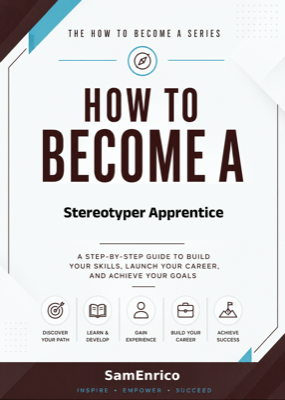
How to Become a Stereotyper Apprentice eBook
How to Become a Stereotyper Apprentice
by Paz Lucila
How to Become a Stereotyper Apprentice
Formats
Free sample
Chapter 1: The Fragile Foundation...--–- The first thing the master stereotyper taught me was how to destroy something valuable. His name was Arthur, and he had been pouring lead since before the moon landing. His hands were a map of scars—white lines crisscrossing knuckles, a missing fingertip, burns that had healed into shiny pink continents. He stood me in front a locked-up forme of type, a solid block of text that had taken a compositor three hours to set by hand, letter by letter, space by space. It was a poem.
I don't remember which one. What I remember is Arthur handing me a stiff-bristled brush and saying, "Now beat it. Gently. If you tear the flong, you have to tell the compositor he gets to do those three hours again. He will not smile."That was my first day.
I was seventeen, had no idea what a stereotyper was, and had applied for the apprenticeship because my father said "printing is a respectable trade" and because the alternative was community college. I stood there holding a sheet of something that felt like wet papier-mâché—the flong—and realized that I was about to press it into a poem. If I succeeded, that poem would be printed ten thousand times. If I failed, I would have to walk across the shop and confess my failure to a man who smelled of tobacco and righteousness. Arthur watched me with the patience of someone who had seen hundreds of seventeen-year-olds make the same mistakes.
"The flong is not your enemy," he said. "It is your teacher. But it is a harsh teacher. It will show you exactly where you are rushing, exactly where you are careless, exactly where you do not care enough. And then it will tear, and you will start over."This chapter is about that first lesson.
Not the technique—though the technique matters—but the philosophy that underpins every other skill in this book. Before you can cast a single plate, before you can light a furnace or ladle molten metal, you must understand the fragile foundation upon which all solid things are built. The flong is that foundation. It is a sheet of paper and plaster, barely thicker than a magazine cover, and it is the most honest material I have ever touched. It does not lie.
It does not forgive. And it will transform you if you let it.The Substance of the Thing: What Flong Actually Is Let us begin with the physical object, because the physical object is the point. In an age of digital abstraction—where we send files, not things; where we click "print" and paper emerges from a plastic box as if by magic—the flong is aggressively, stubbornly real. It is a specialized sheet of laminated paper, coated on one side with a fine layer of plaster or clay. The paper is usually made from rag pulp, the same material used for high-quality art paper, because it needs to be strong enough to withstand pressure without tearing but flexible enough to conform to the smallest details of the type.
The plaster coating is soft when damp and hard when dry, like the shell of an egg before it sets. Together, paper and plaster form a composite material: the paper provides tensile strength, the plaster provides compressive strength. This is not trivial engineering. The flong is designed to do something remarkable: it must become a perfect negative of a three-dimensional surface, capture details as fine as a serif (that little foot at the bottom of a letter, sometimes less than a hundredth of an inch wide), and then release cleanly from that surface after drying. It is, in essence, a single-use mold-making material.
You get one chance per sheet.Historically, flong was made in-house by larger print shops. A "flong beater" was a specific job title, a person who spent their days mixing plaster, spreading it onto paper, and drying the sheets on racks like laundry. Smaller shops bought flong from specialty suppliers, the same way modern print shops buy aluminum plates from Kodak or Fuji. The composition varied by region and by application. English flong tended to use more plaster, producing a harder, more brittle matrix that held finer detail but cracked more easily.
American flong used more paper, producing a tougher, more flexible matrix that was better suited to the faster, more aggressive presses used by newspapers. German flong, according to Arthur, was the best in the world—"like pressing velvet into type," he said—but it was almost impossible to get after the war. By the time I apprenticed, flong came in cardboard boxes from a single supplier in Ohio, and we treated each sheet like gold leaf.The first thing you learn about flong is that it has a memory. When you dampen it—and you must dampen it, because dry plaster is brittle and will shatter—the paper expands. When it dries, it contracts.
If you do not control this expansion and contraction, the matrix will warp. A warped matrix produces a warped plate. A warped plate will not lock into the press. A plate that will not lock into the press is scrap metal, and you have wasted an hour of your time and several dollars of alloy. This cascade of consequences is the first lesson in systems thinking: every action has an echo.
The flong teaches you to listen for the echo before you act.The Art of Beating: Rhythm, Pressure, and Patience The process of creating a matrix is called "beating," and it is a misnomer. You are not beating the flong like a rug or a drum. You are persuading it. The tool is a brush with stiff bristles—horsehair, usually, because synthetic bristles melt near the heat of the dabbing box. The brush is round, about the size of a coffee mug, with a short handle that fits in the palm of your hand.
You hold it like a painter holding a stippling brush, not like a hammer. Your wrist does the work, not your shoulder.The flong is laid over the locked-up forme of type. The forme sits on a flat metal bed, type-high, with the letters facing up. The flong is positioned carefully, aligned to the edges of the forme, because any overhang will curl and any underhang will leave the edges of the plate unsupported. Then you begin.
You dab the brush straight down onto the flong, directly over the type. The motion is vertical: up, down, up, down. You do not slide the brush, because sliding tears the wet paper. You do not twist, because twisting distorts the fibers. You dab, and you dab, and you dab, working in a systematic pattern from one corner of the forme to the other, overlapping each dab by about half a brush-width.The pressure must be exactly right.
Too little, and the flong does not contact the bottom of the type's grooves. The resulting matrix will lack detail—the serifs will be shallow, the counterforms (the enclosed spaces inside letters like 'e' or 'o') will be incompletely formed, and the printed page will look weak and washed out.…
This is the end of the free sample. Get the eBook to keep going. Buy now
About this book
Details
- Author
- Paz Lucila
- Publisher
- SamEnrico
- Language
- English
- ISBN
- 9781506074078
- Genre
- Non-Fiction, Informative, Educational
- Released
- 2026-04-25
- Pages (approx.)
- 120
- Available as
- eBook, Paperback, Audiobook

Read better in the ZLOADR app
Your eBooks on your phone or tablet. Sign in with your SamEnrico account and start reading.
More by Paz Lucila
 Choosing Your Transcendental MantraPaz Lucila$11.99
 Harvard Extension School Course CatalogPaz Lucila$11.99
 NVC Giraffe Ears MethodPaz Lucila$11.99
 Hostage Negotiator DiplomatPaz Lucila$11.99
 Longwang's Lost Pearl: The Dragon King's DescentPaz Lucila$11.99
 How to Produce Bicycle MirrorsPaz Lucila$11.99
 Academic Publishing From ProposalsPaz Lucila$12.99
 Satellite EngineerPaz Lucila$11.99