
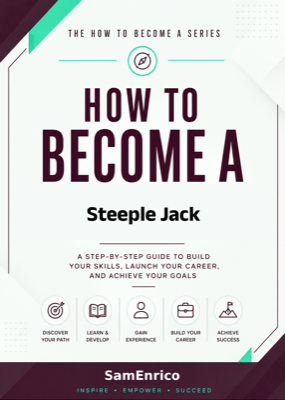
How to Become a Steeple Jack Paperback
How to Become a Steeple Jack
by Cyr Katy
How to Become a Steeple Jack
Formats
Free sample
Chapter 1: The First Rung– The ladder swayed three inches to the left, then two inches back to the right, and in that moment, suspended sixty feet above a gravel parking lot in rural Ohio, I understood something that no manual had ever taught me. The fear wasn't waiting at the top. It wasn't waiting at the bottom. It was right here, on the first rung, where the ground still looked close enough to jump to and the sky still looked far enough away to ignore. The first rung is where most people stop.
Not because they are cowards. Because they are smart enough to know that the decision to climb cannot be unmade.My name is not important. What matters is that I have spent twenty-three years climbing the things that other people pay to have climbed. Smokestacks. Church spires.
Water towers. Broadcast antennas. Clock towers. Steel stacks, brick stacks, concrete stacks, stacks that leaned so far off plumb that the guy wires sang in the wind like cello strings. I have climbed in rain so cold that my eyelids froze shut.
I have climbed in heat so brutal that the tar on the ladder rungs melted into my gloves. I have climbed in wind that made the swing stage lift six inches off its safety stops and hold there, hovering, while I decided whether to ride it out or cut loose and abseil down.This book is not a memoir. There will be no chapters about my childhood, my failed relationships, or the spiritual awakening I supposedly experienced at four hundred feet. Other steeplejacks have written those books, and you should read them, but this is not one of them. This book is a field guide.
It is the book I wished I had when I was twenty-two years old, standing at the base of my first real climb, trying to decide whether the money was worth the fear.It was. It is. But the fear never goes away. It just changes shape.The Mathematics of Courage Let us begin with a number: $170. In 1921, that was the daily wage for a skilled steeplejack working on the industrial chimneys of Pittsburgh and Gary and Birmingham.
Adjusted for inflation, that is roughly $2,500 to $3,000 in today's money. But here is the catch that the history books leave out: a steeplejack in 1921 worked an average of one hundred and forty days per year. The rest of the time, they were waiting for weather, waiting for work, or waiting for their bodies to heal from the last job.The mathematics of steeplejacking has not changed as much as you might think. Today, an entry-level apprentice working as a ground rigger can expect to earn $44,000 to $52,000 per year. A journeyman who can climb independently, run a swing stage, and perform basic inspections earns $60,000 to $75,000.
An expert steeplejack with NVQ Level 3 certification, demolition endorsements, and a reputation for difficult heritage work earns $82,000 to $120,000. The top tier — the steeplejacks who own their own rigging, bid on industrial contracts, and specialize in the kind of work that makes clients nervous just to describe — can reach $150,000 to $200,000 in a good year.But notice the phrase "in a good year." Steeplejacking is not a salary job. It is a feast-or-famine trade. You might work sixty hours a week for three months, bank a pile of cash, and then sit by the phone for six weeks waiting for the next contract to come through. The feast is glorious.
The famine is brutal. And the ability to survive the famine — financially, emotionally, psychologically — is one of the hidden requirements of…
This is the end of the free sample. Get the Paperback to keep going. Buy now
About this book
Details
- Author
- Cyr Katy
- Publisher
- SamEnrico
- Language
- English
- ISBN
- 9781506071176
- Genre
- Non-Fiction, Informative, Educational
- Released
- 2026-04-25
- Pages (approx.)
- 95
- Available as
- eBook, Paperback, Audiobook

Read better in the ZLOADR app
Your eBooks on your phone or tablet. Sign in with your SamEnrico account and start reading.
More by Cyr Katy
 Startup Founder Burnout GuideCyr Katy$11.99
 The Journal Article Citation GuideCyr Katy$11.99
 Customer Service Gamification GuideCyr Katy$11.99
 Validation for Pregnancy LossCyr Katy$11.99
 Intermittent Fasting Keto ComboCyr Katy$11.99
 The Candace's Gold: The Heist That Built an EmpireCyr Katy$11.99
 Climate Insurance for MarineCyr Katy$12.99
 Retrospectives for StartupsCyr Katy$12.99
 Staff Mechanical EngineerCyr Katy$11.99
 Learn to Play the Uruttu ChendaCyr Katy$11.99