
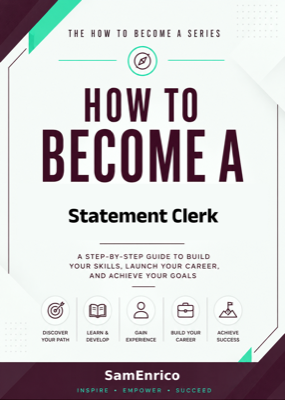
How to Become a Statement Clerk eBook
How to Become a Statement Clerk
by Martel Gaye
How to Become a Statement Clerk
Formats
Free sample
Chapter 1: The $55,000 Typo--You have probably made a mistake today that a computer could not catch.Not a spelling error. Not a math error in the obvious sense. A different kind of mistake—the kind that happens when a number looks right but feels wrong. When a credit card bill shows a $47 charge that you do not remember, but the vendor name is vaguely familiar. When a bank statement lists a withdrawal for $450, but you are almost certain you only spent $45.
When an invoice arrives with a total that is suspiciously round, and something in your gut says that cannot be right.That feeling—that quiet, persistent nagging that a number is off—is not a weakness. It is not anxiety. It is not overthinking.It is a marketable skill.And it is the single most important asset you will bring to the job of statement clerk.The Job Nobody Talks About Let me tell you about a woman named Maria. She was thirty-four years old, had worked retail for twelve years, and had never made more than $15 an hour. She was good at her job—too good, actually.
She kept catching errors at the cash register. A customer would be overcharged by $3.50, and Maria would notice before the customer did. A vendor would double-bill the store for a shipment, and Maria would flag it. Her manager called her "detail-oriented" but never gave her a raise. The store did not value what she did because they did not understand what she did.
They thought she was just checking receipts. She was actually reconciling transactions in real time, comparing point-of-sale data against inventory against vendor invoices against customer memory. She was doing the work of a statement clerk without the title, without the training, and without the salary.When Maria finally learned what a statement clerk was, she almost laughed. "You mean people get paid for this?" she asked.Yes, Maria. They get paid for this.
And they get paid well.The statement clerk is one of the most misunderstood jobs in the modern economy. Ask a hundred people what a statement clerk does, and ninety of them will say "data entry" or "paperwork" or "billing." They will imagine a gray cubicle, a stack of papers, and a person typing numbers into a computer with the enthusiasm of a sleepwalker. They will imagine a job that is boring, low-paid, and destined for automation.They are wrong on every count.What a Statement Clerk Actually Does A statement clerk does not just enter data. A statement clerk verifies data. That is a different verb with a different meaning and a different price tag.Data entry is the act of moving information from one place to another—from a paper form into a database, from a handwritten log into a spreadsheet.
It is mechanical. It is repetitive. And it is increasingly done by software.Verification is the act of checking whether information is true. Not whether it was typed correctly. Whether it corresponds to reality.
Whether a payment that was meant to post on Tuesday actually posted on Tuesday. Whether a fee that was disclosed in paragraph fourteen of a customer agreement was correctly applied. Whether a stop-payment request that a customer made over the phone was actually executed.Verification requires judgment. It requires context. It requires the ability to look at a set of numbers and ask, "Does this make sense?" That is exactly what computers are bad at.
They are good at matching. They are terrible at wondering.Here is a concrete example. A bank's automated system processes a credit card payment of $450. The customer claims she only spent $45. The computer checks the transaction log.
It finds a $450 charge from a vendor called "ABC Services." The computer flags no error because the numbers match.But Maria, the statement clerk, looks at the same transaction and notices something the computer missed. The customer has never spent more than $100 at any single vendor in three years. The vendor's name is generic. The time stamp is 3:00 AM, when the customer was asleep. Maria calls the customer.
The customer confirms she has no idea what "ABC Services" is. Maria flags the transaction as fraudulent. The bank refunds the $450. The customer stays with the bank instead of switching to a competitor.That single call—that single moment of human judgment—saved the bank $450 in fraudulent charges and potentially thousands of dollars in retained customer revenue. The computer could not have made that call because the computer does not have a "gut." The computer does not know that a 3:00 AM charge for $450 from a generic vendor is suspicious.
The computer only knows that the digits add up.That is the difference between data entry and verification. That is the difference between a job that pays minimum wage and a career that pays $55,000 a year.The Salary Reality (And Why Your Future Boss Is Desperate)Let us talk about money, because that is probably why you are reading this book.The statement clerk role pays between $30,000 and $65,000 per year, depending on experience, industry, and geography. A junior clerk—someone with less than one year of experience—typically earns $30,000 to $38,000. A mid-level statement clerk with two to three years of experience earns $38,000 to $48,000. A senior clerk who reviews other people's work and handles complex discrepancies earns $48,000 to $55,000.
A lead clerk who trains new hires and manages the month-end closing cycle earns $55,000 to $65,000 or more.These numbers are not aspirational. They are not "potential earnings" based on some unlikely combination of bonuses and overtime. They are the median salaries reported by the United States Bureau of Labor Statistics, cross-referenced with real-time job postings from Indeed, Linked In, and Glassdoor. They are what actual employers are paying actual humans to do actual work right now.And here is the part that nobody tells you: there are approximately 34,700 statement clerk job openings in the United States every single year. That is not a typo.
Thirty-four thousand seven hundred. Many of those jobs go unfilled for weeks or months because employers cannot find candidates who can demonstrate the specific skill of verification—who can prove that they see what computers miss.Your future boss is desperate. Not desperate in a pathetic way. Desperate in a "We have had this job posted for six weeks and we have interviewed seventeen people and none of them could pass our ten-key test" way. Desperate in a "We keep losing money because our statements are going out with errors that a human should have caught" way.
Desperate in a "We will train the right person because finding the right person is harder than training them" way.That desperation is your leverage.The Typing Test Trap (And How to Beat It)The most common reason qualified candidates fail to get hired as statement clerks has nothing to do with their intelligence, their work ethic, or their attention to detail. It has to do with a piece of plastic attached to a cable: the keyboard.Most government statement clerk jobs require a ten-key typing test. Ten-key refers to the number pad on the right side of a full-sized keyboard—the grid of digits from zero to nine, plus the decimal point and the enter key.…
This is the end of the free sample. Get the eBook to keep going. Buy now
About this book
Details
- Author
- Martel Gaye
- Publisher
- SamEnrico
- Language
- English
- ISBN
- 9781506067087
- Genre
- Non-Fiction, Informative, Educational
- Released
- 2026-04-25
- Pages (approx.)
- 115
- Available as
- eBook, Paperback, Audiobook

Read better in the ZLOADR app
Your eBooks on your phone or tablet. Sign in with your SamEnrico account and start reading.
More by Martel Gaye
 Crow Woman Clan ElderMartel Gaye$11.99
 Naturopathy for Digestive HealthMartel Gaye$11.99
 The Michael Morton CaseMartel Gaye$11.99
 Collaborative Divorce ProcessMartel Gaye$11.99
 The UroLift BPH Procedure GuideMartel Gaye$11.99
 The Sky Dancer: The Untold Story of Michèle Mouton and Rally Racing's First Female ChampionMartel Gaye$11.99
 International Franchisee SelectionMartel Gaye$12.99
 US Masters in AI RankingsMartel Gaye$12.99
 Understanding Sclerosing Lymphocytic LobulitisMartel Gaye$17.99