
Non-FictionInformativeEducational
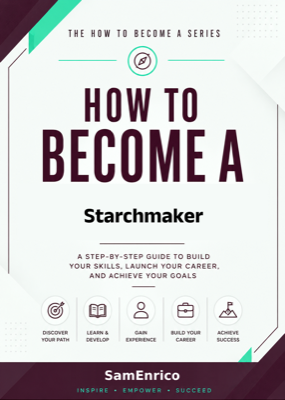
How to Become a Starchmaker eBook
How to Become a Starchmaker
How to Become a Starchmaker
Formats
Free sample
Chapter 1: The Invisible Giant--– You have never met a Starchmaker. You could walk past one on the street a hundred times and never know it. Their name does not appear on any consumer product label. No magazine has ever put a Starchmaker on its cover. And yet, if every Starchmaker in the world stopped working tomorrow, your life would collapse by breakfast.Let us test this claim.Wake up.
The mattress beneath you contains starch in the foam padding and the fire-retardant cotton batting. Walk to the bathroom. The drywall in your walls uses starch as a binder. The toothpaste you squeeze onto your brush uses starch as a thickener and texturizer—without it, the paste would separate into oil and water in the tube. The paper in the magazine you left on the counter last night is coated with starch to keep the ink from bleeding.
Flush the toilet. The cardboard tube inside the toilet paper roll is held together with a starch-based adhesive that is stronger and cheaper than any synthetic alternative.Go to the kitchen. Pour cereal into a bowl. That cereal was processed with starch-based glazes for shine and shelf stability. The milk in your refrigerator comes in a paper carton coated with a starch-clay blend that prevents leaking.
The orange juice bottle wears a label that was glued on with starch adhesive. Even the cardboard box that held the cereal when it arrived at the store was sealed with starch.Get dressed. Your cotton shirt was woven from threads that were coated with starch before they hit the loom—without that coating, called warp sizing, the threads would snap a hundred times per minute during high-speed weaving. Your leather shoes were finished with a starch-based polish. The cardboard shoebox?
Starch adhesive.Commute to work. The tires on your car contain starch as a processing aid in the rubber compound. The asphalt on the road uses starch as a binding agent in certain eco-friendly formulations. The corrugated boxes stacked behind every store you pass are glued with starch. The envelope on your desk at work is sealed with starch gum.Eat lunch.
The soup in your cup thickens because of starch. The salad dressing does not separate because of starch. The bread has starch in the crust for browning. The yogurt has starch for creaminess without fat. The candy bar in your pocket uses starch as a glazing agent.And the fork you eat with?
If you are in California or the European Union, it might be made of starch. Compostable cutlery, biodegradable packaging, dissolvable laundry pods—all of these are starch pretending to be plastic.You touched starch within the first thirty seconds of waking up. You have touched it every thirty seconds since. You will touch it again before you fall asleep tonight.And you have never once thought about who made it.This book is going to change that. More importantly, this book is going to show you how to become one of the people who make it—not as a factory worker pushing buttons, but as a master of the craft.
A Starchmaker.The Most Profitable Industry You Have Never Heard Of Before we go any further, let us address the question sitting in the back of your mind: Why would anyone want to become a Starchmaker?The answer is money, but not in the way you think. Starch manufacturing is not a get-rich-quick scheme. The margins are thin, the capital requirements are brutal, and the global market is dominated by five giants: Cargill, ADM, Ingredion, Roquette, and Tate & Lyle. If your goal is to compete with these companies on price, you will fail. They have economies of scale that you cannot match.
They own the farms, the transportation networks, the processing plants, and the distribution channels.But here is what the giants do not have: agility, specialization, and the ability to serve niche markets that are too small for them to notice. The global starch market is worth approximately 100billion.Withinthatmarket,therearehundredsofsub−marketsworth100 billion. Within that market, there are hundreds of sub-markets worth 100billion.Withinthatmarket,therearehundredsofsub−marketsworth10 million to $100 million each that are completely ignored by the big five because they are not worth their attention. Organic potato starch for European baby food. Single-origin tapioca starch for craft gummy candy.
High-amylose corn starch for boutique resistant-starch supplements. Custom-modified starches for small regional paper mills that cannot get consistent quality from the giants.These niches are where independent Starchmakers build fortunes. Not by making more starch than the next person, but by making smarter starch.Consider the numbers. Commodity corn starch sells for roughly 0.40to0.40 to 0.40to0.60 per pound. Organic potato starch sells for 2.00to2.00 to 2.00to3.00 per pound.
Resistant starch (a specialty product made by manipulating the retrogradation process, which we will cover in detail in Chapter 7) sells for 5.00to5.00 to 5.00to8.00 per pound. The cost of raw materials and processing is not five times higher for the premium product. The difference is knowledge. The difference is craftsmanship.That is what this book teaches: how to turn thirty cents worth of corn into eight dollars worth of functional ingredient by understanding the hidden physics of a tiny white granule.What This Chapter Will Teach You Before we dive into the technical details of extraction, modification, and application, you need to understand three foundational truths that will guide everything that follows. Consider this chapter your orientation—not just to the content of this book, but to the mindset of a Starchmaker.First Truth: The Granule Remembers Starch is not a uniform substance.
It is a collection of microscopic granules, and each granule carries the signature of its botanical origin. Corn starch behaves differently from potato starch, which behaves differently from wheat starch, which behaves differently from tapioca. These differences are not minor. They are as distinct as the difference between pine wood and oak wood—both are wood, but you would not build a ship with pine or a cabinet with oak if you had a choice.The Starchmaker who ignores botanical origin fails before they begin. You cannot simply ask, "What is the cheapest starch?" and expect to succeed.
You must ask, "What starch is right for my customer's application?" A paper mill needs low-viscosity, consistent sizing—corn is the answer. A high-end soup manufacturer needs clarity and freeze-thaw stability—potato is the answer. A gummy candy maker needs neutral taste and high purity—tapioca is the answer.Choosing the wrong source is not an optimization problem. It is a failure state. You will learn, in this chapter and throughout this book, how to match raw materials to markets using a framework I call The Starchmaker's Decision Matrix—a tool we will return to again in Chapters 7, 8, and 11.Second Truth: Water Is Your Enemy and Your Ally Starch processing is, at its heart, a battle with water.
You need water to extract starch from plants—in fact, you need roughly one hundred tons of water for every ton of starch you produce. That water carries away impurities, separates starch from protein and fiber, and allows the extraction process to work at industrial scale.But water also ruins starch. Add heat to wet starch…
This is the end of the free sample. Get the eBook to keep going. Buy now
About this book
Details
- Author
- Stearns Rosaria
- Publisher
- SamEnrico
- Language
- English
- ISBN
- 9781506065519
- Genre
- Non-Fiction, Informative, Educational
- Released
- 2026-05-02
- Pages (approx.)
- 125
- Available as
- eBook, Paperback, Audiobook

Read better in the ZLOADR app
Your eBooks on your phone or tablet. Sign in with your SamEnrico account and start reading.
More by Stearns Rosaria
 Assertiveness In Customer Service GuideStearns Rosaria$11.99
 Swedish Green Tax IncentivesStearns Rosaria$11.99
 Endometriosis Success StoriesStearns Rosaria$11.99
 ShutEye App Sleep GuideStearns Rosaria$11.99
 The Austrian Low Fee Master GuideStearns Rosaria$11.99
 El Cid: The Sword of ReconquistaStearns Rosaria$11.99
 Understanding Retinitis PigmentosaStearns Rosaria$17.99
 Cost of Living in Turkey GuideStearns Rosaria$12.99
 Marketing Hiring Guide ComparisonStearns Rosaria$12.99
 Lead Process EngineerStearns Rosaria$11.99
You may also like
 Hong Kong Handover 1997Dunn Johnnie$11.99
 Zumba For Postnatal Recovery CourseNeal Christian$11.99
 Zumba for BeginnersLadner Nikia$11.99
 YouTube Comment Mining GuideHumes Pandora$12.99
 Worry Box MeditationCarlin Rudy$11.99
 Workplace Stress MeditationNguyen Lynn$11.99
 Workplace Stress and Sleep RepairHawley Ivory$11.99
 Workplace Perfectionism CureDelaney Jeffry$11.99
 Workplace Injustice Anger GuideWallen Isabelle$11.99
 Work Addiction and Burnout LinkGreenwood Ester$11.99
 Women in Yoga and WellnessBeattie Galina$11.99
 Women in Stand Up ComedyChun Evangeline$11.99