
Non-FictionInformativeEducational
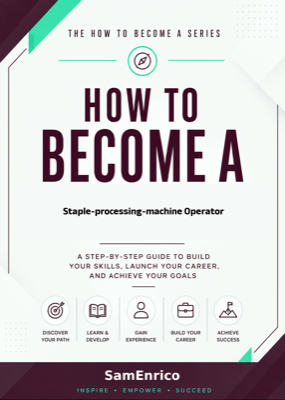
How to Become a Staple-processing-machine Operator eBook
How to Become a Staple-processing-machine Operator
by Waller Chang
How to Become a Staple-processing-machine Operator
Formats
Free sample
Chapter 1: The Last Secure Job...--–- The letter arrived on a Tuesday, tucked between a credit card offer and an electric bill. “Congratulations on your upcoming graduation,” it read. “Your student loan repayment begins in 137 days.” The number at the bottom made him choke on his coffee: $47,800. For a degree in communications. For a job that didn't exist yet.
For a future that felt like a trap with a velvet rope.Across town, in a windowless conference room, a plant manager named Dale was staring at a different number: 43 percent. That was the portion of his workforce eligible to retire within five years. His staple fiber line—the one that ran twenty-four hours a day, three hundred sixty-five days a year, feeding polyester staple into the supply chains of automotive plants and medical device manufacturers—was staffed by men and women who remembered when CDs came in jewel cases. He had seventeen open positions he couldn't fill. Not because the pay was bad.
Not because the work was dangerous. But because no one under the age of thirty-five had ever been told that this job existed.This book exists to close that gap.The gap between the jobs that actually sustain the middle class and the careers that young people are told to chase. The gap between a 78,000−a−yearjobwithfullbenefitsanda78,000-a-year job with full benefits and a 78,000−a−yearjobwithfullbenefitsanda45,000 "entry-level marketing coordinator" position that requires a four-year degree and two unpaid internships. The gap between what guidance counselors preach and what the economy actually needs.Staple-processing-machine operation is not glamorous. You will not see it featured on a billboard.
No one makes a prestige television drama about a woman who runs a crimper. But the work is honest, the pay is real, and the job security is something that Silicon Valley engineers can only dream about. Because while software gets disrupted and startups implode and white-collar jobs get offshored to the lowest bidder, someone still has to make the fiber that goes into your car seats, your surgical masks, your mattress, your winter coat, and the backing of every carpet you have ever walked on.This chapter is the argument. The rest of the book is the instruction manual.The Great Misallocation of Ambition Every year, approximately two million American high school students graduate and are told a version of the same lie: that the only path to a respectable life runs through a four-year university. They are told that manufacturing is dead.
They are told that blue-collar work is for people who couldn't make it in the "knowledge economy." They are told that a job that requires you to stand on your feet and use your hands is somehow less dignified than a job that requires you to sit in a cubicle and answer emails that could have been a Slack message.The numbers tell a different story.The average starting salary for a staple-processing-machine operator in the United States is 48,000.Withinthreeyears,thatclimbsto48,000. Within three years, that climbs to 48,000.Withinthreeyears,thatclimbsto62,000. Senior operators—people who have learned to troubleshoot, optimize, and train others—regularly earn between 75,000and75,000 and 75,000and95,000. Add overtime, shift differentials, and performance bonuses, and six-figure incomes are common. All without a penny of student debt.Compare that to the average starting salary for a college graduate in the humanities: 38,000.Withanaveragestudentloanbalanceof38,000.
With an average student loan balance of 38,000.Withanaveragestudentloanbalanceof37,000. And a monthly payment of approximately $400. And a job market that treats entry-level applicants as disposable.This is not to say that college is worthless. Engineers, doctors, nurses, and scientists obviously need degrees. But the mania for sending everyone to university has created a bizarre inversion: skilled trade positions that pay better than white-collar jobs go begging for applicants, while graduates with six-figure debt compete for the same handful of coffee shop management positions.The staple fiber industry is a perfect example.
There are currently over twelve thousand staple-processing-machine operator positions in North America alone. Nearly five thousand of those are expected to open up in the next five years due to retirements alone. The industry grows at about four percent annually—not explosive, but steady. And steady is exactly what you want when you are looking for a career that will last forty years."But won't automation take these jobs?" This is the question I hear most often when I describe this work to people under thirty. They have been trained to believe that any job involving repetition or manual labor is on the verge of being eliminated by robots.
And it is true that automation is changing manufacturing. But here is what the futurists don't tell you: staple fiber lines are already heavily automated. The machines run themselves most of the time. The operator's job is not to turn cranks; it is to monitor, troubleshoot, and intervene when the machine does something unexpected. And machines still do unexpected things constantly.The more automation advances, the more valuable the human operator becomes.
Because AI can detect an anomaly, but it cannot walk down the line with a flashlight and feel a bearing that is running two degrees warmer than it should. A sensor can measure denier variation, but it cannot notice the faint discoloration that suggests a polymer additive is clumping. The operator is the final layer of quality control, the failsafe that catches what the algorithms miss. And as long as fiber is being made, someone will need to be there to keep the line running when it breaks at two in the morning.The Invisible Industry That Surrounds You Before we go any further, let us be absolutely clear about what we are talking about. A staple fiber is a short length of fiber—typically between one and six inches long—made from synthetic polymer.
The most common is polyester (PET), followed by polypropylene (PP), and then a handful of specialty materials like polylactic acid (PLA) from corn starch or low-melt adhesives used to bond nonwoven fabrics.These fibers are not spun into thread like cotton or wool. Instead, they are chopped into precise lengths and then sold to other manufacturers who will turn them into finished goods. If you have ever touched a piece of clothing, sat in a car, slept on a mattress, or wiped your face with a disposable towel, you have encountered staple fiber.Here is a partial list of what staple fiber becomes:Automotive interiors: The padding in your seats, the carpet on the floor, the headliner above your head, and the insulation in your door panels.Medical nonwovens: Surgical masks, isolation gowns, sterilization wraps, and absorbent layers in wound dressings.Home furnishings: Mattress padding, pillow filling, upholstery batting, and the backing of carpets and rugs.Apparel: The synthetic fibers blended with cotton in your t-shirts, the filling in your winter coat, the lining of your rain jacket.Industrial filtration: The fabric in HVAC filters, water filters, and vacuum cleaner bags.Hygiene products: The absorbent core of diapers, feminine hygiene products, and adult incontinence briefs.That last category alone is a multi-billion dollar industry. Every baby born in North America will go through approximately six thousand diapers before potty training. Each diaper contains several grams of staple fiber.
Do the math, and you will understand why staple fiber plants run twenty-four hours a day.The point is this: staple…
This is the end of the free sample. Get the eBook to keep going. Buy now
About this book
Details
- Author
- Waller Chang
- Publisher
- SamEnrico
- Language
- English
- ISBN
- 9781506065465
- Genre
- Non-Fiction, Informative, Educational
- Released
- 2026-06-02
- Pages (approx.)
- 143
- Available as
- eBook, Paperback, Audiobook

Read better in the ZLOADR app
Your eBooks on your phone or tablet. Sign in with your SamEnrico account and start reading.
More by Waller Chang
 Endometriosis and OophorectomyWaller Chang$11.99
 Muse Headband Sleep GuideWaller Chang$11.99
 Belgian Green Tax GuideWaller Chang$11.99
 Fear Of Failure In Financial DecisionsWaller Chang$11.99
 The Spanish Low Fee Master DirectoryWaller Chang$11.99
 The Red and White Ransom: The Wars of the Roses Held HostageWaller Chang$11.99
 Medical Study in Turkey GuideWaller Chang$12.99
 Philippines Remote Hiring PlatformsWaller Chang$12.99
 Understanding Retinopathy Anemia Cns AnomaliesWaller Chang$17.99
 Lean Canvas CreatorWaller Chang$11.99
You may also like
 Hong Kong Handover 1997Dunn Johnnie$11.99
 Zumba For Postnatal Recovery CourseNeal Christian$11.99
 Zumba for BeginnersLadner Nikia$11.99
 YouTube Comment Mining GuideHumes Pandora$12.99
 Worry Box MeditationCarlin Rudy$11.99
 Workplace Stress MeditationNguyen Lynn$11.99
 Workplace Stress and Sleep RepairHawley Ivory$11.99
 Workplace Perfectionism CureDelaney Jeffry$11.99
 Workplace Injustice Anger GuideWallen Isabelle$11.99
 Work Addiction and Burnout LinkGreenwood Ester$11.99
 Women in Yoga and WellnessBeattie Galina$11.99
 Women in Stand Up ComedyChun Evangeline$11.99