
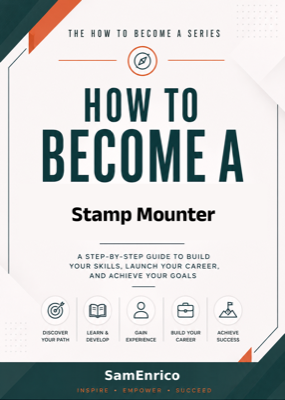
How to Become a Stamp Mounter Paperback
How to Become a Stamp Mounter
How to Become a Stamp Mounter
Formats
Free sample
Chapter 1: The Hidden Cost...--–- The envelope arrived on a Tuesday, sandwiched between a pizza coupon and a credit card offer. Inside was a single stamp – a seemingly unremarkable 1918 24-cent Curtis Jenny airmail issue. To my untrained eye, it looked like a slightly discolored rectangle with an upside-down airplane printed on it. To the philatelic world, it was a $75,000 mistake waiting to happen.I had inherited my great-uncle Harold’s collection – a chaotic shoebox of hundreds of stamps, most of them common, some of them interesting, and at least one of them potentially life-changing. The inverted Jenny.
I knew enough to know it was valuable. I did not know enough to know that I was about to destroy 40 percent of its value in less time than it takes to boil an egg.I did what any eager amateur would do. I pulled the stamp out of its glassine sleeve with my bare fingers – leaving a faint oil print that a forensic lab could have traced back to my lunch. I licked a cheap hinge – the kind that comes five thousand to a roll for $3.99 – and pressed it onto the back of the hundred-year-old gum. I stuck it into a pre-printed album page that was already yellowing from acid migration.
I closed the binder and placed it on a shelf near a window.Three months later, the stamp had developed a faint brown spot where my saliva had activated dormant chemicals in the paper. The hinge had pulled a thin layer off the back – a defect known in the trade as a "thin" – reducing the stamp's grade from Fine-Very Fine to simply Good. The sun had faded the red cancellation mark to a pale pink. What had been a $75,000 stamp was now worth perhaps $28,000 on a good day.I had committed philatelic malpractice. And I had done it without a single bad intention.This book is the result of that mistake.
It is not a general guide to stamp collecting. There are hundreds of those, and most of them are excellent. This book is about one specific skill – mounting – and why it is the single most underrated, misunderstood, and financially consequential act in the entire hobby. I am going to teach you how to mount stamps like a professional curator. But first, I need to convince you why it matters.Because here is the truth that no one tells you at the stamp club meeting or the online forum: a rare stamp in a cheap hinge is worth less than a common stamp mounted professionally.
I have seen a $5 stamp from 1950 win an exhibition prize because it was mounted flawlessly, with perfect alignment, archival materials, and a page design that told a story. I have seen a $10,000 stamp get rejected from the same exhibition because the mounter had used a PVC page and a crooked hinge.The stamp does not create value. The presentation does. And presentation begins and ends with mounting.The Great Deception: Why Stamp Catalogs Lie to You Every stamp catalog – Scott, Stanley Gibbons, Michel, all of them – lists prices based on a fantasy. They assume a stamp in "very fine" condition, unmounted, with original gum, perfectly centered.
That stamp exists only in a laboratory. In the real world, stamps have been handled, posted, hinged, regummed, soaked off envelopes, pressed between the pages of Bibles, stored in attics, and occasionally used as coasters for coffee cups.The catalog price is a starting point. The ending point – what a stamp actually sells for at auction – is determined almost entirely by three factors: centering (how symmetrical the design…
This is the end of the free sample. Get the Paperback to keep going. Buy now
About this book
Details
- Author
- Stephen Stevie
- Publisher
- SamEnrico
- Language
- English
- ISBN
- 9781506064833
- Genre
- Non-Fiction, Informative, Educational
- Released
- 2026-04-25
- Pages (approx.)
- 135
- Available as
- eBook, Paperback, Audiobook

Read better in the ZLOADR app
Your eBooks on your phone or tablet. Sign in with your SamEnrico account and start reading.
More by Stephen Stevie
 Fear Of Failure In HealthcareStephen Stevie$11.99
 Stages of Change Dual DiagnosisStephen Stevie$11.99
 Sports Nutrition for SwimmersStephen Stevie$11.99
 Anger Management for JournalistsStephen Stevie$11.99
 The Self Hypnosis for Commitment FearStephen Stevie$11.99
 The Sonnets of the Sun King: Love and Power in VersaillesStephen Stevie$11.99
 Factoring for Exporters GuideStephen Stevie$12.99
 Estate Planning and CTAStephen Stevie$12.99
 Understanding Rumination SyndromeStephen Stevie$17.99
 Northbrook Officeteam Staffing ManagerStephen Stevie$11.99