
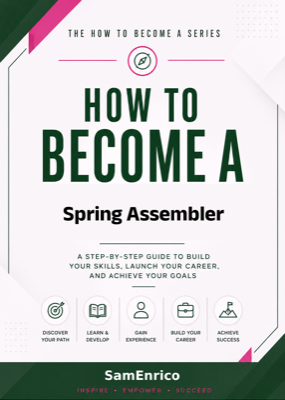
Non-FictionInformativeEducational
How to Become a Spring Assembler eBook
How to Become a Spring Assembler
by Covert Nicki
How to Become a Spring Assembler
Formats
Free sample
Chapter 1: The Silent Workhorses--–Every time you press a key on your keyboard, close a refrigerator door, or start your car, you rely on a hidden technology so ubiquitous that it has become invisible. That technology is the spring. Not the coiled metal in a ballpoint pen, though that is one example, but an entire family of engineered components that store and release mechanical energy with precise, predictable behavior. A typical automobile contains over two hundred individual springs, from the massive coils in the suspension system to the tiny, hair-thin springs inside the fuel injectors. Your washing machine uses springs to dampen vibration during the spin cycle.
Your garage door would crush a car without the counterbalancing force of its massive extension springs. Even the humble mousetrap, one of the simplest spring mechanisms ever devised, demonstrates the extraordinary power that can be stored in a few inches of twisted steel wire.Yet despite their omnipresence, springs are almost never noticed. They work silently, reliably, and continuously, often for decades, without maintenance or recognition. The people who make them are equally invisible to the general public. Spring assemblers, machine setters, and coil winders form a specialized trade that sits at the intersection of metallurgy, mechanical engineering, and precision manufacturing.
They do not simply “make springs.” They translate engineering drawings into physical reality, select the correct materials for demanding applications, set up complex CNC machinery, and verify that each spring meets exacting performance standards. A single mistake in spring manufacturing can cause catastrophic failure: an aircraft landing gear spring that cracks, a medical device spring that loses tension, or an automotive suspension spring that collapses. The stakes are high, and the skills required are substantial.This chapter introduces you to the hidden world of springs and the career path that leads you into it. Whether you are changing careers, entering the manufacturing workforce for the first time, or seeking to upgrade your existing machining skills into the specialized field of spring making, you need to understand what springs are, why they matter, and where they go. More importantly, you need to see the career landscape clearly.
This is not a dead-end job. It is a skilled trade with multiple advancement pathways, competitive compensation, and increasing demand as aging spring makers retire and leave a gap that must be filled.The Four Pillars of Spring Technology All springs, regardless of their application, fall into four fundamental categories. Each category behaves differently, stores energy differently, and requires different manufacturing approaches. Mastering these four types is your first professional competency.Compression Springs The compression spring is the most common type, and it is probably what comes to mind when you hear the word “spring.” These springs are designed to resist compressive forces, meaning they push back when you push on them. They are characterized by a helical coil structure with space between the coils, known as the pitch.
When you apply a load, the spring compresses, storing energy. When you release the load, the spring returns to its original length.You encounter compression springs constantly. The suspension system of every car uses compression springs, often large-diameter coils of thick steel wire that absorb road shocks. The valves in an internal combustion engine use compression springs to close the valves after each camshaft lobe pushes them open. Your mattress contains hundreds of small compression springs that conform to your body shape.
The buttons on your keyboard use tiny compression springs to provide tactile feedback. Even the spring that ejects a CD from a player is a compression spring, though optical media is becoming obsolete.Compression springs are defined by several key dimensions: the outer diameter (OD), the inner diameter (ID), the wire diameter, the free length (the length when no load is applied), the solid height (the length when the spring is fully compressed with all coils touching), and the pitch (the distance between adjacent coils). The most critical performance parameter is the spring rate, measured in newtons per millimeter (N/mm) or pounds per inch (lbs/in), which tells you how much force is required to compress the spring by a given distance. A spring with a rate of 10 N/mm requires 10 newtons of force to compress it by one millimeter.Extension Springs Extension springs are the opposite of compression springs. They are designed to resist stretching forces.
When you pull on an extension spring, it pulls back. These springs are typically wound with coils that touch each other (closed wound) and have hooks, loops, or eyes on each end for attachment.The most familiar example is the garage door spring. Large extension springs mounted above the door track counterbalance the weight of the door, making it possible for a person or an automatic opener to lift hundreds of pounds with minimal effort. Trampolines use extension springs around the perimeter to provide the bouncing surface with its elastic return. The screen door that slams shut if you do not catch it is controlled by an extension spring.
Industrial applications include conveyor belt tensioners, agricultural equipment, and exercise machines.Extension springs require careful attention to end configurations. The hooks or loops must be formed precisely to avoid stress concentrations that cause premature failure. Common end types include English loops (full round loops), German loops (reduced diameter loops that sit inside the spring body), and side loops (loops that exit perpendicular to the spring axis). Each type has advantages for specific attachment methods and space constraints.Torsion Springs Torsion springs operate by twisting rather than compressing or extending. They are wound with their coils at a specific angle, and when you apply a torque to one end while holding the other, the spring resists the twisting motion.
When released, it returns to its original position.The classic example is the mousetrap. The torsion spring in a mousetrap stores energy when you pull the kill bar back, and when triggered, it releases that energy with enough force to break the mouse’s neck. Clothespins use tiny torsion springs to create the pinching force that holds clothes on a line. Vehicle suspension systems, particularly on trucks and heavy equipment, sometimes use torsion bars (a specialized form of torsion spring) instead of coil springs. Hinges on self-closing doors, counterbalance mechanisms for heavy lids, and even some types of watches use torsion springs.Torsion springs are defined by their body length, coil count, leg length (the straight portions that extend from the coils), and the angle between legs in the unloaded state.
Unlike compression and extension springs, where the spring rate is linear in compression or extension, torsion springs have an angular spring rate, measured in newton-meters per degree (Nm/°) or pound-inches per degree (lb-in/°).Constant Force Springs Constant force springs are the least common but most specialized type. Unlike the other three types, which produce increasing force as they are deflected, constant force springs produce nearly the same force throughout their entire range of motion. They are made from flat strip material, not round wire, coiled tightly into a spiral. When you pull the free end, the strip uncoils, but the radius of curvature remains constant, so the force remains constant.The most common application is the retractable tape measure. When you…
This is the end of the free sample. Get the eBook to keep going. Buy now
About this book
Details
- Author
- Covert Nicki
- Publisher
- SamEnrico
- Language
- English
- ISBN
- 9781506060002
- Genre
- Non-Fiction, Informative, Educational
- Released
- 2026-06-03
- Pages (approx.)
- 138
- Available as
- eBook, Paperback, Audiobook

Read better in the ZLOADR app
Your eBooks on your phone or tablet. Sign in with your SamEnrico account and start reading.
More by Covert Nicki
 TM Research and ScienceCovert Nicki$11.99
 Laci Peterson Autopsy Forensic ReportCovert Nicki$11.99
 Calm State AnchoringCovert Nicki$11.99
 PCOS Binge Eating Disorder GuideCovert Nicki$11.99
 The Senior Reverse Income Tax GuideCovert Nicki$11.99
 Corsairs of Carthage: Hannibal's Naval Gambit at the Battle of the Aegates (241 BC)Covert Nicki$11.99
 Nursery AssistantCovert Nicki$11.99
 Geo Domain Marketplace GuideCovert Nicki$12.99
 BYD Patent LandscapeCovert Nicki$12.99
 Understanding Pelizaeus–merzbacher DiseaseCovert Nicki$17.99
You may also like
 Hong Kong Handover 1997Dunn Johnnie$11.99
 Zumba For Postnatal Recovery CourseNeal Christian$11.99
 Zumba for BeginnersLadner Nikia$11.99
 YouTube Comment Mining GuideHumes Pandora$12.99
 Worry Box MeditationCarlin Rudy$11.99
 Workplace Stress MeditationNguyen Lynn$11.99
 Workplace Stress and Sleep RepairHawley Ivory$11.99
 Workplace Perfectionism CureDelaney Jeffry$11.99
 Workplace Injustice Anger GuideWallen Isabelle$11.99
 Work Addiction and Burnout LinkGreenwood Ester$11.99
 Women in Yoga and WellnessBeattie Galina$11.99
 Women in Stand Up ComedyChun Evangeline$11.99