
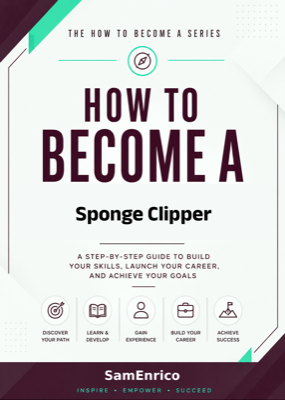
How to Become a Sponge Clipper eBook
How to Become a Sponge Clipper
by Kemp Janella
How to Become a Sponge Clipper
Formats
Free sample
Chapter 1: The Deleted Trade--–- The first thing you need to understand about becoming a sponge clipper is that the job no longer exists. Not officially. Not on any government registry or corporate payroll system updated after 1992. The Dictionary of Occupational Titles—that dusty, three-volume beige encyclopedia last printed by the U.S. Department of Labor—lists Sponge Clipper as code number 447.687-026, and next to that code, in small but permanent type, is a single word: Deleted.
The trade was officially declared obsolete the same year the last commercial sponge diving boat in Tarpon Springs, Florida, was hauled onto dry land and turned into a tourist attraction.And yet.On a Tuesday morning in late October, I watched a seventy-three-year-old man named Costa Karalis sit at a wooden table in a cinder-block building three blocks from the Anclote River. Before him were two hundred and forty raw, uncut sheep's wool sponges, each one roughly the size of a softball, each one still bearing the evidence of its violent journey from the sea floor: sand, shell fragments, barnacle husks, and the occasional piece of coral no bigger than a grain of rice. Costa wore no gloves. His hands, stained brown from decades of sponge tannin, moved with a speed that seemed to bypass conscious thought entirely. His left hand lifted a sponge from the soak bucket.
His right hand, holding a pair of curved shears that had belonged to his father, made three snips—one, two, three—and then the sponge was tossed into a wooden crate marked GRADE A. This entire sequence took less than four seconds. Two hundred and forty sponges would take him sixteen minutes. Then he would start on the next bucket.I asked Costa how many people in the United States could do what he just did. He stopped.
Looked at his shears. Looked at me. Then he said a number that I initially did not believe: "Maybe fifty. Probably less. Most of them are older than me."This is the first truth of sponge clipping: it is a living ghost trade.
The job title has been deleted from the official record, but the work continues because the work is necessary. Natural sea sponges do not clip themselves. They arrive from the diving boats—yes, there are still diving boats, though only a handful—encrusted with the debris of the ocean floor. Somebody has to clean them. Somebody has to sort them.
Somebody has to decide, with absolute certainty, whether a given sponge is a Go or a No-Go. That somebody is called a sponge clipper, and that somebody is vanishing.I did not come to Tarpon Springs to write an obituary. I came because I had spent ten years in corporate management, drowning in the word maybe. Maybe we should approve the budget. Maybe this candidate is the right fit.
Maybe the product is ready for launch. Maybe, maybe, maybe. Every decision was a fog of ambiguity, and every fog required meetings to clear it, and every meeting generated more fog. I had read every productivity book on the shelf. I had tried GTD and Agile and Scrum and Kanban.
I had color-coded my calendar, time-blocked my mornings, and deleted my social media apps. None of it worked because none of it addressed the root problem: I did not have a reliable method for turning ambiguity into certainty.Then a friend told me about sponge clippers."A sponge clipper," he said, "has a tool called a Go-No-Go gauge. It's just a board with holes in it. If the sponge fits through the hole, it's a Go. If it doesn't, it's a No-Go.
That's it. No meetings. No debate. No 'let's circle back.' The gauge decides."I thought he was joking. He was not.The Geography of a Lost Trade Tarpon Springs, Florida, is not where you expect to find a philosophical breakthrough.
It is a small city on the Gulf Coast, about thirty miles northwest of Tampa, and its primary industry for the past century has been natural sponge harvesting. The story begins in 1905, when a man named John Cocoris—a Greek immigrant who had worked the sponge beds off the coast of Crete—realized that the waters of the Gulf of Mexico were thick with sponges of commercial quality. He recruited divers from the Greek islands, and within a decade, Tarpon Springs had become the sponge capital of the Western Hemisphere. At its peak in the 1930s, the sponge docks employed more than two thousand divers, clippers, packers, and shippers. The industry was so lucrative that the local bank kept its vault doors open during business hours because so much cash changed hands on the docks.The divers used standard diving dress: heavy canvas suits, copper helmets, lead-weighted boots, and air pumped from the surface.
They descended to depths of sixty to eighty feet, sometimes deeper, and spent hours on the bottom, cutting sponges free from the rock with long-handled hooks. It was brutal, dangerous work. Decompression sickness—the bends—killed or paralyzed dozens of men. Sharks were a constant threat. The air hoses could kink or tear, and if a diver lost his air supply at depth, he had maybe ninety seconds to reach the surface before drowning.
The mortality rate among sponge divers was higher than among coal miners.But the sponges were worth the risk.A single harvest could yield thousands of pounds of raw sponge. And raw sponge, straight from the bottom, is essentially worthless. It is slimy, sand-encrusted, and filled with debris. It smells like low tide mixed with ammonia. You cannot sell it.
You cannot use it. Before a sponge can become a bath sponge, a paint applicator, or a surgical debridement tool, it must be processed. That processing—the transformation from sea-floor detritus to marketable product—is the job of the sponge clipper.This is the second truth of sponge clipping: the clipper is the invisible half of the partnership. The diver gets the glory. The diver gets the stories of narrow escapes and deep-water courage.
But the diver's work is wasted without the clipper. A boatload of unclipped sponges is a boatload of garbage. A boatload of clipped sponges is inventory.The Two-Stage Definition Let me resolve a point of terminology that has confused every newcomer to this trade since the beginning. The word clip means two different things in the context of sponge processing, and you need to understand both because both are essential.Stage One: De-shelling. The removal of foreign particles embedded in the sponge's fibrous matrix.
Shells, coral bits, barnacles, sand grains, and the occasional small crab that died inside a cavity and is now mummified. Stage One is surgical. You work under magnification. You use tweezers and micro-shears. You do not cut the sponge's own fibers unless absolutely necessary.
The goal is to extract every foreign object while leaving the sponge intact.Stage Two: Trimming. The restoration of the sponge's natural shape. Raw sponges are torn, ragged, and irregular. They have been ripped from rocks, dragged across the bottom, and tossed into boat holds. Stage Two is aesthetic.
You use curved shears to follow the sponge's natural contour lines, cutting away damaged edges while preserving the organic shape.…
This is the end of the free sample. Get the eBook to keep going. Buy now
About this book
Details
- Author
- Kemp Janella
- Publisher
- SamEnrico
- Language
- English
- ISBN
- 9781506057699
- Genre
- Non-Fiction, Informative, Educational
- Released
- 2026-04-25
- Pages (approx.)
- 122
- Available as
- eBook, Paperback, Audiobook

Read better in the ZLOADR app
Your eBooks on your phone or tablet. Sign in with your SamEnrico account and start reading.
More by Kemp Janella
 Meeting Agenda Priority GuideKemp Janella$11.99
 Generous Networker ApproachKemp Janella$11.99
 Hair Loss and Thyroid DiseaseKemp Janella$11.99
 Celeste Golden Strawberry FixKemp Janella$11.99
 Self Esteem for Seniors with DisabilityKemp Janella$11.99
 Sun Tzu: The Strategist Who Shaped War ForeverKemp Janella$11.99
 Understanding Mental Retardation Microcephaly Phalangeal FacialKemp Janella$17.99
 UN Logistics and Supply Chain GuideKemp Janella$12.99
 Promotion Business Case VisualizationKemp Janella$12.99
 Security Operations Center AnalysisKemp Janella$11.99