
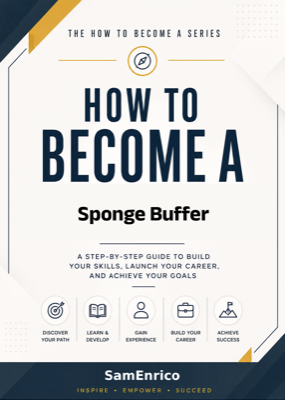
How to Become a Sponge Buffer Paperback
How to Become a Sponge Buffer
How to Become a Sponge Buffer
Formats
Free sample
Chapter 1: The Saturation Point...--You are reading this because you have already broken.Not dramatically, perhaps. Not in a way that would make for a good movie scene. There was no single moment of shattering glass, no collapse to your knees in the rain, no dramatic exit from a burning building. Your breaking was quieter than that. It was the afternoon you stared at your phone for forty-five seconds before answering a text from someone you love.
It was the morning you sat in your parked car in the driveway, engine off, and did absolutely nothing for eleven minutes because the thought of opening the door and becoming a person again required more energy than you had. It was the Tuesday you snapped at a cashier over nothing, then apologized so profusely that she asked if you were okay, and you said “fine” while your voice cracked on the vowel.You are reading this because you have experienced the peculiar math of modern exhaustion: the more pressure you absorb, the less pressure you can absorb. The more you give, the less you have to give. And yet, somewhere along the way, someone told you that strength meant being impervious. That resilience meant never bending.
That a good person, a strong person, an indispensable person, simply takes whatever comes and stays upright.That someone was wrong.This book is built on a single counterintuitive proposition: you are not supposed to be a wall. Walls block everything, including the information you need to adapt. They crack under enough force, and when they fall, they fall all at once. You are also not supposed to be a cloth. Cloths absorb everything until they are saturated, at which point they drip toxicity everywhere and require wringing out by someone else.
Walls shatter. Cloths drip. Neither is sustainable.You are supposed to be a buffer.The Chemistry of the Unbroken Let us borrow a concept from chemistry, because chemistry has solved a problem that self-help has only named. A chemical buffer is a solution that resists changes in p H when small amounts of acid or base are added. This sentence sounds boring.
It is actually revolutionary. Let me translate.Imagine a swimming pool. Someone pours a gallon of acid into it. What happens? If the pool is pure water, the p H plummets instantly.
Everything in the pool dies. But if the pool contains a buffer—a specific combination of chemicals that can absorb hydrogen ions without changing its fundamental nature—the p H barely moves. The buffer does not eliminate the acid. It does not pretend the acid isn't there. It does not block the acid from entering the pool.
It neutralizes the acid by absorbing it into a chemical reaction that leaves the overall system stable.The buffer does not fight the acid. It does not run from the acid. It incorporates the acid and remains itself.That is what you are learning to do.Every day, you are hit with acids. Criticism. Demands.
Interruptions. Disappointments. Betrayals. The slow drip of administrative nonsense. The sudden cascade of a family crisis.
The ambient low-grade toxicity of a news cycle designed to keep you agitated. All of these are hydrogen ions—protons of stress that want to lower the p H of your emotional environment from functional (7) to chaotic (3 or 4 or lower).If you have no buffer, the p H drops instantly. You panic. You snap. You cry.
You freeze. You scroll. You eat things that hurt you. You say things you cannot unsay.If you have a buffer, the p H barely moves. You…
This is the end of the free sample. Get the Paperback to keep going. Buy now
About this book
Details
- Author
- Fitzpatrick Merrilee
- Publisher
- SamEnrico
- Language
- English
- ISBN
- 9781506057675
- Genre
- Non-Fiction, Informative, Educational
- Released
- 2026-05-11
- Pages (approx.)
- 142
- Available as
- eBook, Paperback, Audiobook

Read better in the ZLOADR app
Your eBooks on your phone or tablet. Sign in with your SamEnrico account and start reading.
More by Fitzpatrick Merrilee
 Reading List Priority MethodFitzpatrick Merrilee$11.99
 Senior Grandparent Self Esteem GuideFitzpatrick Merrilee$11.99
 Networking ScorecardFitzpatrick Merrilee$11.99
 Hair Loss Due to Anabolic SteroidsFitzpatrick Merrilee$11.99
 Dark Souls Death Loop FixFitzpatrick Merrilee$11.99
 The Crown’s Wild Child: How Prince Harry’s Vegas Night Almost Toppled the MonarchyFitzpatrick Merrilee$11.99
 Serpentine Group MiningFitzpatrick Merrilee$11.99
 Understanding Mental Retardation Mietens–Weber TypeFitzpatrick Merrilee$17.99
 Promotion Business Case Review ProcessFitzpatrick Merrilee$12.99
 World Bank Social Protection CareersFitzpatrick Merrilee$12.99