
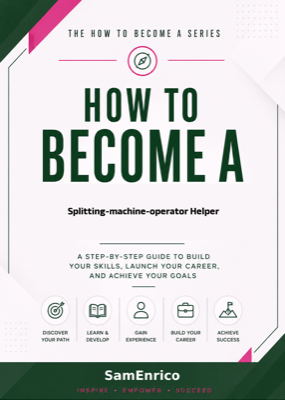
How to Become a Splitting-machine-operator Helper eBook
How to Become a Splitting-machine-operator Helper
by Gunn Genna
How to Become a Splitting-machine-operator Helper
Formats
Free sample
Chapter 1: The Pilot and Co-Pilot...-- The first time I walked onto a factory floor, I was twenty-three years old, two hundred dollars in debt, and absolutely certain I would fail. My steel-toed boots were two sizes too big. My safety glasses fogged up every time I breathed. The operator looked at me like I was a child who had wandered into a war zone. He was right.
I had no idea what I was doing. I did not know the difference between a razor blade and a crush-cut blade. I did not know why tension mattered. I did not know that a clean machine was a fast machine. I knew nothing.But I learned.
Not because I was smart. Not because I was talented. Because I showed up. Because I asked questions. Because I watched the operator who knew everything and copied every move he made.
And because, slowly, I began to understand that the helper is not the bottom of the ladder. The helper is the co-pilot. The operator sets the course, adjusts the controls, and makes the final calls. The helper keeps the machine loaded, the material flowing, and the work area safe. Together, the operator and helper produce more than either could alone.This chapter is about that partnership.
It is about understanding where the helper fits, what the helper does, and why the helper role is a career—not just a job, and not always a stepping stone. By the time you finish this chapter, you will know what a splitting-machine-operator helper actually does, where helpers work, why the role matters, and how to decide if this path is right for you.What Is a Splitting-Machine-Operator Helper?Let us start with a clear definition. A splitting-machine-operator helper assists a skilled operator in setting up, loading, adjusting, operating, and unloading a splitting machine. The helper performs duties that require less skill than the operator's role but are nonetheless critical to production. These include supplying materials, holding tools, cleaning work areas, and maintaining equipment.The word "helper" can sound small.
It can sound like someone who fetches coffee or sweeps floors. That is not what this is. A helper in industrial manufacturing is a production worker with specialized knowledge of the machine, the materials, and the process. You are not a janitor. You are not an errand runner.
You are the operator's right hand. Without you, the machine runs slower, the quality drops, and the operator works twice as hard.In many facilities, the helper is the operator-in-training. You learn the machine by working alongside an experienced operator. You start with simple tasks—loading cores, wiping rollers, clearing jams. As you gain confidence, you take on more responsibility.
You learn to set blades. You learn to adjust tension. You learn to troubleshoot problems. Eventually, when the operator takes a day off, you run the machine yourself. That is the stepping-stone model.But not every facility works that way.
In some facilities, the helper is a permanent role. A dedicated assistant. A specialist in the tasks that keep the machine running while the operator focuses on complex adjustments and quality control. These helpers are not waiting for a promotion. They have found their niche.
They are valued for their consistency, their safety record, and their ability to anticipate the operator's needs before the operator asks.Both paths are valid. Both pay well. Both offer stability. The difference is what you want. Do you want to become an operator?
Or do you want to become the best helper on the floor? There is no wrong answer. The only wrong answer is taking a job without knowing which path the facility offers.Here is a question you must ask in every interview: "Is this role a stepping stone to operator, or is it a permanent position?" The answer tells you what to expect. If they say "stepping stone," promotion is likely within six months to two years. If they say "permanent," you are building a career as a specialist helper.
Know which one you are choosing before you accept the job.Where Helpers Work Splitting machines are everywhere. They cut paper in converting plants. They split leather in tanneries. They process film in packaging factories. They split wood in lumber yards.
Each industry has different materials, different machines, and different challenges. Understanding these industries helps you target your job search and understand what you will handle every day.Paper and Film Converting This is the most common industry for splitting-machine helpers. Paper and film slitters convert large master rolls into smaller rolls for retail or industrial use. Think of the receipt paper in a cash register. The label stock on a shipping box.
The plastic film wrapped around a pallet of goods. All of these start as giant rolls—sometimes weighing a ton or more—and get cut down to size on a slitting machine.In paper and film converting, helpers process lightweight materials at high speeds. The machine might run at three hundred meters per minute. That is faster than a car on a residential street. The material is delicate.
It tears easily. It builds static electricity. It sticks to itself and to machine surfaces. Helpers in this industry need quick hands, sharp eyes, and the patience to rethread the machine when the web breaks (and it will break, often).The hazards in paper converting are not obvious. The blades are sharp—that is obvious.
But the real danger is the pinch points. Nip points where rollers meet can pull a hand in before you can react. That is why lockout/tagout is not optional. That is why you never wear gloves near rotating parts. We will spend an entire chapter on safety.
For now, just know that paper can kill you if you disrespect it.Leather Processing Leather splitting is different. You are not cutting width. You are cutting thickness. A thick hide—maybe eight millimeters thick—feeds between a blade and a roller. The gap determines how thin the leather becomes.
The goal might be two millimeters for a shoe upper, or one millimeter for a glove, or even thinner for a lining.Leather splitters move slowly. The operator controls the feed rate by hand or foot pedal. The blade is a wide band of sharp steel that must be sharpened daily. The hides are heavy and awkward. They can weigh forty or fifty pounds each.
They are slippery when treated with oils and waxes. Handling them requires upper body strength and careful technique to avoid injury.Helpers in leather processing need to understand leather grading. Full grain leather is the highest quality—the natural surface is intact. Top grain leather has been sanded to remove imperfections. Corrected grain leather has been heavily processed.
Each grade feeds differently through the machine. Each grade has different value. A helper who mixes up grades can cost the company thousands of dollars in mislabeled inventory.Wood Processing Wood splitting is the most physically demanding of the three. Log splitters use hydraulic pressure to force a wedge through a log. The operator controls a lever.
The helper loads the logs onto the table, positions them under the wedge, and removes the split pieces. Repeat. Every…
This is the end of the free sample. Get the eBook to keep going. Buy now
About this book
Details
- Author
- Gunn Genna
- Publisher
- SamEnrico
- Language
- English
- ISBN
- 9781506057651
- Genre
- Non-Fiction, Informative, Educational
- Released
- 2026-04-26
- Pages (approx.)
- 100
- Available as
- eBook, Paperback, Audiobook

Read better in the ZLOADR app
Your eBooks on your phone or tablet. Sign in with your SamEnrico account and start reading.
More by Gunn Genna
 Nonprofit Networking GuideGunn Genna$11.99
 MBSR for High Blood Pressure GuideGunn Genna$11.99
 Breath of the Wild ExplorationGunn Genna$11.99
 Hair Loss in Young MenGunn Genna$11.99
 Aging and Self Esteem Journal for MenGunn Genna$11.99
 The Battle of Alcatraz: The 1946 Prison Uprising That Changed AmericaGunn Genna$11.99
 World Bank Education Sector CareersGunn Genna$12.99
 Promotion Objection Handling GuideGunn Genna$12.99
 Service Desk ManagerGunn Genna$11.99
 Understanding Mental Retardation Myopathy Short Stature Endocrine DefectGunn Genna$17.99