
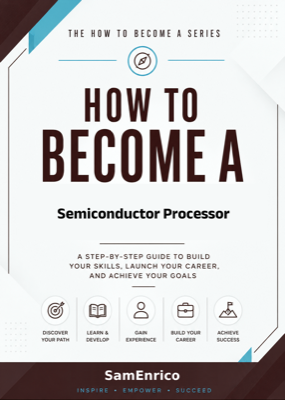
Non-FictionInformativeEducational
How to Become a Semiconductor Processor eBook
How to Become a Semiconductor Processor
How to Become a Semiconductor Processor
Formats
Free sample
Chapter 1: The Sand That Dreams--–- The first thing you need to understand about becoming a semiconductor processor is that you will spend your career trying to see things that are invisible. Not in a mystical, spiritual sense. In a literal, practical, maddening sense. The features you will create on a silicon wafer are smaller than the wavelength of light used to see them. The particles you will obsess over are smaller than a virus.
The mistakes you will make often leave no trace at all until the chip is already in a customer’s phone, three years after you touched it. This book exists because that reality is terrifying to most people, but to a small subset of human beings—people like you, presumably—it sounds like a calling.–- Let me tell you about the first time I held a bare silicon wafer. I was twenty-two years old, freshly hired at a fab in the Pacific Northwest, and my training officer—a man named Marcus who had been processing wafers since the Clinton administration—handed me a plastic cassette and said, “Don’t drop this.” Inside the cassette were twenty-five circles of polished silicon, each exactly 200 millimeters in diameter, each weighing almost nothing, each worth more than my first car. I looked down at them and saw my own reflection staring back. Not a metaphor.
The wafers were so perfectly flat and so perfectly reflective that I could count my own eyelashes in their surface. And Marcus, who had seen this look on a hundred rookies before me, said something I have never forgotten: “You’re looking at yourself now. In six months, you’ll be looking through the wafer to the city inside. That’s when you’ll know you belong here.”–- This chapter is about what you need to see before you ever step into a cleanroom. It is about the material you will spend your career shaping—silicon—and why it is the strangest, most miraculous building block on Earth.
It is about the chip, which is not a single thing but a three-dimensional city of billions of tiny switches, and why that city can only be built by people who understand it as a place, not a product. And it is about you, the person who is about to learn a trade that most of the world doesn’t know exists, even though it underpins literally every aspect of modern life. By the end of this chapter, you will never look at your phone, your car, your microwave, or your laptop the same way again. By the end of this book, you will know exactly how to join the invisible army that builds them.The Most Important Job You Have Never Heard Of–- Let’s start with a simple experiment. Look around you right now.
Count every device that contains a microchip. Your phone, obviously. Your laptop or computer. Your smartwatch. Your television.
The thermostat on the wall. The refrigerator in the kitchen. The car in the driveway. The calculator on your desk. The hearing aid in your uncle’s ear.
The pacemaker in your neighbor’s chest. The insulin pump in your coworker’s bag. The radio in your garage. The drone that delivered your last package. The satellite that routed your last text message.
The missile guidance system that—well, let’s not go there. The point is that you are surrounded. You cannot escape the microchip because the microchip has become the substrate of civilization itself, as fundamental as concrete or steel or electricity.–- Here is what most people do not know: every single one of those chips passed through the hands of a semiconductor processor. Not an engineer designing it in a comfortable office. Not a scientist inventing new materials in a lab.
A processor. A person in a cleanroom gown, standing in front of a machine the size of a delivery truck, loading wafers, pushing buttons, reading screens, signing logbooks, and—most importantly—noticing when something looks wrong. The engineer writes the recipe. The scientist invents the next-generation process. But the processor is the one who actually builds the chip, one wafer at a time, one lot at a time, one shift at a time, year after year.–- Why haven’t you heard of this job?
Because the semiconductor industry has spent forty years hiding its technicians. The fabs are hidden in industrial parks. The job titles are bureaucratic and forgettable: “Process Technician,” “Equipment Operator,” “Manufacturing Specialist.” The work itself happens behind airlocks and gowning rooms and cleanroom walls that keep out not just dust but also public attention. And yet, in the United States alone, there are over 300,000 open semiconductor technician jobs today. That number is not a projection.
That is the current deficit. The fabs are desperate for people who can learn this trade. They are offering signing bonuses, relocation packages, tuition reimbursement, and clear promotion paths from the factory floor to the engineering office. The only thing missing is a pipeline of people who know the job exists and know how to get it.–- That is where this book comes in.Why Silicon? The Strange Material That Changed Everything–- Before you can process wafers, you have to understand the material you are processing.
And silicon is, to put it mildly, a weird substance. It is not a metal. It is not a plastic. It is not an insulator or a conductor in any simple sense. It is a semiconductor, which means its conductivity sits right in the middle—more conductive than rubber, less conductive than copper—and that middle position is exactly why it can be turned into a switch.–- Here is the science, stripped of jargon and equations.
Every atom has electrons orbiting around it. In a conductor like copper, some of those electrons are loosely held and can move freely through the material, carrying electric current. In an insulator like glass or rubber, the electrons are tightly bound and cannot move at all. In a semiconductor like silicon, the electrons are held just tightly enough that they mostly stay put—but if you give them a little energy (heat, light, or an electric field), they can break free and move. That is the key: silicon’s conductivity can be controlled.
You can turn it on and off. That is the fundamental requirement for a switch, and a computer is nothing more than a very, very large collection of very, very small switches.–- But why silicon specifically? Why not germanium, which was used in the very first transistors? Why not gallium arsenide, which is faster and more efficient? The answer is boring but decisive: silicon is cheap.
It is the second most abundant element in the Earth’s crust after oxygen. It is literally sand. Silicon dioxide—common beach sand—can be refined into pure silicon with relative ease. Compare that to gallium, which is rarer than silver, or germanium, which is rarer than gold. The entire semiconductor industry exists because someone in the 1950s realized that silicon was good enough and cheap enough to build billions of transistors.
That calculus has not changed. Silicon still dominates, and it will continue to dominate for the foreseeable future.–- But here…
This is the end of the free sample. Get the eBook to keep going. Buy now
About this book
Details
- Author
- Smallwood Milan
- Publisher
- SamEnrico
- Language
- English
- ISBN
- 9781506059150
- Genre
- Non-Fiction, Informative, Educational
- Released
- 2026-05-25
- Pages (approx.)
- 140
- Available as
- eBook, Paperback, Audiobook

Read better in the ZLOADR app
Your eBooks on your phone or tablet. Sign in with your SamEnrico account and start reading.
More by Smallwood Milan
 College Freshman Attempt MemoirSmallwood Milan$11.99
 Fear of Women Gynophobia GuideSmallwood Milan$11.99
 Depreciation for Office FurnitureSmallwood Milan$11.99
 YouTube Addiction Recovery PlanSmallwood Milan$11.99
 The Chronic Stress Fatigue HandbookSmallwood Milan$11.99
 Frozen Echoes: The Lost Symphony of the Ice QueenSmallwood Milan$11.99
 MindsaySmallwood Milan$11.99
 Time Zone Rotation Fairness GuideSmallwood Milan$12.99
 Data Center Eastern Europe GuideSmallwood Milan$12.99
 Understanding Marfan Syndrome Type VSmallwood Milan$17.99
You may also like
 Hong Kong Handover 1997Dunn Johnnie$11.99
 Zumba For Postnatal Recovery CourseNeal Christian$11.99
 Zumba for BeginnersLadner Nikia$11.99
 YouTube Comment Mining GuideHumes Pandora$12.99
 Worry Box MeditationCarlin Rudy$11.99
 Workplace Stress MeditationNguyen Lynn$11.99
 Workplace Stress and Sleep RepairHawley Ivory$11.99
 Workplace Perfectionism CureDelaney Jeffry$11.99
 Workplace Injustice Anger GuideWallen Isabelle$11.99
 Work Addiction and Burnout LinkGreenwood Ester$11.99
 Women in Yoga and WellnessBeattie Galina$11.99
 Women in Stand Up ComedyChun Evangeline$11.99