
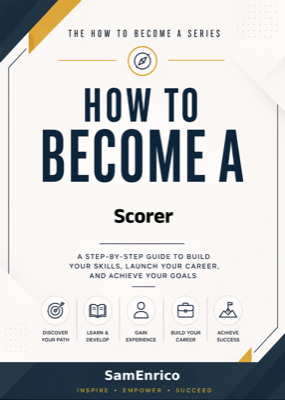
Non-FictionInformativeEducational
How to Become a Scorer eBook
How to Become a Scorer
How to Become a Scorer
Formats
Free sample
Chapter 1: The 70% Lie--– In the summer of 2016, I watched a 19-year-old forward miss eleven shots in a single game. She was playing for a regional development academy, and after the match—a 2-1 loss—she sat alone on the bench for forty-five minutes, her face buried in a towel. The coach had benched her with twelve minutes remaining. Not because she was playing poorly. Because she refused to stop shooting.After the stadium emptied, I walked down to where she sat.
I asked her what she was thinking.“I’m a failure,” she said. “I’ll never be a scorer.”That young forward is now a professional. Last season, she finished third in her league in goals. Her shooting percentage that year? Twenty-two percent.
She missed seventy-eight percent of her shots.This book is not about never missing. It is about understanding that missing is the price of admission.The Silent Epidemic: Fear of Missing Every athlete who has ever wanted to become a scorer knows this moment: the ball comes to you in a dangerous area, a defender closes, the goalkeeper sets their feet, and for a fraction of a second—maybe less—you hesitate. That hesitation is not about skill. You have made that shot a thousand times in practice. That hesitation is about fear.Fear of missing.
Fear of embarrassment. Fear of the sideline. Fear of being taken out. Fear of your teammates rolling their eyes. Fear of the coach’s sigh.And here is the cruel irony: that single moment of hesitation is the difference between a goal and a blocked shot, between a scorer and a player who could have been one.The greatest barrier to becoming a high-volume scorer is not technical.
It is not athletic. It is psychological. You already know how to shoot. What you have not yet learned is how to keep shooting.This chapter dismantles the single biggest obstacle to scoring: the fear of failure. Most athletes sabotage their scoring potential because they subconsciously prioritize avoiding embarrassment over achieving results.
You would rather pass the ball to someone else than miss in front of a crowd. You would rather take a safe, low-percentage shot from distance that gives you an excuse (“it was a long shot”) than attack the dangerous area where a miss feels catastrophic.But here is the truth that separates elite scorers from everyone else: missing is not failure. Refusing to shoot is failure.The Critical Distinction: Practice Mode vs. Game Mode Before we go any further, we must establish a distinction that will frame this entire book. Many books on scoring make a catastrophic error: they tell you to “stop thinking” or to “trust your instincts,” but they never tell you when.Here is the distinction:Practice Mode: This is where conscious thought lives.
In practice, you should think about your mechanics. You should analyze every miss. You should break down your weight transfer, your follow-through, your head position. You should be deliberate, analytical, and even obsessive. Practice is for building.Game Mode: This is where conscious thought dies.
In games, thinking is poison. Your half-second of conscious processing is slower than a goalkeeper’s reaction time. In games, you trust the automaticity you built in practice. You do not analyze. You do not hesitate.
You execute.This chapter covers Practice Mode exclusively. Chapter 2 covers Game Mode. Never confuse the two. The athlete who overthinks in games will freeze. The athlete who refuses to think in practice will never improve.Now, let us build.The TASKS Framework: A Practice-Only System for Building a Scoring Mindset Over a decade of working with collegiate and professional scorers, I have distilled the psychological preparation for scoring into five elements.
I call it the TASKS Framework. Each letter represents a practice habit that, when repeated thousands of times, rewires your brain to treat missing as data rather than judgment.T – Target: Define Measurable Goals for Every Session Most players walk onto the practice field or court with a vague intention: “I want to get better at scoring.” This is not a plan. This is a wish.Elite scorers set specific, measurable targets before every practice session. Examples:“I will take fifty shots from the left side of the slot.”“I will hit the far post or the area within six inches of it twenty times.”“I will attempt ten volleys, ten headers, and ten shots off the dribble.”Why does this matter? Because a measurable target gives you permission to miss.
If your goal is to take fifty shots, then shot number thirty-four is not a failure—it is progress toward fifty. If your goal is to hit the post twenty times, you will inevitably miss eighty times to get there. Those misses are not mistakes. They are data.Action Step: Before your next practice, write down three specific, measurable shooting targets. Do not leave the locker room until they are written.A – Attitude: Adopt a Probabilistic Mindset Here is the math that changed everything for the forward who missed eleven shots in one game.In most team sports, elite scoring percentages are surprisingly low:Basketball: 45-50% from the field is All-NBA level.Soccer: 20-25% of shots resulting in goals is world-class.Hockey: 10-15% shooting percentage wins the Rocket Richard Trophy.Tennis: Winning 55% of points makes you a Grand Slam champion.Let that sink in.
The best scorers in the world fail most of the time.The probabilistic mindset reframes every shot not as a binary success/failure event but as a contribution to a statistical outcome. You cannot control whether any individual shot goes in—goalkeepers make great saves, posts deny perfect shots, luck intervenes. But you can control the number of high-quality shots you take. And over a large enough sample, the numbers work in your favor.Think of yourself as a slot machine that pays out thirty percent of the time. The only way to get thirty percent is to pull the lever again and again.
Every time you hesitate, you leave money on the table.Action Step: Calculate your personal shooting percentage over your last ten practices. If it is above forty percent, your practice is too easy. Increase difficulty until your success rate drops to twenty-five to thirty-five percent. That is your growth zone.S – Show-Up: Consistent Presence in Scoring Positions There is a reason the same players seem to always be in the right place at the right time. It is not luck.
It is a decision.“Show-up” means two things in this framework. First, it means physically arriving in high-danger areas relentlessly. The player who makes ten runs into the box will be there for the one cross that finds them. The player who makes one run will miss it.Second, it means continuing to show up after misses. The hardest shot to take is the one immediately following a terrible miss.
Your body wants to hide. Your mind wants to avoid the spotlight. Elite scorers have trained themselves to want the ball more after a miss, not less.This is not about courage. It is about repetition. You can train yourself to seek the ball after failure the same way you train a…
This is the end of the free sample. Get the eBook to keep going. Buy now
About this book
Details
- Author
- Demers Andree
- Publisher
- SamEnrico
- Language
- English
- ISBN
- 9781506054100
- Genre
- Non-Fiction, Informative, Educational
- Released
- 2026-05-04
- Pages (approx.)
- 154
- Available as
- eBook, Paperback, Audiobook

Read better in the ZLOADR app
Your eBooks on your phone or tablet. Sign in with your SamEnrico account and start reading.
More by Demers Andree
 Complete Vegan Protein Sources HandbookDemers Andree$11.99
 TM Political ClarityDemers Andree$11.99
 MAT for First Responders GuideDemers Andree$11.99
 Dealing With Political DisappointmentDemers Andree$11.99
 Imposter Syndrome and RetirementDemers Andree$11.99
 The Bloodhound’s Last Case: How a Dog Solved the Mystery of the Missing MillionaireDemers Andree$11.99
 The Phantom Ledger: How a $1.2 Billion Fraud Vanished into Thin AirDemers Andree$11.99
 UNHCR Career GuideDemers Andree$12.99
 Lease Holdover Rent UpdateDemers Andree$12.99
 Medical Office Administrative AssistantDemers Andree$11.99
You may also like
 Hong Kong Handover 1997Dunn Johnnie$11.99
 Zumba For Postnatal Recovery CourseNeal Christian$11.99
 Zumba for BeginnersLadner Nikia$11.99
 YouTube Comment Mining GuideHumes Pandora$12.99
 Worry Box MeditationCarlin Rudy$11.99
 Workplace Stress MeditationNguyen Lynn$11.99
 Workplace Stress and Sleep RepairHawley Ivory$11.99
 Workplace Perfectionism CureDelaney Jeffry$11.99
 Workplace Injustice Anger GuideWallen Isabelle$11.99
 Work Addiction and Burnout LinkGreenwood Ester$11.99
 Women in Yoga and WellnessBeattie Galina$11.99
 Women in Stand Up ComedyChun Evangeline$11.99