

Non-FictionInformativeEducational
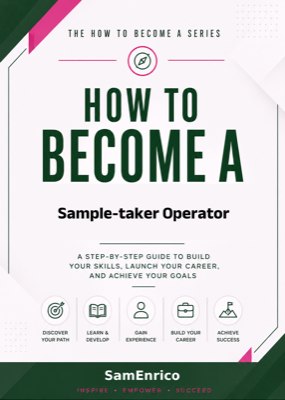
How to Become a Sample-taker Operator eBook
How to Become a Sample-taker Operator
How to Become a Sample-taker Operator
Formats
Free sample
Chapter 1: The Legal Gatekeeper...--For most people, the word “sampling” conjures an image of someone jamming a shovel into a pile of grain, scooping up a random handful, and tossing it into a bucket. That image is not entirely wrong—shovels are involved, and buckets do get filled—but it is dangerously incomplete. It is the difference between watching a carpenter swing a hammer and understanding how that same hammer, in skilled hands, builds a house that will not collapse in the first storm. The sample-taker operator is not a material mover. She is the legal gatekeeper of quality, the first line of defense against product recalls, and in many industries, the only person standing between a company and millions of dollars in liability.This chapter dismantles the single biggest career killer in the sampling industry: the belief that the job is just unskilled manual labor.
If you carry that belief onto the shop floor, you will never advance beyond the entry level. You will make mistakes that could have been avoided. And eventually, you will be replaced—not by a robot, but by the person who read this chapter and understood that sampling is a profession, not a chore. By the time you finish this chapter, you will see every shovel, every probe, and every sample bag as an instrument of legal and scientific authority. You will understand why your signature carries the weight of an affidavit.
And you will be ready to embark on a career that offers stability, respect, and a clear path to advancement.The Picker Versus The Professional Imagine two workers standing on the same factory floor. The first worker, let us call him Marcus, is a picker and packer. His job is straightforward: boxes come down a conveyor belt, he picks them up, scans a barcode, and places them on a pallet. The box’s contents are already determined. His role is physical, repetitive, and requires almost no judgment.
If he makes a mistake—scanning the wrong box—the system usually catches it within minutes. He is valuable to the operation, but he is replaceable with about three days of training. His labor is measured in units per hour, and his success is measured by how fast he moves.The second worker, Elena, is a certified sampling operator. A tanker truck has just arrived at her facility carrying twenty metric tons of pharmaceutical-grade lactose powder. Elena’s job is not to move the powder.
Her job is to determine whether that twenty tons meets the purity specification agreed upon in a million-dollar contract. She selects a stainless steel probe, inserts it into the tanker at nine specific locations—front, middle, rear, left, center, right, top, middle, and bottom—withdraws incremental portions, composites them into a single representative sample, seals it in a tamper-evident bag, affixes a chain-of-custody barcode, and logs every detail into the Laboratory Information Management System. Her signature on that sample tag is a legal affidavit, sworn under penalty of perjury. If the sample is later found to be non-representative—if she accidentally took only from the top layer, which had dried out during transport—the entire twenty-ton load could be rejected at the factory gate. The manufacturer might lose a multi-year customer.
The distributor might file a lawsuit. And Elena could be subpoenaed, terminated, and blacklisted from the industry.The difference between Marcus and Elena is not physical strength, speed, or even intelligence. It is legal authority and professional judgment. Marcus moves product. Elena certifies it.
That distinction is the entire premise of this book and the foundation of a career that can last thirty years. One of these jobs pays by the hour and offers no advancement. The other offers a ladder from the shop floor to the quality manager’s office. Which one do you want?Why This Confusion Persists The misconception that sampling is unskilled labor persists for three stubborn reasons. Each of these reasons has led countless capable people to fail in this profession, not because they lacked ability, but because they lacked understanding.
By naming these traps, you can avoid them.First, the physical act of taking a sample often looks simple. Insert probe. Pull out material. Put it in a bag. Anyone with two working hands can perform those motions.
But the simplicity of the motion masks the complexity of the decision. Where exactly do you insert the probe? How many increments do you take? What do you do if the material looks different at the bottom of the truck than it did at the top? What if the probe smells like solvent from the previous batch?
What if the material is frozen? What if it is caked? These are judgment calls that cannot be taught in an hour, and they are precisely what separates a professional from a laborer.Second, many people enter the sampling field from general labor roles. They were hired as warehouse workers, and one day their supervisor said, “Go take a sample from that truck.” They were handed a shovel and given no training. They did what they were told.
And because nothing catastrophic happened that day—no recall, no lawsuit, no explosion—they assumed they knew how to sample. This is the equivalent of driving to the end of your block and assuming you are ready for the Indianapolis 500. The absence of immediate disaster is not evidence of competence. It is just luck.Third, the industry itself has historically done a poor job of professionalizing the role. Unlike electricians, plumbers, or welders, sampling operators do not have a single universal licensing body.
Requirements vary wildly by industry and by state. A grain sampler in Iowa needs a USDA license. A pharmaceutical sampler in New Jersey needs GMP certification. An environmental sampler in California needs RCRA training. As a result, many operators learn the job through “tribal knowledge”—tips and tricks passed down from senior operators who may themselves have been trained incorrectly.
This book is designed to replace that fragmented, unreliable tribal knowledge with a standardized, auditable, legally defensible framework that works across all five major sampling industries.The Five Industries That Need You Right Now Not all sampling jobs are created equal. The tools, regulations, physical demands, and salary ranges vary significantly across industries. Understanding these differences will help you target your job search and tailor your training. The five industries that hire the most sampling operators are agriculture, mining, environmental services, pharmaceuticals, and food and dairy. Each offers a unique combination of challenges and rewards.Agriculture Grain elevators, feed mills, and oilseed processing plants collectively employ tens of thousands of sampling operators across the United States and Canada.
The primary materials are bulk agricultural commodities—corn, wheat, soybeans, canola, rice, and barley. The key challenge in agriculture is moisture and foreign material. Grain that is too wet will spoil in storage, growing mold that produces carcinogenic aflatoxins. Grain that contains too many weed seeds, insect fragments, or broken kernels will be rejected by buyers or sold at a substantial discount. Sampling in agriculture must be representative across depth because moisture migrates and settles.
The top of a grain bin might test at 12 percent moisture after a week of dry weather, while the…
This is the end of the free sample. Get the eBook to keep going. Buy now
About this book
Details
- Author
- Jolley Jolynn
- Publisher
- SamEnrico
- Language
- English
- ISBN
- 9781506049090
- Genre
- Non-Fiction, Informative, Educational
- Released
- 2026-05-09
- Pages (approx.)
- 133
- Available as
- eBook, Paperback, Audiobook

Read better in the ZLOADR app
Your eBooks on your phone or tablet. Sign in with your SamEnrico account and start reading.
More by Jolley Jolynn
 Esports Pro Stress GuideJolley Jolynn$11.99
 Accountant Imposter SyndromeJolley Jolynn$11.99
 Ancestor Communication ProtocolsJolley Jolynn$11.99
 Diarrhea HandbookJolley Jolynn$11.99
 Napping for Better RecallJolley Jolynn$11.99
 The Catholic Martyr ResponseJolley Jolynn$11.99
 Homework Help ScheduleJolley Jolynn$11.99
 Affirmations For Spiritual CrisisJolley Jolynn$11.99
 Angry Person ListeningJolley Jolynn$11.99
 The Lady of the Lost Isle: Morgana's Forgotten WarJolley Jolynn$11.99
 The $100 Million Bet: How a Tech Mogul Lost It All in a Single DayJolley Jolynn$11.99
 Constantinople: The Unbroken EmpireJolley Jolynn$11.99
You may also like
 Hong Kong Handover 1997Dunn Johnnie$11.99
 Zumba For Postnatal Recovery CourseNeal Christian$11.99
 Zumba for BeginnersLadner Nikia$11.99
 YouTube Comment Mining GuideHumes Pandora$12.99
 Worry Box MeditationCarlin Rudy$11.99
 Workplace Stress MeditationNguyen Lynn$11.99
 Workplace Stress and Sleep RepairHawley Ivory$11.99
 Workplace Perfectionism CureDelaney Jeffry$11.99
 Workplace Injustice Anger GuideWallen Isabelle$11.99
 Work Addiction and Burnout LinkGreenwood Ester$11.99
 Women in Yoga and WellnessBeattie Galina$11.99
 Women in Stand Up ComedyChun Evangeline$11.99