
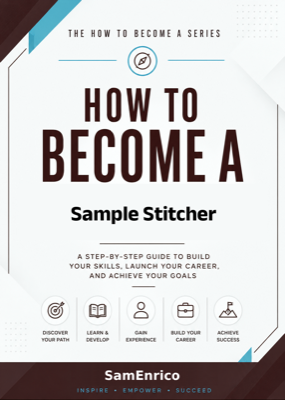
Non-FictionInformativeEducational
How to Become a Sample Stitcher eBook
How to Become a Sample Stitcher
How to Become a Sample Stitcher
Formats
Free sample
Chapter 1: The Invisible Career...-- If you own a sewing machine and have ever wondered whether your hobby could become something more than just making things for yourself or selling occasionally at a craft fair, you have likely asked the wrong question. The right question is not whether you can sew well enough to get paid. The right question is whether you can sew differently. This book exists because those two things are not the same, and the difference between them is the difference between keeping your hobby as a pleasant weekend activity and building a career that pays your rent, buys your groceries, and funds your retirement.Let me tell you about someone I will call Sarah. Sarah had been sewing for twelve years.
She made her own clothes, quilted for friends, and had successfully completed several complicated Halloween costumes for her children that were the envy of the school pickup line. When she decided to turn her hobby into income, she did what most people do. She posted photos on social media, hung a flyer at the local fabric store, and waited for customers to find her. They did find her. They brought her ripped jeans, too-long curtains, and bridesmaid dresses that needed hemming.
Within six months, Sarah hated sewing. She was underpaid, overworked, and spending her evenings unpicking someone else's bad stitching rather than creating anything beautiful. She had become an alterations technician, not a stitcher. And she was miserable.Now let me tell you about someone I will call Marcus. Marcus had been sewing for only three years when he discovered the job that would change his life.
He never wanted to fix other people's mistakes. He wanted to build things from scratch, work with designers, and see his name attached to garments that ended up in shops or on runways. He discovered a role he had never heard of before, a job that exists in every fashion house, every upholstery studio, and every product development department. It is a job that pays reliably, requires no degree, and values precision over speed. That job is sample stitching.Sarah and Marcus started from similar places.
They ended up in vastly different careers. The only difference was that Marcus knew a secret that Sarah did not. The secret is this: the fashion industry, the upholstery industry, and the craft manufacturing world all share a critical bottleneck. They have designers who can draw and pattern makers who can draft, but they have very few people who can translate those drawings and patterns into physical, sewable, wearable prototypes. That translator is the sample stitcher.
And right now, there is a shortage of good ones.This chapter will show you what a sample stitcher actually does, why this career is different from every other sewing-related job you have heard of, and how to know if you have the temperament for it. By the end of this chapter, you will understand not just the tasks of the job but the mindset that separates a professional sample stitcher from someone who simply knows how to sew.The Definition You Have Been Missing A sample stitcher is a specialized technical professional who translates a designer's two-dimensional sketch into a three-dimensional physical prototype. That sentence contains more information than you might think, so let us unpack it carefully.The key word is translates. A translator does not simply copy. A translator interprets.
When a designer hands you a sketch, that sketch is incomplete by definition. It shows a front view but not a back view. It suggests a seam but does not specify the seam type. It implies a fit but does not account for how the fabric will behave when it encounters a curve or a corner. Your job as a sample stitcher is to take that incomplete information and make it real, making dozens of small decisions along the way that the designer never thought to specify.The second key phrase is physical prototype.
You are not making a finished garment for sale. You are making a test version, a proof of concept, a first draft. That prototype will be examined, criticized, marked up with pins and pens, and quite possibly torn apart so that a second version can be made. This is not personal. This is the process.
If you are someone who becomes attached to your work and feels wounded when someone points out a flaw, sample stitching will be an uncomfortable career for you. The sample is not the final product. It is a step toward the final product, and it exists to be improved upon.The third key phrase is technical professional. You are not an artist, though artistry helps. You are not a designer, though design sense matters.
You are a technician. You are hired because you can execute a specific set of technical operations with precision, consistency, and speed within the deliberate framework of sample work. Your value is not in your creativity, though creativity can distinguish you from others. Your value is in your reliability. A designer who gives you a tech pack at 9 AM should know that by 5 PM, they will have a sample that accurately represents their vision, within the limits of physics and fabric.This is not glamorous work.
You will not be on a runway. You will not be photographed for magazines. Your name will appear in a credit line maybe once a year if you are lucky. But you will be employed consistently, paid fairly, and respected deeply by the people who depend on you. And there is a kind of satisfaction in that, a quiet pride that comes from being the person everyone trusts to get it right.The Three Wrong Questions People Ask Before we go further, let us clear away the misconceptions that keep talented sewers from ever considering this career.The first wrong question is: "Do I need a fashion degree?" The answer is no.
In fact, many fashion degree programs spend very little time on actual sewing. They focus on design theory, illustration, fashion history, and trend forecasting. These are valuable subjects for a designer but almost entirely irrelevant for a sample stitcher. What you need is not a degree. You need precision, problem-solving skills, and the ability to work from a technical specification sheet.
This book will teach you those things. No degree required.The second wrong question is: "Do I need to know how to draw?" The answer is no. You are not the designer. You do not need to sketch. You need to read sketches, which is a different skill entirely.
If you can look at a drawing and understand where the seams should go, where the darts should be placed, and what kind of closure the designer intended, you have the visual literacy required for this job. Drawing ability is irrelevant.The third wrong question is: "Do I need to own an expensive industrial machine?" The answer is no, at least not at the beginning. Chapter 2 will cover this in detail, but the short version is that a good domestic machine with variable speed control and the right presser feet will handle the vast majority of sample work. Industrial machines are faster…
This is the end of the free sample. Get the eBook to keep going. Buy now
About this book
Details
- Author
- Morley Mathilde
- Publisher
- SamEnrico
- Language
- English
- ISBN
- 9781506048888
- Genre
- Non-Fiction, Informative, Educational
- Released
- 2026-05-09
- Pages (approx.)
- 149
- Available as
- eBook, Paperback, Audiobook

Read better in the ZLOADR app
Your eBooks on your phone or tablet. Sign in with your SamEnrico account and start reading.
More by Morley Mathilde
 Year Review VisualizationMorley Mathilde$11.99
 Teacher Classroom ListeningMorley Mathilde$11.99
 Contract Abstraction Prompt VersioningMorley Mathilde$11.99
 Indigenous Forgiveness Rituals GuideMorley Mathilde$11.99
 Diarrhea in ChildrenMorley Mathilde$11.99
 Role Transition Imposter GuideMorley Mathilde$11.99
 The Catholic League CrusadeMorley Mathilde$11.99
 Parent Outsourcing GuideMorley Mathilde$11.99
 Remote Work Isolation FixesMorley Mathilde$11.99
 The Blood Eagle: Odin’s Forgotten CurseMorley Mathilde$11.99
 The Ballpoint Breakthrough: How a Disruptive Pen Changed the WorldMorley Mathilde$11.99
 Feast of the Northmen: The Viking Banquets That Built KingdomsMorley Mathilde$11.99
You may also like
 Hong Kong Handover 1997Dunn Johnnie$11.99
 Zumba For Postnatal Recovery CourseNeal Christian$11.99
 Zumba for BeginnersLadner Nikia$11.99
 YouTube Comment Mining GuideHumes Pandora$12.99
 Worry Box MeditationCarlin Rudy$11.99
 Workplace Stress MeditationNguyen Lynn$11.99
 Workplace Stress and Sleep RepairHawley Ivory$11.99
 Workplace Perfectionism CureDelaney Jeffry$11.99
 Workplace Injustice Anger GuideWallen Isabelle$11.99
 Work Addiction and Burnout LinkGreenwood Ester$11.99
 Women in Yoga and WellnessBeattie Galina$11.99
 Women in Stand Up ComedyChun Evangeline$11.99