
Non-FictionInformativeEducational
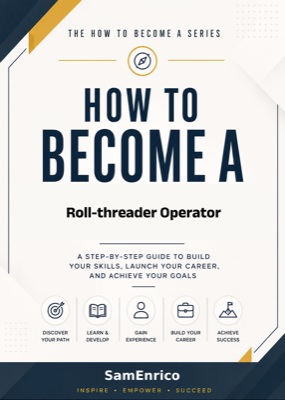
How to Become a Roll-threader Operator Paperback
How to Become a Roll-threader Operator
How to Become a Roll-threader Operator
Formats
Free sample
Chapter 1: The Hidden Economy--If you have ever tightened a bolt that felt rough and gritty, or watched a machine shop video where bright silver chips spiral off a cutting tool, you probably assume that threads are cut. Most people do. The truth is that the strongest, smoothest, and most profitable threads are not cut at all. They are rolled. And the operators who know how to roll them are among the most sought-after—and most underpaid relative to their true value—workers in modern manufacturing.This chapter is not a warm-up.
It is a reality check. Before you touch a die, before you calculate a blank diameter, before you even step onto a shop floor, you need to understand the economic ecosystem you are about to enter. Why do shops pay experienced roll-threader operators sixty or seventy dollars an hour? Why are some jobs unfilled for months? Why do companies that rely on thread rolling operate on razor-thin margins where a single setup mistake can wipe out a week's profit?The answers will surprise you.
They will also tell you exactly where to focus your learning to command the highest pay.Let me start with a story that illustrates everything you are about to learn.The Twenty-Minute Disaster A few years ago, I got a panicked phone call from a production manager at a mid-sized fastener company. Let us call him Dave. Dave's shop had just landed a contract to supply 250,000 special flange bolts for an agricultural equipment manufacturer. The order was worth nearly $900,000. The margin was good.
The timeline was tight but achievable.On the third day of production, the night shift operator made a mistake that took less than twenty seconds to execute. He mis-read the setup sheet and adjusted the die gap incorrectly. Instead of a gap of 0.002 inches over the blank diameter, he set the gap 0.002 inches under the blank diameter. The dies touched the blank with excessive force.The machine ran for twenty minutes before anyone noticed anything wrong. In that time, it produced 1,200 bolts.
Every single one was scrapped. The dies were damaged beyond repair—4,000intoolingdestroyed.Themachine′sspindlebearingswereoverloaded,requiring4,000 in tooling destroyed. The machine's spindle bearings were overloaded, requiring 4,000intoolingdestroyed.Themachine′sspindlebearingswereoverloaded,requiring12,000 in repairs. And the 1,200 bolts had to be sorted, counted, and recycled at a fraction of their material cost.The total cost of that twenty-second mistake exceeded 25,000.Dave′sshopdidnothaveabackupsetofdiesforthatthreadsize.Thereplacementdiestooktendaystoarrive.Thecompanymissedthedeliverydeadline.Theagriculturalequipmentmanufacturercancelledthecontractandimposeda25,000. Dave's shop did not have a backup set of dies for that thread size.
The replacement dies took ten days to arrive. The company missed the delivery deadline. The agricultural equipment manufacturer cancelled the contract and imposed a 25,000.Dave′sshopdidnothaveabackupsetofdiesforthatthreadsize.Thereplacementdiestooktendaystoarrive.Thecompanymissedthedeliverydeadline.Theagriculturalequipmentmanufacturercancelledthecontractandimposeda50,000 penalty for late delivery.That night shift operator was fired. But the real problem was not the operator. The real problem was that no one in that shop had ever trained him on the critical difference between a gap that is too large and a gap that is too small.
He did not know that setting the gap smaller than the blank does not just scrap parts—it destroys machines.This book exists so that never happens to you.The Economics of a Single Thread To understand why roll-threader operators earn what they earn, you need to understand the economics of the parts they make. A single thread seems insignificant. It is a few millimeters of spiral groove on a piece of metal. But consider the math.A typical automotive wheel stud requires about four seconds to roll on a cylindrical machine, including handling time. At that rate, a single machine running one shift can produce roughly 7,000 studs per…
This is the end of the free sample. Get the Paperback to keep going. Buy now
About this book
Details
- Author
- Ware Marielle
- Publisher
- SamEnrico
- Language
- English
- ISBN
- 9781506035284
- Genre
- Non-Fiction, Informative, Educational
- Released
- 2026-05-04
- Pages (approx.)
- 159
- Available as
- eBook, Paperback, Audiobook

Read better in the ZLOADR app
Your eBooks on your phone or tablet. Sign in with your SamEnrico account and start reading.
More by Ware Marielle
 Shame Of Pregnancy LossWare Marielle$11.99
 Facial Wound Care GuideWare Marielle$11.99
 World of Warcraft Moderation PlanWare Marielle$11.99
 Parent Child Nonverbal BondingWare Marielle$11.99
 Remote Work Executive GuideWare Marielle$11.99
 Disability Financial StressWare Marielle$11.99
 Home Sleep TestWare Marielle$11.99
 DNA Doe Project BreakthroughsWare Marielle$11.99
 The Wisdom of the Ancestors: The Philosophers of AxumWare Marielle$11.99
 Shinji Efirda: The Maestro Who Scored Japan’s Silent RevolutionWare Marielle$11.99
 How to Produce Musical Keyboard AccessoriesWare Marielle$11.99
 Growing BulbinellaWare Marielle$11.99
You may also like
 Hong Kong Handover 1997Dunn Johnnie$11.99
 Zumba For Postnatal Recovery CourseNeal Christian$11.99
 Zumba for BeginnersLadner Nikia$11.99
 YouTube Comment Mining GuideHumes Pandora$12.99
 Worry Box MeditationCarlin Rudy$11.99
 Workplace Stress MeditationNguyen Lynn$11.99
 Workplace Stress and Sleep RepairHawley Ivory$11.99
 Workplace Perfectionism CureDelaney Jeffry$11.99
 Workplace Injustice Anger GuideWallen Isabelle$11.99
 Work Addiction and Burnout LinkGreenwood Ester$11.99
 Women in Yoga and WellnessBeattie Galina$11.99
 Women in Stand Up ComedyChun Evangeline$11.99