
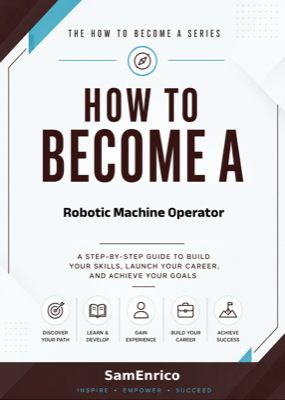
How to Become a Robotic Machine Operator eBook
How to Become a Robotic Machine Operator
How to Become a Robotic Machine Operator
Formats
Free sample
Chapter 1: The Million-Dollar Gap--–- The first time I saw an industrial robot move at full speed, I flinched. It wasn't the noise—though there was plenty of that. It was the sheer, effortless power. A six-axis arm swept through its work envelope, stopped precisely at a welded joint, and held position with a stillness that seemed to defy physics. The operator standing next to me, a woman in her early thirties with calloused hands and safety glasses fogging slightly, didn't even blink.
She’d been running this cell for three years. “You get used to it,” she shouted over the machine’s hum. “What you don’t get used to is how few of us there are.”She wasn’t exaggerating. At that moment, in that sprawling automotive parts plant outside Changchun, three robotic work cells were sitting idle. Not because the machines were broken—they were fine.
Not because there was no work—the order backlog stretched across the floor. They were idle because the plant didn’t have enough trained operators to run them. The company had spent over two million dollars on automation equipment, but nobody had budgeted for the human beings who would need to talk to these machines, coax them through production runs, troubleshoot their tantrums, and keep them running shift after shift.That scene is playing out right now in thousands of factories across China, Germany, Japan, and the United States. The robotics revolution promised to replace human labor with machines. What it actually delivered was something far more interesting: a new kind of human labor, one that pays better, demands more skill, and offers a career path instead of a dead end.This book is not about becoming an engineer.
It is not about designing robots or writing complex algorithms from scratch. It is about becoming the person who walks onto a factory floor, picks up a teach pendant, and makes a million-dollar machine do exactly what it is supposed to do. That person, right now, is worth more than gold. And there are not nearly enough of them to go around.Why This Chapter Exists Before we dive into teach pendants, coordinate systems, and lockout procedures, we need to answer one question honestly: Why should you invest your time—and possibly your money—in learning to become a robotic machine operator?The answer is not sentimental. It is not about “following your passion” or “doing what you love.” Those things matter, but they are not the foundation.
The foundation is this: there is a massive, growing gap between the number of industrial robots being installed worldwide and the number of people qualified to operate them. That gap is called the skills gap. I call it the million-dollar gap—because that is roughly what an untrained operator costs a company in lost productivity, and that is also what a trained operator can earn over a career.According to the Ministry of Human Resources and Social Security of China, the demand for industrial robot system operators will reach 1.25 million in the next five years. Other estimates from the International Federation of Robotics suggest that globally, the shortage of skilled automation workers will exceed two million by 2028. These are not abstract numbers.
They represent actual jobs that companies are trying to fill right now, paying wages that have risen 30 percent faster than factory floor average over the past three years.I have interviewed dozens of plant managers, human resource directors, and training coordinators for this book. The conversation always follows the same arc. I ask: “If I sent you ten qualified robotic machine operators tomorrow, what would you do?” Their eyes light up. They lean forward. One manager in Suzhou told me, “I’d hire all ten on the spot.
Then I’d call my competitor and ask if they had any spares.”The Myth of the Fully Automated Factory Let me stop you right here if you believe the hype. For the past decade, breathless headlines have predicted the end of human work. Robots are coming for your job, they warned. The fully automated factory is just around the corner. The lights-out manufacturing facility—where machines run unsupervised through the night—is the future, and humans are obsolete.None of that is true.
Not remotely.The most automated factories in the world—Tesla’s Gigafactories, BMW’s assembly plants in Dingolfing, Foxconn’s i Phone assembly lines—still employ thousands of people. They employ different people than they used to, and those people do different work. But the factories are not empty. They cannot be empty. Because robots, for all their speed and precision, are remarkably stupid.Here is what an industrial robot cannot do: adapt to unexpected situations, notice when a part is slightly misaligned and adjust its grip, troubleshoot a fault that wasn’t anticipated in the programming, perform preventive maintenance before a small problem becomes a catastrophic failure, communicate with the next shift about what happened during the last eight hours, and make a judgment call when the sensor data is ambiguous.That list is not a weakness.
It is an opportunity. Everything a robot cannot do is exactly what a skilled human operator does. The robot provides brawn and repeatability. The operator provides brains and adaptability. Together, they form a system that outperforms either one alone.I saw this clearly during a visit to a logistics center outside Shanghai.
Twenty autonomous mobile robots scurried across the floor like oversized beetles, carrying pallets to packing stations. They were guided by a central computer that knew the position of every item, every shelf, every robot. It was impressive. But when a pallet shifted during transit—when something fell slightly outside the parameters of the computer’s model—the whole system ground to a halt. A young operator walked over, squatted down, repositioned the pallet by hand, and tapped a few buttons on a tablet.
The robots resumed their dance. She had solved in fifteen seconds a problem that would have stumped the automated system indefinitely.That is the reality of modern manufacturing. The machines do the predictable work. Humans do the unpredictable work. And the unpredictable work is where the value—and the pay—lies.What This Book Will Actually Teach You By the time you finish this book, you will be able to perform the core tasks of an industrial robot system operator at a level consistent with the national职业技能标准.
More concretely, you will learn:First, how to identify every major component of an industrial robot system—the manipulator, the controller, the teach pendant, the end-of-arm tooling, the safety systems—and explain what each one does. You will not just memorize names. You will understand how these parts work together, why they are designed the way they are, and what happens when something goes wrong.Second, how to operate a robot safely. Safety is not a chapter in this book; it is the thread that runs through every chapter. You will learn lockout/tagout procedures, emergency stop protocols, risk assessment, and the proper use of personal protective equipment.
You will learn these things not as abstract regulations but as practical skills that keep you and your coworkers alive. I do…
This is the end of the free sample. Get the eBook to keep going. Buy now
About this book
Details
- Author
- Vanhoose Ruthe
- Publisher
- SamEnrico
- Language
- English
- ISBN
- 9781506031767
- Genre
- Non-Fiction, Informative, Educational
- Released
- 2026-04-25
- Pages (approx.)
- 150
- Available as
- eBook, Paperback, Audiobook

Read better in the ZLOADR app
Your eBooks on your phone or tablet. Sign in with your SamEnrico account and start reading.
More by Vanhoose Ruthe
 Women's Trench Art HistoryVanhoose Ruthe$11.99
 Verbal Judo for AngerVanhoose Ruthe$11.99
 Parenting Through Cannabis Use DisorderVanhoose Ruthe$11.99
 Los Angeles Summer Of TerrorVanhoose Ruthe$11.99
 Caregiver Burnout Prevention PlanVanhoose Ruthe$11.99
 Bhagwan Water Rights FightVanhoose Ruthe$11.99
 Recruiter Outreach ScriptsVanhoose Ruthe$11.99
 Night Eating Syndrome GuideVanhoose Ruthe$11.99
 The Hollow Grail: A Knight's Last QuestVanhoose Ruthe$11.99
 Charlemagne's Intellectual Empire: The Carolingian Renaissance and the Birth of EuropeVanhoose Ruthe$11.99
 How to Produce SnowshoeingVanhoose Ruthe$11.99
 How to Produce a Gas ApplianceVanhoose Ruthe$11.99