
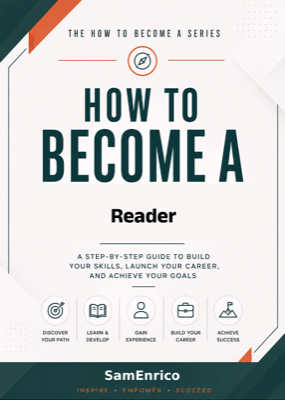
Non-FictionInformativeEducational
How to Become a Reader Paperback
How to Become a Reader
How to Become a Reader
Formats
Free sample
Chapter 1: You Don't Finish--–- The confession arrives in a used bookstore, as all good confessions should. I was thirty-one years old, standing in the poetry section of a cramped shop in Portland, when a stranger asked me a simple question: “What’s the last book you actually finished?” Not started. Not carried around in your bag for three months. Not told people you were reading. Finished.
I opened my mouth to answer and discovered I had nothing to say. The last book I had completed, cover to cover, with no skimming, no “I got the gist,” no guilt-driven sprint through the final chapters, was a 112-page children’s novel I had read aloud to my nephew eighteen months earlier. Everything else—the literary fiction on my nightstand, the dense history of the Cold War on my coffee table, the three self-help books I had purchased as part of a “new year, new me” ritual—sat in various states of arrested decay, like abandoned construction projects. I was not a reader who sometimes failed to finish books. I was a non-reader who pretended to be a reader by acquiring books.This chapter is not for the person who reads fifty books a year and wants to read sixty.
That person already has a different problem, and frankly, a different book exists for them. This chapter—the entire first reset of this book—is for the person who has internalized the belief that finishing books is a moral obligation, and that failing to do so means you are lazy, undisciplined, or simply not “a reader.” That belief is the single greatest barrier to becoming a reader, and it must be destroyed before any other technique or tool can take root. You cannot build a reading life on a foundation of shame. Shame does not produce sustained behavior change. Shame produces avoidance, and avoidance produces more shame, and more shame produces the silent epidemic of adults who own books they will never open and feel worse about themselves every time they see the stack.Let me be clearer than this book will ever be again: you do not have to finish books.
Not the one your friend recommended. Not the one that won the prize. Not the one you spent thirty dollars on. Not the one you have already read a hundred pages of. Not the one sitting on your shelf for seven years.
If a book is not serving you—whether because it is boring, or too difficult, or badly written, or simply wrong for your current mood—you have not only permission to abandon it; you have a responsibility to abandon it. Every hour spent forcing yourself through a book you resent is an hour stolen from the book that might have changed your life.This is not laziness. This is discernment. And discernment is the first skill of the real reader.The Abandonment Ratio Let us begin with data, because data has no shame. In 2019, the e-reading platform Kobo analyzed anonymized reading behavior from millions of users and discovered something that should be taught in every school: the average reader finishes only 42 percent of the books they start.
Read that sentence again. The average person who buys a book, opens a book, and intends to read that book will abandon more than half of what they begin. This number holds across genres, across price points, across age groups. It even holds, with slight variation, for books that readers rate five stars. People abandon books they love.
Not because the books are bad. Because the match between reader and book was wrong at that specific moment in…
This is the end of the free sample. Get the Paperback to keep going. Buy now
About this book
Details
- Author
- Logsdon Martin
- Publisher
- SamEnrico
- Language
- English
- ISBN
- 9781506030814
- Genre
- Non-Fiction, Informative, Educational
- Released
- 2026-05-02
- Pages (approx.)
- 140
- Available as
- eBook, Paperback, Audiobook

Read better in the ZLOADR app
Your eBooks on your phone or tablet. Sign in with your SamEnrico account and start reading.
More by Logsdon Martin
 Small Talk for BartendersLogsdon Martin$11.99
 Moonlit Beach StrollLogsdon Martin$11.99
 Imposter Syndrome CureLogsdon Martin$11.99
 Maxim Gun Conquest FactorLogsdon Martin$11.99
 Work Addiction Recovery PlanLogsdon Martin$11.99
 GAD And ForgetfulnessLogsdon Martin$11.99
 CBT For GAD ManualLogsdon Martin$11.99
 Startup Cost Deduction GuideLogsdon Martin$11.99
 The Iron Walls of Namhan: Korea's Last Stand Against the Qing (1636)Logsdon Martin$11.99
 Blood and Silk: The Forgotten Marathon of the Silk RoadLogsdon Martin$11.99
 How to Produce a Heat SealerLogsdon Martin$11.99
 A Collector's Handbook to the Fiat 600 MultiplaLogsdon Martin$11.99
You may also like
 Hong Kong Handover 1997Dunn Johnnie$11.99
 Zumba For Postnatal Recovery CourseNeal Christian$11.99
 Zumba for BeginnersLadner Nikia$11.99
 YouTube Comment Mining GuideHumes Pandora$12.99
 Worry Box MeditationCarlin Rudy$11.99
 Workplace Stress MeditationNguyen Lynn$11.99
 Workplace Stress and Sleep RepairHawley Ivory$11.99
 Workplace Perfectionism CureDelaney Jeffry$11.99
 Workplace Injustice Anger GuideWallen Isabelle$11.99
 Work Addiction and Burnout LinkGreenwood Ester$11.99
 Women in Yoga and WellnessBeattie Galina$11.99
 Women in Stand Up ComedyChun Evangeline$11.99