
Non-FictionInformativeEducational
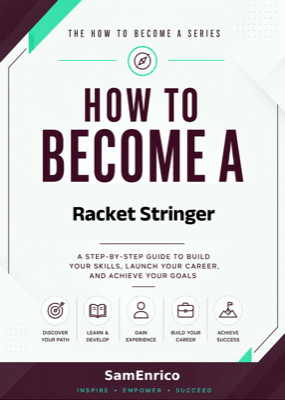
How to Become a Racket Stringer eBook
How to Become a Racket Stringer
How to Become a Racket Stringer
Formats
Free sample
Chapter 1: The Millisecond Mistake...--–- The first time I cut the strings out of a racket that wasn’t mine, my hands shook so badly I nearly sliced through the frame’s paint. I had watched seventeen You Tube videos, read three forum posts written in all-caps by someone named “Stringer King99,” and practiced on my own broken-down racket twelve times. None of that prepared me for the moment when a real player – a left-handed 4.5 tournament grinder named Marcus – handed me his $250 Yonex and said, “Just do what feels right.” I had no idea what felt right. I had no idea what the strings were supposed to do. I had no idea that in the 3 to 5 milliseconds between the ball hitting the strings and leaving the racket, everything I thought I knew about power, control, and feel was about to be proven wrong.Marcus beat me 6-2, 6-1 the next day.
After the match, he walked over to my chair, tossed his racket on the ground, and said, “This feels like a wooden board. What did you do?” I had strung his racket at 58 pounds with polyester because I had read somewhere that “pros use poly at high tension.” I didn’t know that Marcus had a sensitive elbow. I didn’t know that 58 pounds of polyester feels like 65 pounds of synthetic gut. I didn’t know that the “trampoline effect” was even a thing. I was a hobbyist pretending to be a professional, and Marcus’s elbow paid the price for three weeks.That was the day I stopped guessing and started learning the physics.This chapter is not a physics textbook.
I am not a physicist. I am a stringer who made every mistake possible so you don’t have to. What follows is the practical, usable, no-math-required explanation of what actually happens when a tennis ball meets a string bed. You will learn why “feel” is just vibration data. You will learn why a looser string bed can sometimes hit harder than a tighter one.
And you will learn the single most important diagnostic skill you need before you ever pull tension on a customer’s racket: how to know whether a problem is the strings, the frame, or the person holding it.Welcome to the impact zone.The 5 Milliseconds That Changed Everything Let us start with a number that will haunt you in a useful way: 5.That is the maximum number of milliseconds the tennis ball spends in contact with the string bed. Five thousandths of a second. For context, you blink in about 100 milliseconds. By the time your brain registers that the ball has arrived, it has already left. This means something profound: no player, at any level, consciously controls what happens during impact.
Not Roger Federer. Not Novak Djokovic. Not the 3.5 weekend warrior who swears he can “feel the pocket.”What players call “feel” is entirely post-impact sensation. It is the vibration that travels up the racket handle, through the grip, and into their hand after the ball has already departed. That vibration tells them something about what just happened, but it does not allow them to change it.
As a stringer, you need to understand that you are not giving players real-time control. You are shaping the after-the-fact sensation that helps them make decisions for the next shot.The ball hits the strings. The strings stretch. The ball flattens against the string bed. The strings snap back toward their original position.
The ball launches. All of this happens before the player can say the word “hit.”The first thing you must accept is that your job is not to give players magic. Your job is to give players predictability. A consistent, repeatable response from the string bed allows their unconscious brain to calibrate. An inconsistent response – one racket feels like a trampoline, another feels like plywood – destroys their ability to adjust.
This is why professional stringers get paid hundreds of dollars per tournament job. Not because they have secret knots. Because they deliver the same result every single time.The Spring That You Control Imagine a trampoline. Now imagine covering that trampoline with concrete. That is the difference between a loose string bed and a tight one.At its simplest level, the string bed is a spring.
When the ball hits, the spring compresses (the strings stretch), stores energy, and then releases that energy back into the ball. The amount of energy returned is called the coefficient of restitution, or COR. A higher COR means more power. A lower COR means less power.Here is where intuition fails most new stringers. They assume tighter strings = more power, because tighter feels more “solid” in the hand.
That is backwards.Looser strings stretch more. More stretch means more energy stored. More energy stored means more energy returned. A loosely strung racket (say, 45 pounds) will typically produce more power on a slow swing than a tightly strung racket (say, 60 pounds). This is the trampoline effect.
The ball sinks into the string bed, the strings grab it, and then they fling it forward.Tighter strings stretch less. Less stretch means less energy stored. Less energy stored means less power. However, tighter strings provide more control because the ball deforms less on the string bed, reducing the angle at which it can launch unpredictably.There is a trade-off: low tension gives you power and depth but reduces directional control. High tension gives you control and spin potential but reduces power and increases shock to the arm.I want you to remember this for the rest of your stringing career.
When a customer says “I want more power,” your instinct might be to reach for a higher tension because “pros string tight.” Resist that instinct. Ask them about their swing speed first. A slow-swinging senior needs low tension. A fast-swinging junior can handle higher tension because their racket head speed generates its own power.Frame Power Versus String Power Not all power comes from the string bed. In fact, in modern rackets, most of the power comes from the frame itself.Racket manufacturers have spent forty years making frames stiffer, thicker, and more powerful.
A stiff frame bends less at impact, meaning less energy is lost to frame deformation. That energy goes into the ball instead. This is frame-dominant power. Think of a pure drive from Babolat – stiff, thick-beamed, powerful even with dead strings.String-dominant power is the trampoline effect we just discussed. A flexible frame (like a Pro Staff) relies more on the string bed for power.
If you string a flexible frame too tight, you kill all its power and end up with a racket that feels like a wooden plank.Why does this matter to you as a stringer? Because you need to diagnose whether a player’s complaint (“not enough power,” “too much power,” “feels dead”) is coming from the frame or the strings before you cut anything out.Here is your first real diagnostic rule: if a racket feels dead with brand new strings, check the frame. A cracked frame, a loosening handle, or worn grommets can make a fresh string job feel like garbage. If the frame is healthy, then the “dead” feel is coming…
This is the end of the free sample. Get the eBook to keep going. Buy now
About this book
Details
- Author
- Cotter Micheline
- Publisher
- SamEnrico
- Language
- English
- ISBN
- 9781505948967
- Genre
- Non-Fiction, Informative, Educational
- Released
- 2026-05-11
- Pages (approx.)
- 142
- Available as
- eBook, Paperback, Audiobook

Read better in the ZLOADR app
Your eBooks on your phone or tablet. Sign in with your SamEnrico account and start reading.
More by Cotter Micheline
 The Anger Iceberg ExplorationCotter Micheline$11.99
 Chunking Memory Mastery GuideCotter Micheline$11.99
 Binge Eating and Family Patterns WorkbookCotter Micheline$11.99
 Cortisol and Eye Floaters GuideCotter Micheline$11.99
 Roommate Conflict Stress ReductionCotter Micheline$11.99
 Blood and Bronze: The Secret Wars of the Gladiator PoetsCotter Micheline$11.99
 The AI Whisperer: How a Teen Coder Outsmarted Silicon ValleyCotter Micheline$11.99
 Understanding Ekbom's Syndrome[disambiguation Needed]Cotter Micheline$17.99
 Belgium Logistics DirectoryCotter Micheline$12.99
 Sales Tax Filing GuideCotter Micheline$12.99
 Export Compliance AnalystCotter Micheline$11.99
You may also like
 Hong Kong Handover 1997Dunn Johnnie$11.99
 Zumba For Postnatal Recovery CourseNeal Christian$11.99
 Zumba for BeginnersLadner Nikia$11.99
 YouTube Comment Mining GuideHumes Pandora$12.99
 Worry Box MeditationCarlin Rudy$11.99
 Workplace Stress MeditationNguyen Lynn$11.99
 Workplace Stress and Sleep RepairHawley Ivory$11.99
 Workplace Perfectionism CureDelaney Jeffry$11.99
 Workplace Injustice Anger GuideWallen Isabelle$11.99
 Work Addiction and Burnout LinkGreenwood Ester$11.99
 Women in Yoga and WellnessBeattie Galina$11.99
 Women in Stand Up ComedyChun Evangeline$11.99