
Non-FictionInformativeEducational
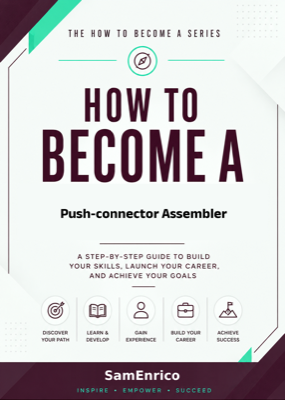
How to Become a Push-connector Assembler Paperback
How to Become a Push-connector Assembler
by Lira Melisa
How to Become a Push-connector Assembler
Formats
Free sample
Chapter 1: The Silent Connection--The first thing you need to understand about becoming a push-connector assembler is that you have probably already touched one today. That coffee machine at the office, the air brake system on the city bus you rode last week, the dental drill your hygienist used, the robotic arm on the assembly line that made your smartphone – all of them rely on push-connectors. And yet, almost no one outside the world of precision manufacturing knows what a push-connector assembler does, let alone why this role has become one of the most quietly critical positions in modern industry.This chapter is your entry point. It will not teach you how to cut tubing or read a blueprint – those skills come in later chapters. Instead, this chapter answers the fundamental questions: What is a push-connector?
Why do industries depend on them? And why should you invest your time in becoming an assembler who specializes in them? By the time you finish this chapter, you will understand the landscape, the opportunity, and the surprising complexity hidden inside that small, plastic-and-brass fitting that clicked when someone pushed a tube into it.The Anatomy of a Revolution: What Push-Connectors Really Are A push-connector – also known as a one-touch fitting, push-to-connect fitting, or quick-connect coupling – is a mechanical device that allows a tube to be inserted and sealed without wrenches, clamps, or any hand tool whatsoever. You push the tube in. It locks.
It seals. You are done. The entire operation takes less than one second.But that simplicity is deceptive. Inside every push-connector lives a carefully engineered sequence of components: a stainless steel grab ring with razor-sharp teeth that bite into the outer wall of the tube, an O-ring that compresses just enough to create an airtight or watertight seal, a collet that guides the tube squarely into the mechanism, and a release bushing that allows disassembly when needed. When you push a tube into a properly manufactured push-connector, the grab ring angles inward, allowing the tube to slide forward but instantly resisting any backward movement.
The harder you pull, the tighter the grab ring bites. This is called a “one-way gripping mechanism,” and it is the secret behind the push-connector’s reliability.Push-connectors come in dozens of configurations. The most common are straight connectors (tube enters one end, threads on the other), elbow connectors (90-degree turn), bulkhead connectors (designed to mount through a panel), and swivel connectors (the fitting rotates after assembly). They are manufactured from materials ranging from nickel-plated brass for industrial pneumatics to high-performance plastics like PEEK for medical and aerospace applications. Seal materials vary as well: NBR (nitrile rubber) for general-purpose air and water, FKM (Viton) for high-temperature or chemical-resistant applications, and EPDM for hot water and steam systems.The key point is this: push-connectors are not cheap, low-quality shortcuts.
In many applications, they outperform threaded fittings because they eliminate cross-threading, reduce assembly time by approximately 80 percent, and allow for easy rework without damaging the tubing port. A properly assembled push-connector, when used within its rated pressure and temperature range, will outlast the machine it is installed on.The Industries That Cannot Run Without You Understanding where push-connectors are used is essential because it determines your earning potential, your working environment, and your long-term career options. Push-connectors have spread far beyond their original home in factory automation. Here are the major sectors that depend on them.Industrial Automation and Robotics – This is the birthplace of the modern push-connector. Every pneumatic cylinder, every vacuum generator, every solenoid valve on an automated assembly line uses push-connectors to deliver compressed air.
Without them, robots could not grip parts, conveyor systems could not sort packages, and pick-and-place machines could not populate circuit…
This is the end of the free sample. Get the Paperback to keep going. Buy now
About this book
Details
- Author
- Lira Melisa
- Publisher
- SamEnrico
- Language
- English
- ISBN
- 9781505943665
- Genre
- Non-Fiction, Informative, Educational
- Released
- 2026-05-06
- Pages (approx.)
- 155
- Available as
- eBook, Paperback, Audiobook

Read better in the ZLOADR app
Your eBooks on your phone or tablet. Sign in with your SamEnrico account and start reading.
More by Lira Melisa
 Complicated Grief And PTSD GuideLira Melisa$11.99
 Dysfunctional Family Recovery BlueprintLira Melisa$11.99
 Boat Dock SunsetLira Melisa$11.99
 Chunking for SeniorsLira Melisa$11.99
 The Geo Arbitrage Thailand GuideLira Melisa$11.99
 Benzo Brain Fog Recovery CourseLira Melisa$11.99
 Commercial Real Estate Ethics GuideLira Melisa$11.99
 Resume South Korea GuideLira Melisa$11.99
 John Collison StripeLira Melisa$11.99
 The Silent Storm: Hiram Rhodes Revels and the Birth of Black Political PowerLira Melisa$11.99
 The Unseen Hand: How a Librarian Shaped the Cold WarLira Melisa$11.99
 Letters from the Wilderness: Love and Loss at ShilohLira Melisa$11.99
You may also like
 Hong Kong Handover 1997Dunn Johnnie$11.99
 Zumba For Postnatal Recovery CourseNeal Christian$11.99
 Zumba for BeginnersLadner Nikia$11.99
 YouTube Comment Mining GuideHumes Pandora$12.99
 Worry Box MeditationCarlin Rudy$11.99
 Workplace Stress MeditationNguyen Lynn$11.99
 Workplace Stress and Sleep RepairHawley Ivory$11.99
 Workplace Perfectionism CureDelaney Jeffry$11.99
 Workplace Injustice Anger GuideWallen Isabelle$11.99
 Work Addiction and Burnout LinkGreenwood Ester$11.99
 Women in Yoga and WellnessBeattie Galina$11.99
 Women in Stand Up ComedyChun Evangeline$11.99