
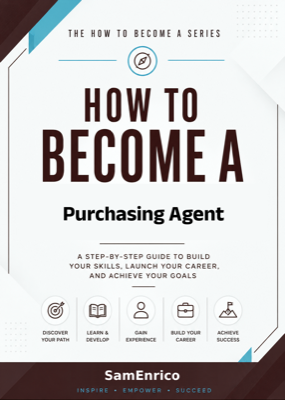
How to Become a Purchasing Agent eBook
How to Become a Purchasing Agent
by Ashton Rolf
How to Become a Purchasing Agent
Formats
Free sample
Chapter 1: The Million-Dollar Misunderstanding--The average professional will spend over 67,000 hours at work in a lifetime. For most of those hours, they will buy things—software, raw materials, office supplies, machinery, services, shipping, marketing, and a thousand other line items that keep their organization running. And yet, almost none of them will have the faintest idea how to buy well. They will overpay. They will accept terrible terms.
They will lock themselves into bad contracts that bleed money for years. And they will never know it.This book is not about becoming a clerk who pushes paper from an inbox to an outbox. This book is about becoming the person your organization turns to when money is on the line, when suppliers are playing games, and when failure is not an option. This book is about becoming a purchasing agent—not the kind from a 1980s training video, but the modern, strategic, data-driven professional who consistently delivers millions in value without spending a dollar more than necessary.If you picked up this book because you think purchasing is easy, close it now. If you think it is just calling a few suppliers and picking the lowest price, put it down.
But if you suspect—perhaps from watching a colleague stumble, or from reading about procurement scandals, or from seeing your own company pay too much for too long—that there is a real skill here, a craft that can be learned and mastered, then stay. What follows will change not only your career but also how you see every transaction, every negotiation, and every relationship in business.Let me tell you about David. David was an engineer who got "promoted" into purchasing because no one else wanted the job. His company spent 18millionannuallyoncustommetalcomponents.David′spredecessorhadsimplyrenewedthesamecontractsyearafteryear.Daviddidsomethingradical:heaskedquestions.Hemappedeverysupplier,everypartnumber,everyprice.Hediscoveredthatthecompanywasbuyingthesamewasherfromthreedifferentsuppliersatthreedifferentprices.Hefoundacontractthathadautomaticallyrenewedforsevenyearswitha518 million annually on custom metal components. David's predecessor had simply renewed the same contracts year after year.
David did something radical: he asked questions. He mapped every supplier, every part number, every price. He discovered that the company was buying the same washer from three different suppliers at three different prices. He found a contract that had automatically renewed for seven years with a 5% annual price escalator. Within eighteen months, David had saved his company over 18millionannuallyoncustommetalcomponents.David′spredecessorhadsimplyrenewedthesamecontractsyearafteryear.Daviddidsomethingradical:heaskedquestions.Hemappedeverysupplier,everypartnumber,everyprice.Hediscoveredthatthecompanywasbuyingthesamewasherfromthreedifferentsuppliersatthreedifferentprices.Hefoundacontractthathadautomaticallyrenewedforsevenyearswitha52 million.
He was not smarter than his predecessor. He was just intentional. He had learned the difference between ordering and purchasing.That difference is the entire subject of this book.The Five Rights: Your North Star Every purchasing decision, no matter how simple or complex, can be evaluated against five criteria. These are called the Five Rights of Procurement, and they have been the foundation of this profession for decades precisely because they work. You will hear them on the first day of any certification course.
You will see them in job descriptions. And you will return to them again and again throughout your career.The first right is quality. If you buy something that does not work, that fails prematurely, or that damages your own production process, you have saved nothing regardless of the price. Quality means fitness for use—not the highest possible规格, but the right specifications for your actual need. A fastener that holds two pieces of furniture together does not need aerospace-grade tensile strength.
Conversely, a brake component for a school bus cannot be the cheapest option on Alibaba. Quality is the non-negotiable foundation.The second right is quantity. Too little and you shut down production or miss a customer deadline. Too much and you tie up cash in inventory that might never be used, take up expensive warehouse space, and risk obsolescence or spoilage. The right quantity balances the cost of carrying inventory against the risk of running out.
This is not guesswork; it is data science, and we will cover the tools you need later.The third right is price. Notice that price comes third, not first. Many amateurs reverse this order because price is easy to compare. A supplier quotes 10,anotherquotes10, another quotes 10,anotherquotes9, so the 9supplierwins.Butifthe9 supplier wins. But if the 9supplierwins.Butifthe9 supplier delivers late (violating the fourth right, time) or ships from a distant warehouse that you must pay to receive (violating the fifth right, place), that $1 saving evaporates.
Price matters enormously—the profit leverage effect, which we will explore shortly, proves that—but it matters in context.The fourth right is time. On-time delivery is a metric that separates professional purchasing organizations from amateurs. Late deliveries cause production delays, customer cancellations, and reputational damage that no contract can fully remedy. A purchasing agent who cannot reliably predict when goods will arrive is not adding value.The fifth right is place. Where will the goods be delivered?
To your loading dock? To your customer directly? To a third-party warehouse? Each option has different costs and risks, and each should be negotiated explicitly rather than assumed.These five rights are not independent. They conflict constantly.
Faster delivery usually costs more. Higher quality may require larger minimum quantities. A more convenient delivery location might require accepting a less competitive price. Your job as a purchasing agent is not to maximize any single right but to find the optimal balance for your specific organization at this specific moment.The Profit Leverage Effect: Why Purchasing Matters More Than Sales Here is a truth that most business school graduates learn only after years of experience: a dollar saved in purchasing is more valuable than a dollar earned in sales. This is not opinion.
It is arithmetic.Consider a company with a 10% net profit margin. To add one dollar to its bottom line through sales, that company must generate ten dollars in additional revenue—because only one of those ten dollars falls to profit after paying for cost of goods sold, operating expenses, and taxes. But a one-dollar reduction in the cost of purchased materials or services adds one full dollar to the bottom line, because that dollar never left the company in the first place.This is the profit leverage effect. It means that a purchasing agent who saves 100,000onrawmaterialshasdonetheequivalentworkofasalespersongenerating100,000 on raw materials has done the equivalent work of a salesperson generating 100,000onrawmaterialshasdonetheequivalentworkofasalespersongenerating1 million in new revenue at a 10% margin company. At a 5% margin company, the leverage is 20x.
At 2%, it is 50x.Do you see why purchasing is strategic yet? Do you see why companies that ignore this function leave millions on the table?The profit leverage effect also explains why top executives eventually pay attention to purchasing—usually after a crisis. When sales are flat, when margins are under pressure, when a private equity firm acquires the company and starts asking where the waste is, suddenly the purchasing department becomes very interesting. The purchasing agents who have been quietly saving money year after year become heroes. The ones who have simply been ordering get replaced.I want you to internalize this concept before you read another word.
Every time you negotiate a better price, every time you consolidate suppliers, every time you eliminate a wasteful specification, you are not just saving money. You are creating profit that would not otherwise exist. You are doing the…
This is the end of the free sample. Get the eBook to keep going. Buy now
About this book
Details
- Author
- Ashton Rolf
- Publisher
- SamEnrico
- Language
- English
- ISBN
- 9781505943603
- Genre
- Non-Fiction, Informative, Educational
- Released
- 2026-05-02
- Pages (approx.)
- 152
- Available as
- eBook, Paperback, Audiobook

Read better in the ZLOADR app
Your eBooks on your phone or tablet. Sign in with your SamEnrico account and start reading.
More by Ashton Rolf
 Cocaine Relapse Prevention Planning ManualAshton Rolf$11.99
 Resume Ireland Specific GuideAshton Rolf$11.99
 Letting Go of Fear of JudgmentAshton Rolf$11.99
 Depreciation of Professional Sports TeamsAshton Rolf$11.99
 Commercial Real Estate ForecastingAshton Rolf$11.99
 Ferry Boat CrossingAshton Rolf$11.99
 Chunking Workbook for StudentsAshton Rolf$11.99
 Female Tank CommanderAshton Rolf$11.99
 Kevin Systrom InstagramAshton Rolf$11.99
 The Last Stand of the Coca-Cola Bottlers: A Soda War That Shook the WorldAshton Rolf$11.99
 Frozen Rivalry: The Race to the South Pole That Shook the WorldAshton Rolf$11.99
 The Ballerinas of the African Diaspora: Grace, Power, and Revolution on StageAshton Rolf$11.99