
Non-FictionInformativeEducational
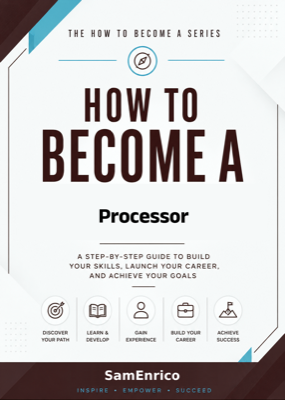
How to Become a Processor eBook
How to Become a Processor
by Keener Tatum
How to Become a Processor
Formats
Free sample
Chapter 1: The Logic Layer--–- On a Tuesday afternoon in a glass-walled office in Chicago, a senior loan underwriter named Sarah approved a $400,000 mortgage for a couple who had submitted incomplete tax returns. She approved it not because the numbers worked—they didn't, not quite—but because the husband had tears in his eyes when he described losing his previous home to medical debt. Sarah felt sorry for him. She overrode the system's warning flags manually. Fourteen months later, the loan defaulted.
The investor demanded a buyback. Sarah's firm lost $75,000. Sarah lost her job.On the same Tuesday, in a cubicle outside Atlanta, a data analyst named Marcus spent three hours building a spreadsheet to reconcile two customer databases. He was proud of his work. He had used nested IF statements, conditional formatting, and a beautiful color-coded output.
When he presented it to his manager, she pointed to the totals column. "These don't match the source system," she said. Marcus had copied the wrong field mapping from a document he trusted but had not verified. Three hours of work, discarded.Two hours later, in a hospital in Seattle, a pharmacist named Elena filled a prescription for a pediatric patient. The dosage was calculated as 2.5 milliliters.
Elena glanced at the prescription, thought "that looks right," and dispensed the medication. She did not run the standard double-check because she was in a hurry. The actual prescribed dosage was 0.25 milliliters. Elena had misplaced a decimal. The patient survived only because a nurse caught the error before administration.Three people.
Three careers. Three moments of failure that had nothing to do with laziness, incompetence, or lack of effort. Sarah worked sixty-hour weeks. Marcus prided himself on his Excel skills. Elena had been named Pharmacist of the Month three times.
They failed not because they didn't care, but because they processed information the way humans naturally process information: emotionally, intuitively, and with dangerous confidence in their own judgment.This book exists because there is another way.There is a way to work that does not rely on how you feel, how hard you try, or how many hours you grind. It is a way borrowed from the coldest, most reliable, most ruthlessly efficient systems ever built: computer processors. A processor does not approve a transaction because it "feels right." A processor does not skip a validation step because it is "in a hurry." A processor does not trust a source because it "seems trustworthy." A processor evaluates inputs against a fixed set of logical rules, produces outputs, and never apologizes for following the protocol.This chapter deconstructs the fundamental unit of all processing: the binary decision. You will learn the four-step cycle that powers every processor on Earth. You will learn why your intuition is a liability disguised as a gift.
And you will create your first processing tool: a Truth Table that replaces subjective judgment with verifiable logic.By the end of this book, you will have the tools to become a 10x Processor—someone who produces ten times the output of an untrained worker, not by working ten times harder, but by building better architecture. But before you can run a complex system, you must understand the logic layer. Everything else rests on it.The Four-Step Cycle That Runs the World Every computer processor—whether it is a $5 chip in a children's toy or a $10,000 server processor in a data center—operates on a simple, ancient, unchanging cycle. It is called the fetch-decode-execute-write-back cycle. Learn these four steps.
Memorize them. They are the skeleton of this entire book.Step One: Fetch. The processor retrieves an instruction from memory. This instruction might say "add these two numbers" or "move this piece of data to that location" or "jump to a different part of the program." The processor does not question the instruction. It does not wonder if the instruction is a good idea.
It simply fetches whatever is next in the queue.Step Two: Decode. The processor translates the instruction into signals that its various components can understand. This is the step where the processor figures out what the instruction actually means. What operation needs to happen? Which pieces of data are involved?
Where should the result go? Decoding is interpretation without evaluation. The processor does not yet act; it translates.Step Three: Execute. The processor performs the operation. It adds the numbers.
It moves the data. It jumps to the new address. This is the visible work, the step that outsiders call "doing something." But note: execution is impossible without fetch and decode. A processor that jumps straight to execution is a processor that crashes.Step Four: Write-Back. The processor stores the result.
It updates registers, writes to memory, or sends a signal to an output device. This is the closing of the loop. Without write-back, the work happened but no one knows about it. The result exists but cannot be used.Four steps. Fetch.
Decode. Execute. Write-Back.Every task you perform at work follows this same cycle, whether you know it or not. When you receive an email request (fetch), interpret what it actually asks for (decode), do the work (execute), and reply with confirmation (write-back), you have completed one processor cycle. When you open a loan file (fetch), review the documents against underwriting guidelines (decode), calculate the debt-to-income ratio (execute), and log the approval (write-back), you have completed another.The problem is that humans skip steps.
We combine decode and execute into a single frantic motion. We forget write-back entirely. We fetch things that are not instructions—distractions, noise, low-priority requests—and treat them as if they matter. We execute without decoding, producing output that matches no one's requirements. We write back to the wrong place or not at all.A processor never skips steps.
A processor that skipped decode would execute nonsense. A processor that skipped write-back would forget its own work. A processor is not faster than a human in raw speed; a processor is faster because it never wastes cycles on steps it should not take.Garbage In, Garbage Out: The Single Most Important Rule There is a phrase that appears in every introductory computer science textbook, every programming bootcamp, and every engineering orientation. It is the first law of processing: Garbage In, Garbage Out. GIGO.It means exactly what it says.
If you feed a processor bad inputs, it will produce bad outputs. The processor does not know the inputs are bad. The processor has no way to correct them. The processor will faithfully, accurately, efficiently transform garbage into more garbage, beautifully formatted and confidently presented.Here is what GIGO means for your work: your effort cannot fix bad inputs. Your skill cannot compensate for missing data.
Your speed cannot outrun an error that entered the pipeline at the intake stage. Once garbage enters your processing stream, you are guaranteed to produce garbage at the other end. The only question is how much time you will waste transforming garbage into a slightly different shape before you discover the truth.Sarah the underwriter violated GIGO. She knew the tax returns were incomplete—that was garbage input. But she proceeded anyway, hoping that her skill and intuition would somehow overcome the…
This is the end of the free sample. Get the eBook to keep going. Buy now
About this book
Details
- Author
- Keener Tatum
- Publisher
- SamEnrico
- Language
- English
- ISBN
- 9781505930702
- Genre
- Non-Fiction, Informative, Educational
- Released
- 2026-06-02
- Pages (approx.)
- 125
- Available as
- eBook, Paperback, Audiobook

Read better in the ZLOADR app
Your eBooks on your phone or tablet. Sign in with your SamEnrico account and start reading.
More by Keener Tatum
 Franchising Your Local Brand Across Borders Trade SecretsKeener Tatum$11.99
 Stimulant Recovery JournalKeener Tatum$11.99
 NVC For Veterans GuideKeener Tatum$11.99
 Fertility Window TimingKeener Tatum$11.99
 Long Term Care Insurance GuideKeener Tatum$11.99
 Overcoming Depression in Alcohol RecoveryKeener Tatum$11.99
 Vitamin D Testosterone LinkKeener Tatum$11.99
 Mistake Analysis MemoryKeener Tatum$11.99
 The Stargazers of Meroë: Kushite Astronomers and the Secrets of the CosmosKeener Tatum$11.99
 The Battle of Chaldiran: The Safavids Clash with the OttomansKeener Tatum$11.99
 Mastering The Art of Combat HopakKeener Tatum$11.99
 How to Produce Grinder AccessoriesKeener Tatum$11.99
You may also like
 Hong Kong Handover 1997Dunn Johnnie$11.99
 Zumba For Postnatal Recovery CourseNeal Christian$11.99
 Zumba for BeginnersLadner Nikia$11.99
 YouTube Comment Mining GuideHumes Pandora$12.99
 Worry Box MeditationCarlin Rudy$11.99
 Workplace Stress MeditationNguyen Lynn$11.99
 Workplace Stress and Sleep RepairHawley Ivory$11.99
 Workplace Perfectionism CureDelaney Jeffry$11.99
 Workplace Injustice Anger GuideWallen Isabelle$11.99
 Work Addiction and Burnout LinkGreenwood Ester$11.99
 Women in Yoga and WellnessBeattie Galina$11.99
 Women in Stand Up ComedyChun Evangeline$11.99