
Non-FictionInformativeEducational
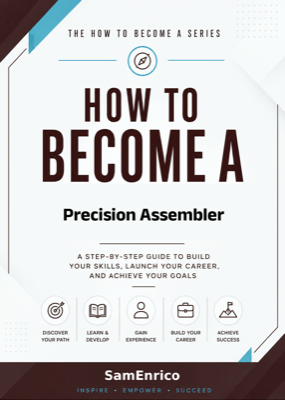
How to Become a Precision Assembler Paperback
How to Become a Precision Assembler
How to Become a Precision Assembler
Formats
Free sample
Chapter 1: The Gospel of Exactitude...--–- The first time I held a part that was out of tolerance by one tenth of a thousandth of an inch, I could not feel it. I could not see it. Under a magnifying glass, it looked identical to the perfect part sitting next to it. And yet, the senior assembler standing beside me shook his head, set it aside, and said, “That one will kill someone if it goes into an airplane.”That moment changed everything I thought I knew about manufacturing.Before that day, I believed that precision was about numbers on a blueprint—arbitrary thresholds set by engineers in clean offices, far from the grease and noise of the factory floor. I assumed that if a part was 99.9 percent correct, that was good enough.
After all, 99.9 percent is an A grade in any classroom. But in the world of precision assembly, 99.9 percent is a catastrophe. A 99.9 percent success rate in commercial aviation would mean two unsafe landings every day at Chicago O’Hare alone. In medical devices, it would mean four incorrect pacemaker implants every week. In aerospace, it would mean that one out of every thousand jet engine turbine blades would shatter at 30,000 feet, sending fragments through the fuselage.The difference between 99.9 percent and 99.9999 percent is not a matter of math.
It is a matter of philosophy, of ethics, of a worldview that separates the casual hobbyist from the professional precision assembler. This chapter is about that worldview. Before you learn to hold a torque wrench, before you step into a cleanroom, before you ever read your first geometric dimensioning and tolerancing blueprint, you must understand one thing: precision is not about being picky. Precision is about being responsible for human lives.Welcome to the gospel of exactitude.The Invention of "Good Enough"To understand why precision matters, we must first understand how we lost it.For most of human history, “precision” did not exist in any measurable sense. The ancient Egyptians built the pyramids with extraordinary care, but they did not measure in millimeters.
They used cubits—the length of a forearm from elbow to fingertip—which varied from one pharaoh to the next and from one worker to another. The Parthenon in Athens appears perfectly straight to the naked eye, but laser scanning reveals that its columns bulge slightly in the middle, an optical illusion intentionally carved to make the building appear more majestic. That was not imprecision; it was artistry. It was also non-interchangeable. Every stone in the Parthenon was cut to fit its specific location.
Swap two columns, and nothing would align.For thousands of years, that was how the world worked. Skilled craftsmen—blacksmiths, carpenters, stonemasons, shipwrights—built every object as a unique creation. A wagon wheel made in one village would not fit on a wagon made in another village. A musket barrel from London would not accept a trigger mechanism from Birmingham. This was not considered a problem because no one expected parts to be interchangeable.
The concept of a “spare part” did not exist. If something broke, you brought the entire object to the craftsman who had built it, or you hired someone to make a custom replacement from scratch.Then came the Industrial Revolution, and with it, a radical new idea: what if every part of a machine was made so precisely that any copy of that part would fit into any copy of that machine?The man who first solved this problem was not a famous inventor. His name was John “Iron-Mad” Wilkinson, and he was a British ironmaster who, in…
This is the end of the free sample. Get the Paperback to keep going. Buy now
About this book
Details
- Author
- Merritt Thalia
- Publisher
- SamEnrico
- Language
- English
- ISBN
- 9781505929010
- Genre
- Non-Fiction, Informative, Educational
- Released
- 2026-06-02
- Pages (approx.)
- 136
- Available as
- eBook, Paperback, Audiobook

Read better in the ZLOADR app
Your eBooks on your phone or tablet. Sign in with your SamEnrico account and start reading.
More by Merritt Thalia
 Solo Drinking RecoveryMerritt Thalia$11.99
 Steve Elkington Swing ArchitectMerritt Thalia$11.99
 Creative Problem Solving for Aerospace EngineersMerritt Thalia$11.99
 MDD and Inflammation LinkMerritt Thalia$11.99
 Geography Capital CardsMerritt Thalia$11.99
 Inattentional Blindness in Crime ScenesMerritt Thalia$11.99
 Dental Phobia GuideMerritt Thalia$11.99
 Aspirin for Heart PreventionMerritt Thalia$11.99
 The Poisoned Bottle: Australia's Prohibition-Era Undercover WarMerritt Thalia$11.99
 The Man Who Shaped British Music: Walter Legge and the Birth of EMI ClassicsMerritt Thalia$11.99
 Service Providers Guide to Plumbing Drain CleaningMerritt Thalia$11.99
 How to Produce Household Storage CaddiesMerritt Thalia$11.99
You may also like
 Hong Kong Handover 1997Dunn Johnnie$11.99
 Zumba For Postnatal Recovery CourseNeal Christian$11.99
 Zumba for BeginnersLadner Nikia$11.99
 YouTube Comment Mining GuideHumes Pandora$12.99
 Worry Box MeditationCarlin Rudy$11.99
 Workplace Stress MeditationNguyen Lynn$11.99
 Workplace Stress and Sleep RepairHawley Ivory$11.99
 Workplace Perfectionism CureDelaney Jeffry$11.99
 Workplace Injustice Anger GuideWallen Isabelle$11.99
 Work Addiction and Burnout LinkGreenwood Ester$11.99
 Women in Yoga and WellnessBeattie Galina$11.99
 Women in Stand Up ComedyChun Evangeline$11.99