
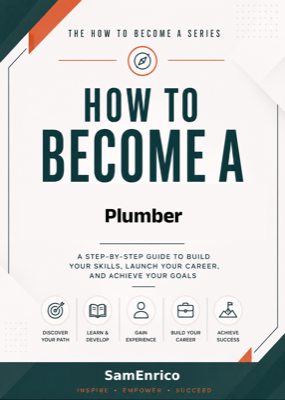
How to Become a Plumber eBook
How to Become a Plumber
by Lutz Brandee
How to Become a Plumber
Formats
Free sample
Chapter 1: Beyond the Wrench...--The moment you tell someone you want to become a plumber, watch their face. You will see it almost every time—a slight hesitation, a flicker of surprise, and then the inevitable follow-up question: "So what do you really want to do?"That question reveals everything wrong with how our society views the trades. It assumes plumbing is a fallback, a second choice, something you settle for when college doesn't work out or when life takes an unexpected turn. Nothing could be further from the truth. The average person has no idea that plumbers routinely earn six-figure salaries, run their own businesses, solve complex physics problems daily, and enjoy job security that would make a tenured professor envious.
They don't know that the demand for plumbers is so severe that by 2030, the United States will face a shortage of over 550,000 tradespeople, with plumbing at the top of the list. And they certainly don't know that plumbing apprentices earn money while learning, graduating with zero student debt while their college-bound peers emerge burdened by an average of $37,000 in loans.This book exists to correct those misconceptions and to give you a complete, no-nonsense roadmap from your first spark of interest to running your own successful plumbing business. Whether you are eighteen years old fresh out of high school, thirty-eight years old looking for a more stable and lucrative career change, or anywhere in between, the path ahead is clearer than you think. But before we dive into the tools, the codes, the apprenticeship applications, and the business strategies, we need to start with the most important question of all: Why plumbing? Why would you choose to spend your days crawling under houses, wading through crawlspaces, and solving problems that most people cannot even begin to understand?The answer might surprise you.The Myth of the "Dumb Plumber"Let us start by killing a stereotype that should have died decades ago.
The image of the plumber as a toothless, crude, unintelligent laborer who simply tightens pipes until they stop leaking is not only offensive—it is dangerously inaccurate. Modern plumbing is a sophisticated discipline that requires mastery of physics, chemistry, geometry, and the most complex legal code of any building trade.Consider what a plumber actually does on a typical day. You arrive at a house where the owner reports that the toilet bubbles when the sink drains. A "dumb plumber" would simply snake the drain and leave. But a real plumber—the kind who lasts in this trade—understands that bubbling toilet is a symptom of a deeper problem.
The vent stack is likely partially blocked, or the drain line has developed negative pressure because the pipe slope is insufficient. To diagnose this correctly, you need to visualize the entire DWV system in three dimensions: where every fixture connects, how far each vent runs, and whether any siphoning effect is pulling water out of the traps.Or consider water hammer. That loud banging noise when a washing machine valve slams shut is not just annoying—it is a pressure wave moving through the pipes at nearly the speed of sound, capable of bursting joints and damaging appliances. Fixing it requires understanding fluid dynamics, calculating PSI spikes, and knowing which type of arrestor to install based on pipe material and water velocity. You cannot Google your way through that diagnosis while standing in a customer's basement with water spraying everywhere.
The knowledge has to be in your head.The plumber is, in many ways, the last line of defense between the public and waterborne disease. Before modern plumbing, cholera and typhoid fever killed millions. Even today, improper plumbing can allow sewer gas to infiltrate homes, causing illness and even death. The plumbing code is not arbitrary bureaucracy—it is public health law, written in blood.So let us retire the stereotype once and for all. The dumb plumber does not exist.
The successful plumber is a problem-solver, a diagnostician, a businessperson, and a skilled craftsperson all rolled into one. If anyone asks you what you "really" want to do, tell them the truth: you want a career that challenges your mind, rewards your effort, and cannot be outsourced or automated.The Financial Reality Nobody Talks About Now let us talk about money, because money matters. You are making a career decision, and that decision has financial consequences that will affect every aspect of your life for decades. The good news is that plumbing offers one of the most reliable paths to the middle class—and beyond—that exists in the American economy today.Here is the baseline. A first-year apprentice typically earns between 18and18 and 18and25 per hour, depending on location, union status, and the specific employer.
That translates to roughly 37,000to37,000 to 37,000to52,000 per year before overtime. And there will be overtime. Construction projects run behind schedule. Emergency service calls happen at 2 AM on Christmas morning. If you are willing to work, the hours are there.Contrast that with the typical college graduate.
The average starting salary for a bachelor's degree holder is around 55,000peryear.Thatsoundshigherthantheapprenticewageuntilyoufactorinthefouryearsoflostearningswhilethecollegestudentwasstudyingandtheaverage55,000 per year. That sounds higher than the apprentice wage until you factor in the four years of lost earnings while the college student was studying and the average 55,000peryear.Thatsoundshigherthantheapprenticewageuntilyoufactorinthefouryearsoflostearningswhilethecollegestudentwasstudyingandtheaverage37,000 in student loan debt they carry. The apprentice, meanwhile, earned 150,000to150,000 to 150,000to200,000 during those same four years, accumulated zero debt, and emerged with four years of real-world experience.By the time you complete your apprenticeship and become a journeyman plumber, typically after four to five years, your hourly rate jumps significantly. Journeymen earn between 55,000and55,000 and 55,000and85,000 per year as a base salary, but few plumbers work only base hours. With overtime, weekend rates, and emergency call premiums, six-figure incomes are routine for journeymen in most metropolitan areas.The numbers get even more compelling at the master plumber level.
After two additional years as a journeyman and passing a rigorous exam, master plumbers can pull permits, design systems, and run their own businesses. Independent master plumbers who own a small company with one or two service trucks typically earn between 120,000and120,000 and 120,000and250,000 per year. Successful owners of larger plumbing companies earn significantly more.But raw numbers only tell part of the story. You also need to understand the difference between union and non-union compensation, because that choice affects not just your take-home pay but your healthcare, retirement, and working conditions.Union plumbers, represented by the United Association (UA) of Plumbers, Fitters, Welders, and Service Technicians, work under collective bargaining agreements that typically include higher base wages, fully paid healthcare, pensions, and guaranteed raises tied to experience. The trade-off is that union apprenticeships can have waiting lists, you have less control over which contractor you work for, and you pay union dues.
Non-union plumbers often have more flexibility to switch employers, may advance faster if they are exceptional, and keep what they earn without dues. However, they are responsible for their own healthcare and retirement savings, and wages can vary more widely.Neither path is inherently better. The right choice depends on your location, your career goals, and your personality. We will explore how to make that decision in Chapter 3.The…
This is the end of the free sample. Get the eBook to keep going. Buy now
About this book
Details
- Author
- Lutz Brandee
- Publisher
- SamEnrico
- Language
- English
- ISBN
- 9781505916072
- Genre
- Non-Fiction, Informative, Educational
- Released
- 2026-05-02
- Pages (approx.)
- 141
- Available as
- eBook, Paperback, Audiobook

Read better in the ZLOADR app
Your eBooks on your phone or tablet. Sign in with your SamEnrico account and start reading.
More by Lutz Brandee
 The Arthritis Joint Replacement GuideLutz Brandee$11.99
 The Portable Walking MeditationLutz Brandee$11.99
 Modern Blue Zone AdaptationLutz Brandee$11.99
 ABCDE for Morning RoutineLutz Brandee$11.99
 Eisenhower Matrix For Travel PlanningLutz Brandee$11.99
 The Silent Network: How a Forgotten Telecom Giant Shaped the Modern WorldLutz Brandee$11.99
 VAT for Amazon Sellers EULutz Brandee$12.99
 Rwanda Student Meal GuideLutz Brandee$12.99
 Merbau Ipil HarvestingLutz Brandee$11.99
 Understanding Rieger SyndromeLutz Brandee$17.99