
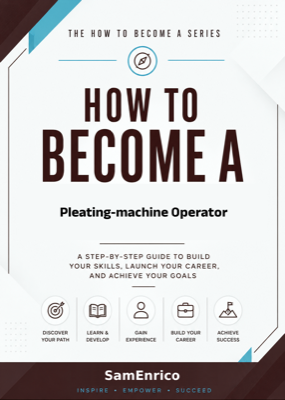
Non-FictionInformativeEducational
How to Become a Pleating-machine Operator Paperback
How to Become a Pleating-machine Operator
How to Become a Pleating-machine Operator
Formats
Free sample
Chapter 1: Beyond the Button...--–- The first thing you need to understand about becoming a pleating-machine operator is that the job has almost nothing to do with pushing buttons. If you walk onto the production floor believing that your role begins and ends with pressing a green "start" button and watching the machine work, you will fail. You will fail quickly, and you will fail expensively. The machines that create precision pleats in textiles, leather, and industrial media are not autonomous appliances like a household washing machine. They are complex electromechanical systems that require constant attention, subtle adjustment, and deep understanding.
The operator who succeeds is not the one with the fastest reflexes or the strongest back. It is the one who thinks like a diagnostician, acts like a craftsman, and respects the machine as a partner rather than a servant.This misconception—that operating industrial equipment is "unskilled labor"—has caused more scrap, more injuries, and more career frustration than any other single factor. It persists because outsiders see a finished product emerging from a machine and assume the machine did all the work. They do not see the hours of calibration, the careful reading of material specifications, the split-second decisions to adjust tension or temperature, or the disciplined documentation that separates a professional from a pretender. This book exists to correct that misunderstanding and to give you the complete roadmap from novice to master.Before we dive into the mechanical details of gears, plates, and control systems, we must first understand the landscape you are about to enter.
Pleating is not one industry but three distinct sectors, each with its own machines, materials, and career paths. The operator who thrives in decorative textile pleating may struggle in automotive leather plating, not because of any deficiency in skill but because the demands are fundamentally different. By understanding these sectors upfront, you can target your job search, tailor your training, and avoid the frustration of applying for roles that do not match your developing expertise.The Three Worlds of Pleating The first sector is textile curtain pleating, which serves the decorative home furnishings market. This is the oldest and most familiar form of pleating, producing the crisp, uniform folds found in draperies, valances, and Roman shades. Machines in this sector typically operate at moderate speeds, handling materials like cotton, linen, polyester blends, and silk.
The primary challenge here is aesthetic: pleats must be visually perfect, with no ghosting (faint secondary creases), no uneven spacing, and no distortion at the selvage edges. Tolerances are measured in millimeters, and a single flawed inch can ruin an entire curtain panel that retails for hundreds of dollars. Operators in this sector need a strong eye for visual detail and patience for slow, precise work.The second sector is leather plating, which supplies the automotive and luxury goods industries. Here, pleating serves a functional as well as decorative purpose: the folds in leather car seats and handbags create padding channels, improve fit, and reduce material waste. Leather behaves nothing like textile.
It shrinks under heat, stiffens under pressure, and carries natural variations in thickness that can throw off pleat depth within seconds. Machines in this sector run at slower speeds but require far greater pressure, often measured in tons rather than pounds per square inch. Operators must understand hide grading, grain direction, and the effects of different tanning processes. This sector pays higher wages than textile pleating but demands more mechanical troubleshooting and material science knowledge.The third sector is industrial embossing and filtration media, which serves the most technically demanding markets: HVAC filters, automotive…
This is the end of the free sample. Get the Paperback to keep going. Buy now
About this book
Details
- Author
- Arevalo Maryellen
- Publisher
- SamEnrico
- Language
- English
- ISBN
- 9781505915235
- Genre
- Non-Fiction, Informative, Educational
- Released
- 2026-06-02
- Pages (approx.)
- 142
- Available as
- eBook, Paperback, Audiobook

Read better in the ZLOADR app
Your eBooks on your phone or tablet. Sign in with your SamEnrico account and start reading.
More by Arevalo Maryellen
 Franchise Exit Interview ProtocolArevalo Maryellen$11.99
 The Walking Meditation DeckArevalo Maryellen$11.99
 Eisenhower Matrix for SalesArevalo Maryellen$11.99
 ABCDE For Job SearchArevalo Maryellen$11.99
 Medical AdministratorArevalo Maryellen$11.99
 Rwanda Student Internet GuideArevalo Maryellen$12.99
 VAT Returns Filing GuideArevalo Maryellen$12.99
 Understanding Richieri–Costa–montagnoli SyndromeArevalo Maryellen$17.99
You may also like
 Hong Kong Handover 1997Dunn Johnnie$11.99
 Zumba For Postnatal Recovery CourseNeal Christian$11.99
 Zumba for BeginnersLadner Nikia$11.99
 YouTube Comment Mining GuideHumes Pandora$12.99
 Worry Box MeditationCarlin Rudy$11.99
 Workplace Stress MeditationNguyen Lynn$11.99
 Workplace Stress and Sleep RepairHawley Ivory$11.99
 Workplace Perfectionism CureDelaney Jeffry$11.99
 Workplace Injustice Anger GuideWallen Isabelle$11.99
 Work Addiction and Burnout LinkGreenwood Ester$11.99
 Women in Yoga and WellnessBeattie Galina$11.99
 Women in Stand Up ComedyChun Evangeline$11.99