
Non-FictionInformativeEducational
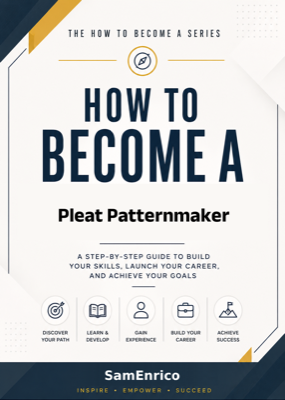
How to Become a Pleat Patternmaker Paperback
How to Become a Pleat Patternmaker
How to Become a Pleat Patternmaker
Formats
Free sample
Chapter 1: The Grain Lie--–- Most patternmakers learn to respect the grain line. Pleat patternmakers learn to fear it.This is not hyperbole. In standard garment construction, the grain line is a guideline—a reliable friend that ensures your garment hangs straight, your seams don't twist, and your hem falls evenly. Misalign the grain by five degrees on a basic bodice, and the average wearer will never notice. Misalign the grain by five degrees on a knife-pleated skirt, and the hem will spiral around the body like a barber pole.
The pleats themselves will pull diagonally, opening on one side and compressing on the other. What should have been a precise, architectural garment becomes a distorted mess that no amount of pressing can fix.This chapter dismantles the single most dangerous assumption carried over from conventional patternmaking: that grain lines matter only for drape and hang. In pleating, the grain line determines whether your folds will stand crisp for a decade or collapse after three washes. It dictates whether a heat-set pleat will remain permanent or slowly relax back to flat fabric. It decides whether your spiral pleat will create a graceful twist or an unwearable tangle.Before you cut your first pleat, you must understand the geometry of fullness—not as an abstract mathematical concept, but as a physical reality that will save you hundreds of dollars in wasted fabric and dozens of hours in frustrated sewing.
This chapter teaches you to read grain lines the way a structural engineer reads blueprints: as the invisible skeleton that supports every fold.The Three Grains and Their Personalities Fabric has three fundamental grain directions, and each behaves so differently under pleating that they might as well be three different materials.True Straight Grain (Warp): These are the yarns that run parallel to the selvage, the factory-finished edges of the fabric. In woven fabric, the warp yarns are under tension during weaving, making them the most stable and least stretchable. When you fold a pleat on the true straight grain, the crease will be sharp, the fold will hold its angle, and the edge of the pleat will remain clean. This is why tailored garments, military uniforms, and any pleat that must stay crisp for years are cut on the straight grain. The cost?
Straight grain pleats have no give. If you try to wrap a straight-grain pleat around a curved body part—say, the hip of a fitted skirt—the pleat will resist, creating horizontal pull lines or causing the pleat to gape open.True Cross-Grain (Weft): These yarns run perpendicular to the selvage, from raw edge to raw edge. Because they are inserted during weaving rather than held under tension, cross-grain yarns have modest stretch—typically 5-10% depending on the weave. Pleats cut on the cross-grain will be softer, with a more fluid drape. They will conform to body curves more readily than straight-grain pleats.
However, this softness comes at a price. Cross-grain pleats are less permanent; they will relax over time and may require re-pressing. They are also more susceptible to "grinning"—the phenomenon where the interior of the fold becomes visible from the outside because the fabric is not stiff enough to hide it.True Bias: The bias is the 45-degree angle between straight and cross grains. Here, the fabric has maximum stretch—often 25-50% depending on the fiber and weave. Bias-cut garments are famous for their liquid drape and body-hugging fit.
In pleating, bias grain enables spiral pleats, twisted folds, and any design that requires the fabric to change direction while compressed. But bias is treacherous. A…
This is the end of the free sample. Get the Paperback to keep going. Buy now
About this book
Details
- Author
- Breedlove Denyse
- Publisher
- SamEnrico
- Language
- English
- ISBN
- 9781505915051
- Genre
- Non-Fiction, Informative, Educational
- Released
- 2026-05-04
- Pages (approx.)
- 153
- Available as
- eBook, Paperback, Audiobook

Read better in the ZLOADR app
Your eBooks on your phone or tablet. Sign in with your SamEnrico account and start reading.
More by Breedlove Denyse
 Values And Mission Alignment Customer Experience HandbookBreedlove Denyse$11.99
 The SAD Cognitive Behavioral GuideBreedlove Denyse$11.99
 Mediterranean Brain HealthBreedlove Denyse$11.99
 Email Overload FixBreedlove Denyse$11.99
 TM for Mathematicians GuideBreedlove Denyse$11.99
 The Algorithm Whisperer: How a Forgotten Genius Cracked the Code of Human BehaviorBreedlove Denyse$11.99
 Exit Driven Business PlanBreedlove Denyse$12.99
 Remote SWOT Analysis GuideBreedlove Denyse$12.99
 Understanding Tricho Onychic DysplasiaBreedlove Denyse$17.99
 Asset Management ConsultantBreedlove Denyse$11.99
You may also like
 Hong Kong Handover 1997Dunn Johnnie$11.99
 Zumba For Postnatal Recovery CourseNeal Christian$11.99
 Zumba for BeginnersLadner Nikia$11.99
 YouTube Comment Mining GuideHumes Pandora$12.99
 Worry Box MeditationCarlin Rudy$11.99
 Workplace Stress MeditationNguyen Lynn$11.99
 Workplace Stress and Sleep RepairHawley Ivory$11.99
 Workplace Perfectionism CureDelaney Jeffry$11.99
 Workplace Injustice Anger GuideWallen Isabelle$11.99
 Work Addiction and Burnout LinkGreenwood Ester$11.99
 Women in Yoga and WellnessBeattie Galina$11.99
 Women in Stand Up ComedyChun Evangeline$11.99