
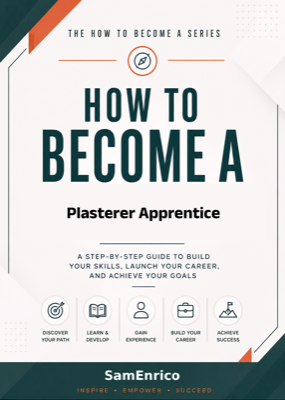
Non-FictionInformativeEducational
How to Become a Plasterer Apprentice eBook
How to Become a Plasterer Apprentice
How to Become a Plasterer Apprentice
Formats
Free sample
Chapter 1: The Diploma Trap...--I was twenty-three years old, sitting in a cubicle that smelled like microwaved fish and stale coffee, when I realized I had been scammed. Not by a Nigerian prince or a fake lottery ticket—by everyone I had ever trusted. My high school guidance counselor, my parents, every television commercial that showed happy college students throwing frisbees on perfect green lawns. They had sold me a story. The story went like this: go to college, borrow whatever money you need, graduate, get a good job, and live happily ever after.
I borrowed eighty-seven thousand dollars for a degree in marketing. Four years later, I was formatting spreadsheets for a company that sold industrial lubricants. My job title was “Marketing Coordinator.” My actual job was changing the font size on PDFs and sitting in meetings that could have been emails. I made thirty-eight thousand dollars a year. My student loan payment was four hundred and twenty dollars a month.
After rent, I had two hundred dollars left for food, gas, and everything else. I was broke, miserable, and too embarrassed to tell anyone.One night, I called my dad. I expected sympathy. Instead, he asked me a question that changed everything. “Have you ever thought about plastering?”I laughed.
Plastering? I had a college degree. I was a professional. I didn’t know anything about plaster except that it was white and went on walls. My dad, who had been a carpenter for forty years, did not laugh back.
He said, “You’re twenty-three. You have no money, no skills anyone will pay for, and you hate your job. What exactly do you have to lose?” I thought about it. He was right. I had nothing to lose except my pride.
So I said yes.That was seven years ago. Today, I own a plastering company with eight employees. I work forty hours a week, sometimes less. I make more money than any of my college friends who became accountants or junior associates. I have no debt.
I sleep through the night. And I have never once regretted leaving that cubicle.This book is not a traditional how‑to guide. It is not going to show you, in gentle numbered steps, how to hold a trowel and mix a bag of plaster. Other books will do that—some of them are quite good. What this book will do is something more important.
It will show you why plastering might be the best decision you ever make, and then it will show you exactly how to get started, even if you have zero experience, zero connections, and zero confidence.Here is the truth that nobody told me at seventeen: college is a lottery ticket, and most tickets lose. The Federal Reserve Bank of New York publishes data on this every year. The most recent numbers show that forty‑one percent of recent college graduates are underemployed—meaning they work jobs that do not require their degree. That’s nearly half. Half of the people who spent four years and tens of thousands of dollars end up doing work they could have learned in six months.
Meanwhile, the average age of a skilled plasterer in the United States is fifty-four years old. Within the next decade, nearly half of all plasterers will retire. There are not enough young people entering the trade to replace them. That means if you learn to plaster today, you are not competing against a thousand other applicants. You are walking into an industry that is desperate for young, reliable bodies.Let me put numbers on it.
A first‑year apprentice plasterer in a union shop typically starts at forty to sixty percent of a journeyman’s wage. In most major cities, that is eighteen to twenty‑two dollars an hour. You earn that while you learn. You are not paying tuition. You are getting paid.
By your third year, you will be making closer to seventy percent, which is twenty‑five to thirty dollars an hour. By the time you become a journeyman—usually four years—you will earn between thirty‑five and forty‑five dollars an hour, depending on your location and specialty. Plus benefits. Plus overtime. Plus the ability to take side jobs on weekends for cash.Now do the math on the college path.
A four‑year degree costs, on average, one hundred and forty thousand dollars including room, board, and lost wages if you factor in what you could have earned working full‑time instead. The average starting salary for a new graduate is fifty‑five thousand dollars, but remember that forty‑one percent are underemployed and make much less. By age twenty‑five, the typical college graduate has a negative net worth. The typical plasterer who started at eighteen or nineteen has a positive net worth, owns tools that appreciate in value, and has four years of raises under their belt. The gap widens from there.I am not saying college is worthless for everyone.
If you want to be a doctor, a lawyer, or an engineer, go to college. But if you went to college because you did not know what else to do—if you borrowed money for a degree in something vague like communications, sociology, or general studies—you might be in the wrong place. And even if you did not go to college, you might be working retail, food service, or gig economy jobs that pay nothing and lead nowhere. This book is for you.The Lie of the “Safe Path”When I was eighteen, everyone told me that college was the safe path. Get the degree, get the job, get the retirement plan.
Nobody mentioned that the safe path was crowded. Millions of young people were doing the same thing, competing for the same entry‑level jobs, driving down wages and driving up requirements. My first job out of college required a degree. It also required two years of experience. It paid thirty‑eight thousand dollars.
That is not a safe path. That is a trap.Plastering, by contrast, seemed risky. My friends thought I was crazy. “You’re going to throw away your degree to smear mud on walls?” Yes. That is exactly what I did.
And here is what I learned: a skill that people need cannot be outsourced, automated, or replaced by artificial intelligence. You cannot hire someone in the Philippines to plaster your living room wall. You cannot ask Chat GPT to patch the hole in your ceiling. A robot cannot run a crown molding profile along a curved staircase. Physical trades that require touch, judgment, and on‑site problem‑solving are among the most secure jobs in the modern economy.The pandemic proved this.
When offices closed and white‑collar workers stared at Zoom screens from their kitchen tables, construction continued. Plasterers kept working. My phone kept ringing. People needed their basements finished, their walls repaired, their home offices plastered. The work did not stop because the economy stuttered.
In fact, it accelerated, because people trapped in their houses suddenly noticed all the cracks and imperfections they had been ignoring for years.The Physical Truth: What Plastering Actually Demands Let…
This is the end of the free sample. Get the eBook to keep going. Buy now
About this book
Details
- Author
- Fernandes Cheryll
- Publisher
- SamEnrico
- Language
- English
- ISBN
- 9781505912869
- Genre
- Non-Fiction, Informative, Educational
- Released
- 2026-05-11
- Pages (approx.)
- 146
- Available as
- eBook, Paperback, Audiobook

Read better in the ZLOADR app
Your eBooks on your phone or tablet. Sign in with your SamEnrico account and start reading.
More by Fernandes Cheryll
 Growth Mindset For Chronic PainFernandes Cheryll$11.99
 Bedtime Affirmation Practice GuideFernandes Cheryll$11.99
 Italian Business NegotiationFernandes Cheryll$11.99
 Incarceration Reentry GuideFernandes Cheryll$11.99
 The Self Forgiveness WorkbookFernandes Cheryll$11.99
 Kappa's Last Laugh: The River Imp's RevengeFernandes Cheryll$11.99
 Forklift Sit DownFernandes Cheryll$11.99
 Digital Certification VerificationFernandes Cheryll$12.99
 Pre Seed Crowdfunding GuideFernandes Cheryll$12.99
 Understanding Urban–Rogers–Meyer SyndromeFernandes Cheryll$17.99
You may also like
 Hong Kong Handover 1997Dunn Johnnie$11.99
 Zumba For Postnatal Recovery CourseNeal Christian$11.99
 Zumba for BeginnersLadner Nikia$11.99
 YouTube Comment Mining GuideHumes Pandora$12.99
 Worry Box MeditationCarlin Rudy$11.99
 Workplace Stress MeditationNguyen Lynn$11.99
 Workplace Stress and Sleep RepairHawley Ivory$11.99
 Workplace Perfectionism CureDelaney Jeffry$11.99
 Workplace Injustice Anger GuideWallen Isabelle$11.99
 Work Addiction and Burnout LinkGreenwood Ester$11.99
 Women in Yoga and WellnessBeattie Galina$11.99
 Women in Stand Up ComedyChun Evangeline$11.99