
Non-FictionInformativeEducational
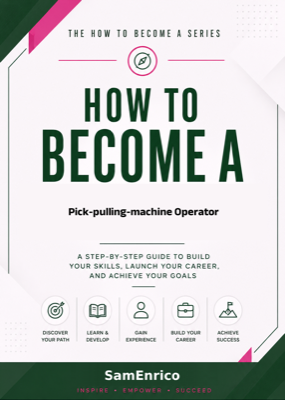
How to Become a Pick-pulling-machine Operator eBook
How to Become a Pick-pulling-machine Operator
How to Become a Pick-pulling-machine Operator
Formats
Free sample
Chapter 1: The Last Respectable Blue-Collar Hack...--Every morning, twenty-two-year-old Marcus Vasquez walked past a row of cubicles where college graduates sat shuffling spreadsheets for forty thousand dollars a year. He walked past them, through a reinforced steel door, into a warehouse the size of four football fields. By seven-fifteen, he was thirty feet in the air on an order picker, pulling fifty-pound cases of protein powder for Amazon Prime orders. At twenty-two, with no degree and no debt, Marcus made sixty-eight thousand dollars last year.This book is not about luck. It is about a specific piece of industrial machinery, a specific set of skills, and a specific job title that almost nobody understands but every single person reading this depends on daily.
The title is "pick-pulling-machine operator." The reality is something closer to "the human who makes modern life possible."If you have ever received a package in under forty-eight hours, a pick-puller touched that box. If your grocery store has milk on the shelf every single morning, a pick-puller staged that pallet. If your new phone arrived intact, a pick-puller decided where to place it on a pallet so it would not crush or be crushed. The job sounds mundane. The impact is anything but.This chapter has one job: to convince you that picking is not a dead-end job for people who could not do anything else.
It is, in fact, the last respectable blue-collar hack—a role that pays better than most entry-level white-collar work, requires no degree, and offers a clearer path to six figures than almost any other trade you can learn in six months. But you have to understand why it matters first.The Two Lies You Have Been Told About Warehouse Work Before we talk about machines or metrics or money, we need to clear out the cultural garbage. Most people believe two things about warehouse work that are simply false.Lie number one: Warehouse jobs are for people who could not make it anywhere else. This lie comes from a 1980s manufacturing mind-set that never died. The reality is that modern warehouse work, specifically order picking, requires a cognitive load that rivals air traffic control.
You are navigating a three-dimensional space with moving obstacles (other machines, pedestrians, loose pallets, fallen boxes). You are making real-time routing decisions while processing audio or visual instructions. You are performing spatial reasoning—fitting irregular objects into a growing pallet like Tetris on hard mode. And you are doing all of this while maintaining safety protocols that would make a commercial pilot nod in respect.Lie number two: It is unskilled labor. This lie is perpetuated by people who have never driven a turret truck in a narrow aisle at twenty feet of height with a load extending four feet to their left.
Operating a pick-pulling machine is a certified skill, governed by federal regulations (OSHA 29 CFR 1910.178 in the United States), requiring separate written and practical exams. You cannot just show up and do this job. You have to learn it, practice it, and prove you can do it without killing yourself or someone else. That is the definition of skilled labor.Warehouses Do Not Store Things – They Move Things Here is the single most important shift in mind-set you will make in this entire book.Most people think a warehouse is a place where companies store stuff. They imagine rows of pallets gathering dust, waiting for someone to eventually retrieve them.
This is backwards. A warehouse is not a storage facility. It is a throughput machine.Every warehouse has two functions, but only one of them matters for your paycheck. The first function is storage: keeping inventory in a known location until it is needed. This is passive.
The building does this whether you are there or not. The second function is throughput: moving goods from receiving to storage to picking to packing to shipping. This is active. This is where you come in. And within throughput, pick-pulling is the bottleneck.
Nothing moves to the customer until you pick it.To understand why pickers are more valuable now than ever before, you need to understand the difference between two types of supply chains: traditional retail and e-commerce.In traditional retail, goods move in large quantities. A pallet holds two hundred boxes of the same cereal. A forklift driver moves that entire pallet from storage to a store's back room. The picker, in this model, is less important because the unit of movement is the pallet, not the individual box.In e-commerce, everything changes. An online order might contain a pair of shoes, a phone charger, a bag of coffee, and a children's book.
That is four different products from four different storage locations. No pallet contains all four. Someone has to walk (or drive) to each location, retrieve each individual unit, and consolidate them. That someone is you.This is why the pick-puller has become more valuable than the forklift driver in modern fulfillment centers. The forklift driver moves pallets.
The pick-puller moves orders. And in e-commerce, every single transaction is an order, not a pallet. The shift from pallet-based to unit-based logistics has made the pick-puller the most critical human in the building.But let me be absolutely clear about something. "More valuable" does not mean "superior." A warehouse cannot function without forklift drivers moving bulk inventory from receiving to storage. You and the forklift driver are interdependent.
You need them to replenish your pick slots. They need you to clear their staging areas. The best facilities cross-train operators on both roles. The point is not to build ego. The point is to understand leverage.
When you understand that you sit at the bottleneck of the entire operation, you understand why skilled pickers get paid what they get paid.The Economics of One Wrong Pick Let us talk about mistakes, because mistakes have different consequences depending on what you are picking.If you pick the wrong item for a customer, here is what happens. The customer receives the wrong product. They initiate a return. The company pays for return shipping. The returned item arrives at the warehouse, where someone inspects it for damage.
If the packaging is compromised (even slightly), the item goes to liquidation. If the item was perishable (food, cosmetics, certain chemicals), it is destroyed entirely. The correct item must then be picked again and shipped. The customer, now annoyed, is less likely to buy from that company again. Over time, this erosion of trust reduces Customer Lifetime Value, which is the total amount of money that customer would have spent with the company over their entire relationship.That cascade costs real money.
For a low-value item like a box of pencils, the total cost of one error might be three to five dollars. For a high-value item like a laptop, the cost can exceed two hundred dollars. For hazardous materials, the cost can include regulatory fines and lawsuits.However—and this is important—the industry does not expect perfection. Perfect accuracy is mathematically and economically impossible at scale. The accepted standard in most warehouses is 99.9 percent accuracy.
That means one error per one thousand picks. If you pick ten thousand units a week (which top performers do)…
This is the end of the free sample. Get the eBook to keep going. Buy now
About this book
Details
- Author
- Brunner Frances
- Publisher
- SamEnrico
- Language
- English
- ISBN
- 9781505780208
- Genre
- Non-Fiction, Informative, Educational
- Released
- 2026-05-11
- Pages (approx.)
- 147
- Available as
- eBook, Paperback, Audiobook

Read better in the ZLOADR app
Your eBooks on your phone or tablet. Sign in with your SamEnrico account and start reading.
More by Brunner Frances
 Conversation Starters for Retirement PartiesBrunner Frances$11.99
 The Nap Yoga IntegrationBrunner Frances$11.99
 Memory Palace TechniqueBrunner Frances$11.99
 Zumba for MenBrunner Frances$11.99
 Bipolar PTSD Comorbidity GuideBrunner Frances$11.99
 Morning Pain MeditationBrunner Frances$11.99
 Atypical Antipsychotics GuideBrunner Frances$11.99
 Other People's PregnanciesBrunner Frances$11.99
 Assertiveness For Public SpeakersBrunner Frances$11.99
 The Maestro of the Pitch: How a 19th-Century Argentine Manager Revolutionized Football TacticsBrunner Frances$11.99
 The Mind War: Athens vs. Sparta – The Psychological Battle That Shaped the Ancient WorldBrunner Frances$11.99
 The Last King of the Golden Triangle: Khun Sa's Empire of OpiumBrunner Frances$11.99
You may also like
 Hong Kong Handover 1997Dunn Johnnie$11.99
 Zumba For Postnatal Recovery CourseNeal Christian$11.99
 Zumba for BeginnersLadner Nikia$11.99
 YouTube Comment Mining GuideHumes Pandora$12.99
 Worry Box MeditationCarlin Rudy$11.99
 Workplace Stress MeditationNguyen Lynn$11.99
 Workplace Stress and Sleep RepairHawley Ivory$11.99
 Workplace Perfectionism CureDelaney Jeffry$11.99
 Workplace Injustice Anger GuideWallen Isabelle$11.99
 Work Addiction and Burnout LinkGreenwood Ester$11.99
 Women in Yoga and WellnessBeattie Galina$11.99
 Women in Stand Up ComedyChun Evangeline$11.99