
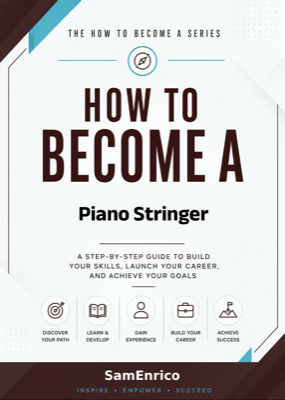
How to Become a Piano Stringer Paperback
How to Become a Piano Stringer
How to Become a Piano Stringer
Formats
Free sample
Chapter 1: The Singing Wound--– In my first week as an apprentice, I watched a master stringer snap a bass string at full tension. The sound was not a pop or a ping but a deep, metallic groan—like a ship’s hull giving way—followed by a whip crack as the severed end lashed across the cast iron plate. The wire left a gray scuff on the rim, missing my mentor’s left cheek by two inches. He did not flinch. He simply set down his crank, walked to his toolbox, and pulled out a fresh #21 bass string.
“That one,” he said, “was trying to tell me something. I wasn’t listening.”That moment taught me my first and most important lesson about piano stringing: the instrument is always speaking. Most people hear a piano as a finished thing—a polished piece of furniture that produces pleasant sounds when you press its keys. But a piano is not a thing. It is a war.
It is 20,000 pounds of tension held in suspension by 230 thin steel wires, each one pulled to the very edge of its breaking point. Every second of every day, that tension wants to escape. The cast iron plate, the wooden soundboard, the 440 pounds of compression from the pinblock—all of it is an elaborate, beautiful, and temporary truce between human intention and raw physical force.The stringer is the diplomat in that war. And the first step to becoming one is to understand exactly what you are about to touch.The Physics of 20 Tons Let us be precise about that number, because precision is the religion of this craft. A typical concert grand piano—say, a Steinway D-274—contains approximately 230 strings.
The average tension per string in the treble is about 160 pounds. In the tenor, it rises to 180. In the bass, where the strings are thickly wound with copper, individual tensions can exceed 200 pounds per string. Multiply across the instrument, and the total tension lands between 35,000 and 45,000 pounds. That is 18 to 22 tons.To feel what that means, imagine parking a fully loaded garbage truck on top of a baby grand piano.
That is the force the plate must contain hour after hour, year after year, through humidity swings and temperature extremes and the violence of a fortissimo chord. The fact that pianos do not instantly explode is a miracle of industrial engineering—and a testament to the stringer’s art.But tension alone is not the whole story. A wire under tension wants to return to its resting length. That is simple elasticity. But a piano string is not merely stretched; it is struck.
When a felt hammer hits a string at 10 miles per hour (faster for fortissimo, slower for piano), the string does not just vibrate up and down. It moves in a complex three-dimensional pattern: side to side, forward and back, and in a twisting motion called longitudinal vibration. The string’s own stiffness fights against these motions. The bearing points—the V-bar at the treble end, the agraffes, the bridge pins—constrain the string’s movement while also transmitting its energy to the soundboard.All of this happens in milliseconds. And all of it can be ruined by a single poorly seated loop or a coil that overlaps by one millimeter.The Restorer vs.
The Stringer One of the first questions a newcomer asks is: “Isn’t stringing just part of piano restoration?” The answer is no, and the distinction is crucial to your identity as a craftsman.A piano restorer works on wood and action. The restorer replaces soundboards, repairs cracked bridges, rebuilds keyframes, repins…
This is the end of the free sample. Get the Paperback to keep going. Buy now
About this book
Details
- Author
- Rawlings Jacinta
- Publisher
- SamEnrico
- Language
- English
- ISBN
- 9781505779806
- Genre
- Non-Fiction, Informative, Educational
- Released
- 2026-05-02
- Pages (approx.)
- 125
- Available as
- eBook, Paperback, Audiobook

Read better in the ZLOADR app
Your eBooks on your phone or tablet. Sign in with your SamEnrico account and start reading.
More by Rawlings Jacinta
 Child Loss And InfertilityRawlings Jacinta$11.99
 Conversation Starters for English LearnersRawlings Jacinta$11.99
 CrossFit Gymnastics SkillsRawlings Jacinta$11.99
 Napping for Postpartum RecoveryRawlings Jacinta$11.99
 Bipolar Psychosis GuideRawlings Jacinta$11.99
 Bipolar Creativity GuideRawlings Jacinta$11.99
 Apple Calendar RemindersRawlings Jacinta$11.99
 Past Paper StrategyRawlings Jacinta$11.99
 Self Regulation EQ Techniques GuideRawlings Jacinta$11.99
 The Last Telegram: How a Single Wire Changed the Fate of WWIIRawlings Jacinta$11.99
 The Last Waltz: How a Forgotten Dance Saved a GenerationRawlings Jacinta$11.99
 Breaking the Canvas: The Visionary Works of Ralph Hotere and His Indigenous LegacyRawlings Jacinta$11.99