
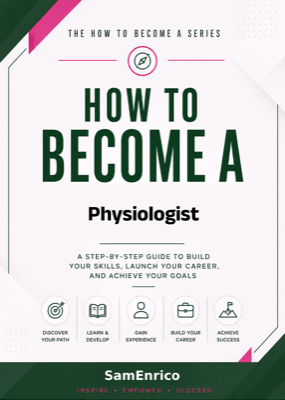
Non-FictionInformativeEducational
How to Become a Physiologist Paperback
How to Become a Physiologist
by Chapa German
How to Become a Physiologist
Formats
Free sample
Chapter 1: The Three Doors--–- Imagine a hospital corridor at 3:00 AM. The lights are dimmed. A patient in Room 4B has just developed shortness of breath, and the nurse pages the on-call clinical physiologist. Within minutes, a professional arrives, places twelve electrodes on the patient’s chest, and records an electrocardiogram that reveals a new arrhythmia. That same night, five miles away, an exercise physiologist reviews data from a cardiac rehabilitation patient’s wearable device, adjusting a walking program for someone recovering from a heart attack.
Meanwhile, in a university lab lit by the blue glow of computer monitors, a research physiologist analyzes calcium ion channel data from isolated heart cells, hoping to understand why some patients develop fatal arrhythmias after otherwise minor heart attacks.Three people. Three job titles that all include the word “physiologist.” Three completely different careers.If you are reading this book, you have likely encountered this confusion already. A high school guidance counselor may have mentioned “physiology” as a potential major. A family friend might have said, “Oh, so you want to work in a gym?” Or perhaps you have scrolled through university websites, finding programs labeled “Clinical Physiology,” “Exercise Physiology,” and “Applied Physiology,” with no clear explanation of how they differ or which one leads to a stable, well-paying job.This confusion is not your fault. The field of physiology has fragmented over the past thirty years into three distinct career paths, each with its own educational requirements, certification exams, work settings, and salary expectations.
Most career guides treat these paths as interchangeable. They are not. Choosing the wrong branch can mean spending four years earning a degree that does not qualify you for the job you actually want.This chapter is the antidote to that confusion. By the time you finish reading these pages, you will understand exactly what a clinical physiologist does versus an exercise physiologist versus a research physiologist. You will know the typical work settings, daily tasks, salary ranges, and educational timelines for each.
More importantly, you will complete a self-assessment that will point you toward the door that best fits your personality, financial needs, and tolerance for advanced education.Let us begin by opening each door, one at a time.Door One: The Clinical Physiologist – Diagnostic Detective in the Hospital The clinical physiologist is the closest thing to a physician without the medical degree. These professionals work primarily in hospitals, often within the National Health Service (NHS) in the United Kingdom or large healthcare systems in the United States and Australia. Their job is to perform diagnostic tests that measure how the body’s systems are functioning, then provide those results to physicians who make treatment decisions.What does a clinical physiologist actually do with their hands? The work is highly procedural. A typical clinical physiologist in a cardiology department will perform hundreds of electrocardiograms (ECGs) each month, placing electrodes on patients’ chests to record the electrical activity of their hearts.
They will fit patients with ambulatory monitors—Holter monitors or event recorders—that track heart rhythms for 24 to 48 hours while patients go about their daily lives. They will conduct exercise stress tests, walking patients on treadmills while monitoring their ECG, blood pressure, and symptoms, looking for evidence of coronary artery disease.In a respiratory department, the clinical physiologist performs spirometry, asking patients to blow into a tube as hard and fast as possible to measure lung function. They may conduct gas transfer tests, assess bronchodilator reversibility, or set up patients for overnight pulse oximetry to screen for sleep apnea. In a sleep laboratory, they attach dozens of sensors to…
This is the end of the free sample. Get the Paperback to keep going. Buy now
About this book
Details
- Author
- Chapa German
- Publisher
- SamEnrico
- Language
- English
- ISBN
- 9781505779714
- Genre
- Non-Fiction, Informative, Educational
- Released
- 2026-05-06
- Pages (approx.)
- 154
- Available as
- eBook, Paperback, Audiobook

Read better in the ZLOADR app
Your eBooks on your phone or tablet. Sign in with your SamEnrico account and start reading.
More by Chapa German
 Public Executions RetributionChapa German$11.99
 Chechen Organized Crime NetworksChapa German$11.99
 Brainstorming for InnovationChapa German$11.99
 Anger And Caffeine ReductionChapa German$11.99
 Overcoming Procrastination for LawyersChapa German$11.99
 Winston Churchill ImperialistChapa German$11.99
 Dream Character Dialogue GuideChapa German$11.99
 The Shadow Archetype in DreamsChapa German$11.99
 The $100 Million Dollar Flop: How 'John Carter' Crashed Disney's EmpireChapa German$11.99
 Iron and Majesty: The Warriors of the NokChapa German$11.99
 The Photographer's Guide to Lo-fi PhotographyChapa German$11.99
 How to Produce Power SuppliesChapa German$11.99
You may also like
 Hong Kong Handover 1997Dunn Johnnie$11.99
 Zumba For Postnatal Recovery CourseNeal Christian$11.99
 Zumba for BeginnersLadner Nikia$11.99
 YouTube Comment Mining GuideHumes Pandora$12.99
 Worry Box MeditationCarlin Rudy$11.99
 Workplace Stress MeditationNguyen Lynn$11.99
 Workplace Stress and Sleep RepairHawley Ivory$11.99
 Workplace Perfectionism CureDelaney Jeffry$11.99
 Workplace Injustice Anger GuideWallen Isabelle$11.99
 Work Addiction and Burnout LinkGreenwood Ester$11.99
 Women in Yoga and WellnessBeattie Galina$11.99
 Women in Stand Up ComedyChun Evangeline$11.99