
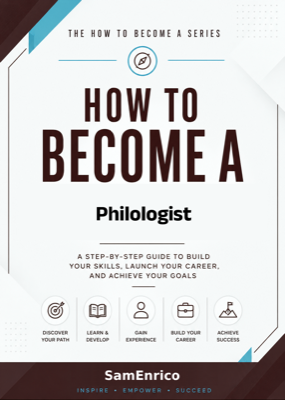
How to Become a Philologist
How to Become a Philologist
by Beers Maxima
How to Become a Philologist
Formats
About this book
Free sample
Chapter 1: The Great Burning--– The smoke had not yet cleared from the ruins of the Serapeum of Alexandria when the first scholar realized what had been lost. It was the year 391 AD, and the great daughter library of the Musaeum—what remained of the legendary collection after Julius Caesar’s accidental fire four centuries earlier—was being systematically dismantled by Christian mobs under the authority of Pope Theophilus. Parchment that had taken generations to copy was being fed to bakeries. Papyrus scrolls containing lost dialogues of Aristotle, complete works of Sappho, and astronomical tables from Babylon were being torn apart for binding scrap. And in a single afternoon, more knowledge vanished than most of us will encounter in a lifetime.This chapter is not about Alexandria.
That story has been told too many times, usually wrong, always sentimental. This chapter is about what came after—and what is happening right now, in your lifetime, in ways you cannot see. Because here is the uncomfortable truth that every aspiring philologist must confront before they learn a single grammatical rule or transcribe a single line of paleography: we are losing texts faster than we are finding them, and you are being trained to join a rescue mission that began two thousand years ago and will not end in your lifetime.The Great Burning is not a single event. It is a permanent condition of human civilization.The Mathematics of Oblivion Let us begin with numbers, because numbers do not lie and they do not sentimentalize.Of all the literature produced in ancient Greece and Rome, less than one percent survives. Let that sink in.
Ninety-nine percent of everything written by Greek and Latin authors—epics, tragedies, comedies, histories, philosophical treatises, medical handbooks, erotic poetry, technical manuals, private letters, and everything in between—has been reduced to ash, pulp, recycled parchment, or simply decay into illegibility.Consider the known losses:Sophocles wrote 123 plays. Seven survive intact. That is 5.6 percent.Aeschylus wrote approximately 90 plays. Seven survive. That is 7.7 percent.Euripides wrote 92 plays.
Nineteen survive (some with gaps). That is 20.6 percent—the highest survival rate among the major tragedians, and still four-fifths lost.Sappho…
This is the end of the free sample. Get the eBook to keep going. Buy now
Contents
- Chapter 1
- Chapter 2
- Chapter 3
- Chapter 4
- Chapter 5
- Chapter 6
- Chapter 7
- Chapter 8
- Chapter 9
- Chapter 10
- Chapter 11
- Chapter 12
Details
- Author
- Beers Maxima
- Publisher
- SamEnrico
- Language
- English
- ISBN
- 9781505777925
- Genre
- Non-Fiction, Informative, Educational
- Released
- 2026-05-02
- Pages (approx.)
- 147
- Available as
- eBook, Paperback, Audiobook

Read better in the ZLOADR app
Your eBooks on your phone or tablet. Sign in with your SamEnrico account and start reading.
More by Beers Maxima
 Tolerance Design CreativityBeers Maxima$11.99
 Temporomandibular ReleaseBeers Maxima$11.99
 The Vascular ED GuideBeers Maxima$11.99
 Full Time WholesalingBeers Maxima$11.99
 Listening to UnderstandBeers Maxima$11.99
 Restructuring Anger for CaregiversBeers Maxima$11.99
 Weekend Batch Work MethodBeers Maxima$11.99
 Gaming for First RespondersBeers Maxima$11.99
 Kamikaze Winds: The Mongol Storm That Failed (1274 & 1281)Beers Maxima$11.99
 The Siege of Ludlow Castle: A Yorkist Gambit in the Wars of the RosesBeers Maxima$11.99
 A Collector's Handbook to the Alfa Romeo Giulia SpiderBeers Maxima$11.99
 The Essential Guide to North AmericaBeers Maxima$11.99