
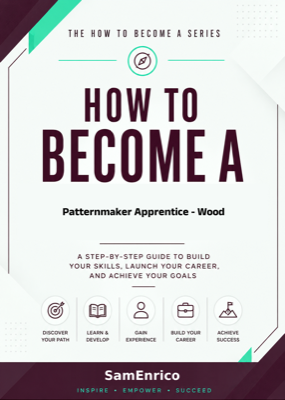
Non-FictionInformativeEducational
How to Become a Patternmaker Apprentice - Wood eBook
How to Become a Patternmaker Apprentice - Wood
by Viera Dawna
How to Become a Patternmaker Apprentice - Wood
Formats
Free sample
Chapter 1: The Invisible Blueprint--– In a quiet corner of an industrial district, behind a door that has no sign and a window filmed with decades of fine sawdust, a journeyman patternmaker runs his palm across a block of sugar pine. The wood is cool, smooth, and perfectly flat. He holds a steel ruler against it, then a brass scale marked with strange, oversized increments. He nods. Tomorrow, this block will become a wooden replica of a pump housing.
Next week, that wooden replica will be pressed into damp foundry sand. The week after, molten iron will be poured into the void left behind, and a metal part will emerge that fits an engine built in 1978—an engine for which no replacement part has been manufactured in twenty years. The patternmaker does not work in a glamorous trade. He does not appear on social media feeds or in lifestyle magazines. But without him, factories stop.
Ships remain docked. Power plants idle. His work is invisible, silent, and utterly indispensable.This book is not about furniture. It is not about cutting boards, dovetailed drawers, or live-edge slabs. Those are honorable crafts, but they are not patternmaking.
Patternmaking is the bridge between a drawing on paper and a metal object that can be lifted, bolted, welded, and machined. It is the art and science of creating the master templates—called patterns—that are used to produce sand molds for metal casting. Every time you turn the key in an ignition, every time a pump moves water through a municipal system, every time a train rolls on a track, you are touching the legacy of a patternmaker who built the tooling that made those metal parts possible.If you are reading this book, you likely fall into one of three categories. First, you may be a woodworker who has discovered that your skills are worth significantly more in an industrial context than they are in a custom furniture shop. Second, you may be a metalworker or machinist who has realized that you cannot cast parts until someone builds the patterns, and that someone could be you.
Third, you may be a complete beginner who heard a rumor that patternmaking is a dying trade—and you are smart enough to know that dying trades often pay the highest wages because the supply of skilled workers cannot meet demand.The rumor is wrong, by the way. Patternmaking is not dying. It is evolving. And evolution creates opportunity.The Apprentice’s First Question: What Exactly Is a Pattern?Let us start with absolute clarity. A pattern is a replica of the object you intend to cast in metal.
It is almost always made slightly larger than the desired finished part because metal shrinks as it cools. It is also tapered slightly—draft, in the trade—so that it can be withdrawn from sand without tearing the mold. It is sealed, painted, and often reinforced with brass plates at the points where foundry workers will strike it with a rapping bar to loosen it. A pattern is not beautiful in the way a Queen Anne highboy is beautiful. But a well-made pattern is beautiful in the way a surgical instrument is beautiful: every surface, every angle, every finish exists for a reason, and there is no ornament that does not serve function.Patterns can be made from many materials: aluminum, iron, plastic, and even 3D-printed resins.
But wood remains the gold standard for a specific and powerful reason. Wood is forgiving. Wood can be shaped, adjusted, and repaired with hand tools long after a machine has done its rough work. Wood absorbs vibrations during the rapping process that would crack a rigid plastic pattern. Wood is lightweight enough that a single person can handle a pattern for an engine block that would weigh hundreds of pounds if cast in aluminum.
And wood has a warmth and workability that no digital fabrication method has yet replicated. The most technologically advanced foundry in the world still employs a wood patternmaker for prototypes, short runs, and complex geometries that cannot be economically justified for 3D sand printing.Your job as a patternmaking apprentice is to learn how to take an engineering drawing of a finished metal part and produce a wooden pattern that accounts for shrinkage, draft, machining allowances, core prints, and a dozen other variables that most engineers have never considered. You are not building the final product. You are building the tool that builds the tool that builds the final product. You are three steps removed from the end user, which means you are invisible to them.
But you are also irreplaceable.Why Apprenticeship Still Matters In most trades, apprenticeship has been diluted or abandoned. You can watch a You Tube video, buy a course, and call yourself a welder or a carpenter within months. Patternmaking has resisted this trend for one simple reason: you cannot learn patternmaking from a screen. The feedback loop is too long. When you cut a dovetail joint incorrectly, you know immediately because the joint is loose or gap-toothed.
When you mis-calculate a shrinkage allowance, you do not discover your error until a foundry pours two hundred pounds of molten iron into your pattern, produces a casting that is 1.3 percent too small, and scrapes the entire run. That discovery can take days or weeks. By then, you have forgotten what you did wrong, and the foundry has lost thousands of dollars.Apprenticeship solves this problem by putting you beside a journeyman who can catch your mistakes before they become catastrophes. The journeyman watches you lay out a pattern, notices that you have forgotten to add draft to an internal corner, and corrects you before you cut wood. The journeyman sees you reaching for a standard steel ruler instead of a shrink rule and stops your hand.
The journeyman teaches you not through lectures but through the accumulated weight of small corrections delivered over months and years.This book cannot replace a journeyman. No book can. What this book can do is prepare you to be an apprentice worth training. It can give you the foundational knowledge that will allow you to ask intelligent questions instead of basic ones. It can teach you the vocabulary, the math, and the shop practices that will make you useful on day one.
And it can help you identify which apprenticeship path—formal, union, or on-the-job—best fits your circumstances and goals.The Three Pathways to the Pattern Shop Before you can become an apprentice, you need to understand how apprenticeships actually work in the patternmaking trade. They are not all the same, and choosing the wrong pathway can add years to your journey or steer you into a dead end.Pathway One: Formal Apprenticeship Programs A handful of institutions in the United States still operate formal, multi-year apprenticeship programs for patternmaking. The most famous is The Apprentice School at Newport News Shipbuilding in Virginia. This program is extraordinary. It is also extraordinarily competitive.
You apply, you take entrance exams, you interview, and if accepted, you spend four years rotating through every aspect of shipbuilding, including patternmaking. You earn a wage while you learn. You graduate with no debt…
This is the end of the free sample. Get the eBook to keep going. Buy now
About this book
Details
- Author
- Viera Dawna
- Publisher
- SamEnrico
- Language
- English
- ISBN
- 9781505778090
- Genre
- Non-Fiction, Informative, Educational
- Released
- 2026-05-04
- Pages (approx.)
- 133
- Available as
- eBook, Paperback, Audiobook

Read better in the ZLOADR app
Your eBooks on your phone or tablet. Sign in with your SamEnrico account and start reading.
More by Viera Dawna
 Alcohol Withdrawal Delirium TremensViera Dawna$11.99
 Morning Visualization Success GuideViera Dawna$11.99
 Daily Review for ArchitectsViera Dawna$11.99
 Self Talk For Learning New SkillsViera Dawna$11.99
 Caregiver Financial StressViera Dawna$11.99
 Procrastination Emotional RootsViera Dawna$11.99
 Meditation for Gallbladder PainViera Dawna$11.99
 Wings of the Celestial RiverViera Dawna$11.99
 The Battle of the Delta: Ramses III vs. the Sea Peoples (1175 BC)Viera Dawna$11.99
 How to Produce Semi-gloss Exterior CoatingViera Dawna$11.99
 The Essential Guide to American Trad RockViera Dawna$11.99
 How to Produce Reflective ProductsViera Dawna$11.99
You may also like
 Hong Kong Handover 1997Dunn Johnnie$11.99
 Zumba For Postnatal Recovery CourseNeal Christian$11.99
 Zumba for BeginnersLadner Nikia$11.99
 YouTube Comment Mining GuideHumes Pandora$12.99
 Worry Box MeditationCarlin Rudy$11.99
 Workplace Stress MeditationNguyen Lynn$11.99
 Workplace Stress and Sleep RepairHawley Ivory$11.99
 Workplace Perfectionism CureDelaney Jeffry$11.99
 Workplace Injustice Anger GuideWallen Isabelle$11.99
 Work Addiction and Burnout LinkGreenwood Ester$11.99
 Women in Yoga and WellnessBeattie Galina$11.99
 Women in Stand Up ComedyChun Evangeline$11.99