
Non-FictionInformativeEducational
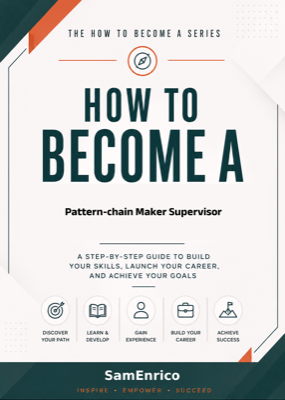
How to Become a Pattern-chain Maker Supervisor eBook
How to Become a Pattern-chain Maker Supervisor
by Libby Cheree
How to Become a Pattern-chain Maker Supervisor
Formats
Free sample
Chapter 1: The Librarian of the Loom--–- Most people walk past a Jacquard loom without understanding what they are seeing. They hear the clatter of metal on metal, they see the punched cards ascending and descending in their continuous loop, and they assume some machine somewhere is doing the thinking. They are wrong. The machine does nothing without the pattern chain. The pattern chain does nothing without the person who cut, laced, and verified every single card.
That person is you—or rather, that person is the worker you currently are, and the supervisor you are about to become. This chapter exists to convince you that the Pattern-Chain Maker is not a mere factory hand. You are the Librarian of the Loom, the custodian of the machine's memory, the human intelligence that tells the Jacquard head which threads to lift and which to leave at rest. Without you, the most sophisticated loom in the world produces only plain cloth. With you, it produces flowers and birds and geometric miracles that transform raw silk into art.
But before you can supervise others, you need to understand the world you are stepping into—the history, the hierarchy, the career path, and the economics of the trade. This chapter gives you that foundation. The chapters that follow will build the supervisor on top of it.The title of this chapter is not chosen lightly. The "Librarian of the Loom" is not a metaphor that appears once and disappears. It is the organizing principle of this entire book.
Throughout the following chapters, you will return to this image: the pattern chain as a book, each card as a page, the lacing as the binding, the sequence as the narrative. The weaver reads the narrative one pick at a time. The loom has no memory of its own. You are the memory. Without you, the loom is illiterate.
This is not poetry. This is the technical reality of Jacquard weaving, and understanding it is the first step toward supervising the people who make it possible.The Crisis That Created Your Job The year is 1804. Joseph Marie Jacquard, a silk weaver from Lyon, France, is standing in front of a panel of judges at the Conservatoire des Arts et Métiers. He is about to demonstrate a machine that will change the course of textile manufacturing and, incidentally, lay the groundwork for modern computing. His device is simple in concept but revolutionary in execution: a series of punched cards that pass over a reading mechanism, lifting specific warp threads in specific sequences to create patterns that would be impossible to produce by hand.
The judges are skeptical. The weavers of Lyon, who fear that the machine will put them out of work, have already broken two of Jacquard's prototypes. But the machine works. The punched cards are read. The pattern emerges.
And the age of automated pattern weaving begins.What the weavers of Lyon did not understand—what many factory workers still do not understand today—is that the Jacquard loom did not eliminate the need for skilled workers. It transformed that need. The weaver who once created patterns by manually selecting threads became the Pattern-Chain Maker who creates patterns by punching cards. The skill shifted from the hand to the head. The physical labor decreased.
The mental labor increased. And a new role was born: the person who curates the machine's memory.That role has evolved over two centuries, but its essence remains unchanged. The Pattern-Chain Maker sits between the designer and the loom. The designer dreams in color and texture, imagining flowers that span meters of fabric. The loom understands only binary decisions: lift or not lift, hole or no hole.
The Pattern-Chain Maker translates the dream into the binary, card by card, hole by hole, pick by pick. This is not transcription. This is translation. And translation requires judgment, experience, and a deep understanding of both the artistic vision and the mechanical reality.The Hierarchy of the Textile Mill Before you can supervise, you need to know where you stand. The modern textile mill is not a flat organization.
It is a hierarchy of interdependent roles, each with its own responsibilities, its own pressures, and its own view of the production floor. The Pattern-Chain Maker occupies a unique position in this hierarchy—technically skilled enough to work independently, but junior enough to still be supervised by someone who has walked the same path.At the top of the hierarchy, at least from the pattern room's perspective, sits the Designer. The designer creates the artwork that the Pattern-Chain Maker will translate. In a well-run mill, the designer understands the constraints of Jacquard weaving: the minimum pick size, the maximum repeat length, the limitations of the loom's harness. In a poorly run mill, the designer hands the Pattern-Chain Maker an impossible drawing and says "make it work." Your job as a supervisor will be to manage this relationship, pushing back when necessary and translating when possible.Below the designer sits the Maintenance Team.
The Jacquard loom is a complex machine with hundreds of moving parts. The pattern chain is useless if the reading mechanism is misaligned, if the harness cords are stretched, or if the shedding motion is out of timing. The maintenance team keeps the machine honest. A good supervisor builds a relationship with maintenance, learning to distinguish between pattern errors (your problem) and machine errors (their problem). A bad supervisor blames the loom for every defect, creating friction that slows production.On the production floor, the Weavers are your primary customers.
They are the ones who thread the warp, load the pattern chain, and monitor the fabric as it emerges. When a floating thread appears in the cloth, the weaver is the first to see it. When the pattern repeats incorrectly, the weaver is the first to stop the loom. Your success as a supervisor depends on how quickly and accurately you respond to the weaver's reports. A weaver who trusts you will call with a minor issue before it becomes a major defect.
A weaver who distrusts you will let the loom run, collect the defective fabric, and file a complaint that ends up on the production manager's desk.And then there is the Pattern-Chain Maker—the role you currently hold or aspire to leave. The Pattern-Chain Maker cuts blanks, punches holes, laces cards, verifies sequences, and maintains the inventory of active and archived patterns. It is detailed work, repetitive work, work that requires patience and precision and the ability to stare at a grid of holes for hours without losing focus. It is also work that most people cannot do. The error rate for new trainees is painfully high.
The burnout rate for experienced workers is surprisingly low. Those who survive the first year tend to stay for decades, building a mental library of patterns that no computer can match.The Career Path: From Apprentice to Supervisor The journey from apprentice to supervisor is not measured in years alone. It is measured in competencies. The apprentice learns to cut blanks without wasting paper. The journeyman learns to punch holes without misreading the pattern grid.
The senior Pattern-Chain Maker learns to verify chains by eye, catching errors before they reach the loom. The supervisor learns…
This is the end of the free sample. Get the eBook to keep going. Buy now
About this book
Details
- Author
- Libby Cheree
- Publisher
- SamEnrico
- Language
- English
- ISBN
- 9781505777956
- Genre
- Non-Fiction, Informative, Educational
- Released
- 2026-05-04
- Pages (approx.)
- 94
- Available as
- eBook, Paperback, Audiobook

Read better in the ZLOADR app
Your eBooks on your phone or tablet. Sign in with your SamEnrico account and start reading.
More by Libby Cheree
 The Elouise Cobell StoryLibby Cheree$11.99
 Sober Career Change GuideLibby Cheree$11.99
 Morning MIT Task RoutineLibby Cheree$11.99
 Future Self VisualizationLibby Cheree$11.99
 Short Chain Fatty AcidsLibby Cheree$11.99
 Cognitive Restructuring Anger GuideLibby Cheree$11.99
 Self Talk For Health ChallengesLibby Cheree$11.99
 Fortnite Gaming Addiction HelpLibby Cheree$11.99
 The Forgotten Code of the Dead Sea Scrolls: A Lost Language RevealedLibby Cheree$11.99
 The Hollow Throne: When Kings Were Cast Out by the PeopleLibby Cheree$11.99
 The Essential Guide to RockabillyLibby Cheree$11.99
 How to Produce ReinsLibby Cheree$11.99
You may also like
 Hong Kong Handover 1997Dunn Johnnie$11.99
 Zumba For Postnatal Recovery CourseNeal Christian$11.99
 Zumba for BeginnersLadner Nikia$11.99
 YouTube Comment Mining GuideHumes Pandora$12.99
 Worry Box MeditationCarlin Rudy$11.99
 Workplace Stress MeditationNguyen Lynn$11.99
 Workplace Stress and Sleep RepairHawley Ivory$11.99
 Workplace Perfectionism CureDelaney Jeffry$11.99
 Workplace Injustice Anger GuideWallen Isabelle$11.99
 Work Addiction and Burnout LinkGreenwood Ester$11.99
 Women in Yoga and WellnessBeattie Galina$11.99
 Women in Stand Up ComedyChun Evangeline$11.99