
Non-FictionInformativeEducational
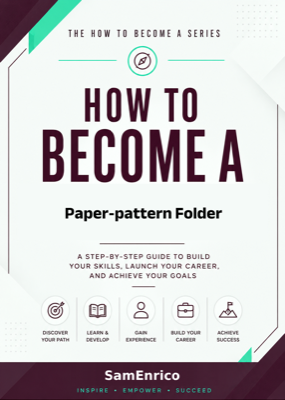
How to Become a Paper-pattern Folder eBook
How to Become a Paper-pattern Folder
by Dotson Ardis
How to Become a Paper-pattern Folder
Formats
Free sample
Chapter 1: The Napkin That Changed Everything...--–- It started with a crumpled napkin at a wedding reception. Not because I was nervous, though I was. Not because I was bored, though the toast was running long. I folded that napkin because my hands needed something to do while my brain raced through the uncomfortable truth that I had just been laid off from my architecture job, and I had no idea what came next. I folded it into a fan, then a hat, then something that looked vaguely like a bird with a broken wing.
A child at the next table watched me, wide-eyed, and asked if I was a magician. I laughed and said no. But later that night, alone in my apartment, I wondered: what if folding could be more than a party trick? What if it could be a profession?That question led me down a path I never expected. Over the next five years, I would go from folding napkins at weddings to licensing crease patterns to IKEA, consulting for Nike on collapsible packaging, and teaching folding techniques at design schools across three continents.
This book is not about origami, though origami is beautiful. This book is not about crafting, though crafting is valuable. This book is about paper-pattern folding as a serious design discipline – a hidden language used by architects, fashion designers, product developers, and even NASA engineers to solve problems that seem impossible until you realize the answer is hidden in a single sheet, waiting to be released by the right sequence of creases.If you are holding this book, you already sense that folding offers something special. Maybe you are an artist who wants to move beyond two dimensions. Maybe you are a designer who suspects that folding could make your packaging, furniture, or architecture more elegant and efficient.
Maybe you are simply someone who loves paper and wants to transform it into something extraordinary. Whatever brought you here, this chapter will do three things. First, it will redefine what paper-pattern folding actually is – and what it is not. Second, it will show you why folding matters, not just as a hobby but as a professional skill with real-world applications and real-world income. Third, it will give you your first fold in the next ten minutes, because I want you to experience success before you finish reading this chapter.Let us begin.What Paper-Pattern Folding Is Not Before we define what paper-pattern folding is, we need to clear away some misconceptions.
The biggest one is that folding is the same as origami. Origami is a specific tradition – Japanese in origin, typically starting with a square of paper, often (though not always) resulting in representational forms like cranes, frogs, and flowers. Origami is magnificent. I have spent hundreds of hours folding origami, and I recommend that anyone interested in paper should learn the basics. But origami is to paper-pattern folding what calligraphy is to typography: related, overlapping, but fundamentally different in purpose and application.Paper-pattern folding, as taught in this book, is not primarily about representation.
We are not trying to make a paper elephant that looks like an elephant. We are trying to understand how creases transform flat sheets into functional three-dimensional structures. We care about structural integrity, material efficiency, scalability, and repeatability. When an automotive engineer folds a prototype airbag, they are not making origami. When a packaging designer creates a collapsible box that ships flat and assembles in seconds, they are using paper-pattern folding.
When an architect designs a facade that unfolds like a fan to provide shade, they are folding patterns, not cranes.Another misconception is that folding is easy, or that it is just for children. This misconception persists because many people’s only exposure to folding is elementary school crafts. But professional folding requires precision, geometric reasoning, patience, and creativity at the highest levels. The folds in this book will challenge you. You will make mistakes.
You will throw away sheets of paper that look like crumpled failures. That is not a sign that you lack talent. That is a sign that you are learning a real skill, with real depth.The final misconception is that folding is limited to paper. This is the most practical misunderstanding, because the techniques you learn in this book transfer directly to metal, plastic, fabric, cardboard, and even living tissue. Yes, living tissue – medical researchers now use folding techniques to create stents that unfold inside arteries and surgical robots that fold into tiny capsules.
Paper is just your first material. It is forgiving, cheap, and responsive. Paper teaches you the logic of folding so that when you move to aluminum or acrylic, you are solving design problems, not learning basic mechanics.The Secret History of Folding Folding is ancient. The oldest surviving folded paper map dates to sixth-century China, but folding almost certainly predates paper itself. Think about leather, textile, and metal – all were folded before paper existed.
Roman soldiers folded their tents. Medieval bookbinders folded vellum. Sailors folded sails. Every human civilization has used folding to solve the fundamental problem of how to make flat things three-dimensional and how to make large things portable.But the modern era of paper-pattern folding as a design discipline began in the twentieth century, with three key developments. The first was the work of Josef Albers at the Bauhaus in the 1920s.
Albers, an artist and educator, gave his students simple exercises in paper folding to teach them about material properties, light and shadow, and structural logic. One of his most famous exercises was the “paper folding problem”: take a single sheet, make a series of cuts and folds, and create a three-dimensional form that stands on its own. Albers was not training origami artists. He was training designers who would go on to shape the modern world.The second development was the mathematical formalization of folding in the 1960s and 1970s. Researchers at Bell Labs, Mitsubishi, and other industrial laboratories began studying folding as a geometric problem: given a flat sheet, what three-dimensional shapes can be created by folding along straight lines?
This research led to the Miura-ori fold, a tessellation pattern that allows a large surface to be compressed into a small package and deployed with a single pulling motion. The Miura-ori is now used in everything from solar panels on spacecraft to collapsible emergency shelters.The third development was the emergence of the folding consultant. Paul Jackson, whose work heavily influences this book, was one of the first. Starting in the 1980s, Jackson taught folding on over 150 university design courses and worked as a consultant for Nike, Siemens, and other global companies. He showed that folding is not just a technique – it is a way of thinking.
When a team of engineers is stuck on a packaging problem, a folding consultant can walk in, fold a piece of paper for fifteen minutes, and hand them a solution that costs pennies to produce. That is the power of this discipline.Why Folding Matters Right Now You might be thinking: this is interesting history, but why should I learn folding today? There are three urgent reasons.First, sustainability. The world is drowning in packaging waste.…
This is the end of the free sample. Get the eBook to keep going. Buy now
About this book
Details
- Author
- Dotson Ardis
- Publisher
- SamEnrico
- Language
- English
- ISBN
- 9781505768183
- Genre
- Non-Fiction, Informative, Educational
- Released
- 2026-05-11
- Pages (approx.)
- 152
- Available as
- eBook, Paperback, Audiobook

Read better in the ZLOADR app
Your eBooks on your phone or tablet. Sign in with your SamEnrico account and start reading.
More by Dotson Ardis
 Binge Eating and Perfectionism GuideDotson Ardis$11.99
 The Default Effect GuideDotson Ardis$11.99
 Emotional Self Efficacy GuideDotson Ardis$11.99
 Workplace Stress and CommunicationDotson Ardis$11.99
 The Clown of Shanghai: The Deadly Double Life of a Spy KillerDotson Ardis$11.99
 Zinc-melanterite MiningDotson Ardis$11.99
 Advertising and Tracking TermsDotson Ardis$12.99
 How to Produce Arracachas (Vegetable)Dotson Ardis$11.99
You may also like
 Hong Kong Handover 1997Dunn Johnnie$11.99
 Zumba For Postnatal Recovery CourseNeal Christian$11.99
 Zumba for BeginnersLadner Nikia$11.99
 YouTube Comment Mining GuideHumes Pandora$12.99
 Worry Box MeditationCarlin Rudy$11.99
 Workplace Stress MeditationNguyen Lynn$11.99
 Workplace Stress and Sleep RepairHawley Ivory$11.99
 Workplace Perfectionism CureDelaney Jeffry$11.99
 Workplace Injustice Anger GuideWallen Isabelle$11.99
 Work Addiction and Burnout LinkGreenwood Ester$11.99
 Women in Yoga and WellnessBeattie Galina$11.99
 Women in Stand Up ComedyChun Evangeline$11.99