
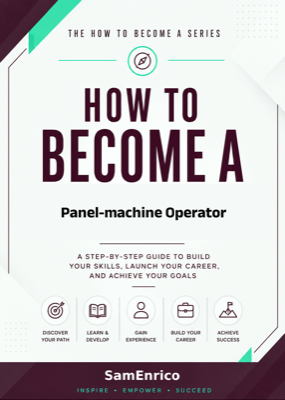
Non-FictionInformativeEducational
How to Become a Panel-machine Operator eBook
How to Become a Panel-machine Operator
by Ellison Sari
How to Become a Panel-machine Operator
Formats
Free sample
Chapter 1: The Eighty-Thousand-Dollar Secret...--The first thing you need to know about becoming a panel-machine operator is that almost everyone outside the industry—and even some people inside it—has no idea what you actually do. They imagine a dim factory floor, a greasy button, a man in a stained polo shirt pressing that button eight hours a day, daydreaming about anything else. They call you a button pusher. They assume you took this job because you could not do anything else. They think you top out at twenty dollars an hour if you are lucky.They are wrong about everything.Here is the truth that no career counselor will tell you and that your high school guidance department probably does not even know.
A skilled panel-machine operator in a mid-sized American city earns between fifty and sixty-five thousand dollars per year. A senior operator who can set up and run all four major machine types—panel saw, edge bander, CNC router, and through-feed drill—pulls down seventy to eighty-five thousand dollars annually. Field service technicians who started as operators and learned to fix what they used to run earn six figures. That is $100,000 per year. No four-year degree required.
No six-figure student debt. No MBA necessary. No night classes for a master's degree that qualifies you for a job that pays less than this one.Let me say that again so it sinks all the way in. You can earn more money running a CNC router than your college graduate friend who studied marketing now owes in student loans. You can earn the same as a registered nurse without spending four years and eighty thousand dollars on tuition.
You can earn more than many elementary school teachers, social workers, journalists, and even some lawyers who graduated at the bottom of their class. And you can get there in two years or less, sometimes in six months if you learn fast, work hard, and use this book as your roadmap.I am not selling you a dream. I am giving you a map. This is not a theoretical textbook written by an academic who has never touched a panel saw. It is not a manufacturer's manual written in broken English by an engineer who assumes you already know what a spindle is and what to do when the VFD throws error code 42.
This is a practical, no-bullshit, step-by-step guide written for exactly one person: someone who wants to walk into a cabinet shop, a furniture factory, an architectural millwork plant, or a prefabricated home manufacturing facility and get hired as a panel-machine operator on the spot. Then grow that job into a career that pays enough to buy a house, support a family, save for retirement, and maybe even take a real vacation once a year.Before we touch a single machine, before we learn G-code or glue temperatures or chip load calculations, we need to understand what we are actually getting into. This chapter is the lay of the land. It answers three questions that every new operator asks but rarely gets answered honestly by anyone who actually knows the answers.First, what exactly are these machines and what do they make? Second, what does an operator actually do all day—not the job description version, but the real version?
Third, how much money can you really make and how do you move up from the bottom to the top?Let us start with the material itself. You cannot understand the machines until you understand what they cut, why they cut it that way, and why your high school shop teacher's advice about solid wood does not apply here.The Hidden World of Engineered Panels Walk into any kitchen, any office, any hotel lobby, any airport terminal, any hospital waiting room, any school classroom. Look at the cabinets, the desks, the reception counters, the wall panels, the shelving, the display cases. What are they made of? If you said wood, you are only half right.
If you said plastic, you are also only half right. Most of what you just looked at is made from engineered wood products—panels manufactured from wood fibers, veneers, resins, and paper that have been compressed, heated, and laminated into sheets that are stronger, more stable, and more consistent than solid wood ever could be on its own.The four main panel types you will encounter are MDF, particleboard, plywood, and OSB. Each one behaves differently under a cutting tool, and each one will humble you if you treat it like the others. I have seen experienced operators ruin fifty sheets in an hour because they assumed the material on the pallet was the same as the material they ran yesterday. Do not make that mistake.Medium-Density Fiberboard, or MDF, is the most common panel in cabinet manufacturing across North America and Europe.
It is made from wood fibers broken down to their smallest components, mixed with wax and resin binders, then compressed under high heat and enormous pressure into dense, uniform sheets. The beauty of MDF is its consistency. There is no grain, no knots, no voids, no surprises hidden inside the sheet. It machines like butter. You can cut it, drill it, route it, shape it, and edge band it with predictable results every single time.
The nightmare of MDF is its dust. When you cut MDF, it produces an ultra-fine powder that gets everywhere—into your lungs, into your machine bearings, into the pores of your skin, into the electrical cabinets where it causes shorts, into the air handling system where it clogs filters within days. That dust has been linked to nasal cancers after chronic exposure, which is why we will spend an entire chapter on respiratory protection. Do not skip that chapter. Do not tell yourself you will wear a mask tomorrow.
Wear it today.Particleboard is MDF's cheaper, crumbly cousin. It is made from larger wood particles—sawdust, shavings, broken pallets, even recycled wood waste from demolition—mixed with resin and pressed into sheets under less pressure than MDF. Particleboard is less expensive than MDF but also less dense, less strong, and more prone to chipping at the edges. You will find particleboard in mass-produced furniture, inexpensive cabinets, big box store shelving units, and as the core material for melamine panels where the surface finish matters more than the internal structure. The challenge with particleboard is that it does not hold screws well—the threads tear out the loose particles—and its edges look like a granola bar if left unfinished.
That is why particleboard panels almost always receive edge banding, which we will cover in depth in Chapter 5. A naked particleboard edge is an admission of failure.Plywood is the aristocrat of engineered panels. Thin layers of wood veneer called plies are stacked with alternating grain directions, glued together under high pressure, and cured into sheets that are incredibly strong and resistant to warping. Unlike MDF and particleboard which are homogeneous throughout, plywood has varying density between the surface veneers and the inner plies. When a router bit hits a void in an inner ply—and it will, eventually—you will hear the chatter and feel the vibration in…
This is the end of the free sample. Get the eBook to keep going. Buy now
About this book
Details
- Author
- Ellison Sari
- Publisher
- SamEnrico
- Language
- English
- ISBN
- 9781505767728
- Genre
- Non-Fiction, Informative, Educational
- Released
- 2026-05-07
- Pages (approx.)
- 158
- Available as
- eBook, Paperback, Audiobook

Read better in the ZLOADR app
Your eBooks on your phone or tablet. Sign in with your SamEnrico account and start reading.
More by Ellison Sari
 Financial Stress Support Group GuideEllison Sari$11.99
 Remote Work Decision FatigueEllison Sari$11.99
 The Comparison and Eating DisordersEllison Sari$11.99
 The TA 65 Telomere SupplementEllison Sari$11.99
 The Iron Conqueror: Timur's March on Delhi (1398)Ellison Sari$11.99
 Learn to Play the ValihaEllison Sari$11.99
 ParacentesisEllison Sari$11.99
 Remote Team Conflict Resolution GuideEllison Sari$12.99
You may also like
 Hong Kong Handover 1997Dunn Johnnie$11.99
 Zumba For Postnatal Recovery CourseNeal Christian$11.99
 Zumba for BeginnersLadner Nikia$11.99
 YouTube Comment Mining GuideHumes Pandora$12.99
 Worry Box MeditationCarlin Rudy$11.99
 Workplace Stress MeditationNguyen Lynn$11.99
 Workplace Stress and Sleep RepairHawley Ivory$11.99
 Workplace Perfectionism CureDelaney Jeffry$11.99
 Workplace Injustice Anger GuideWallen Isabelle$11.99
 Work Addiction and Burnout LinkGreenwood Ester$11.99
 Women in Yoga and WellnessBeattie Galina$11.99
 Women in Stand Up ComedyChun Evangeline$11.99