
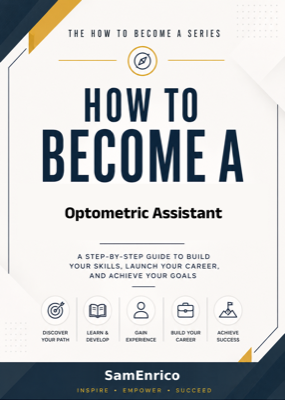
How to Become a Optometric Assistant eBook
How to Become a Optometric Assistant
How to Become a Optometric Assistant
Formats
Free sample
Chapter 1: The $47,000 Mistake--The first time I watched a new optometric assistant cry in the break room, I assumed she had lost a patient. She hadn’t. She had simply misfiled a single visual field test. That misfiled report led to a six-month delay in diagnosing glaucoma in a 61-year-old retired teacher. By the time the doctor caught the error, the patient had lost 15 percent of her peripheral vision—permanently.
The practice settled for $47,000. The assistant was terminated. And no one had ever taught her why that one piece of paper mattered so much.You are about to learn why that mistake happens, how to never make it yourself, and why becoming an optometric assistant is one of the most stable, rewarding, and underrated careers in modern healthcare. But first, you need to understand something that no job description will tell you.You are not “just the assistant.”In the next two hundred pages, you will learn clinical skills that doctors trust with their licenses. You will master technology that did not exist ten years ago.
You will become the person who calms the anxious patient, catches the hidden diagnosis, and keeps the practice profitable. And by Chapter 12, you will know exactly how to demand—not ask, demand—the salary you deserve.But let us start where every best-selling professional book starts: with the truth about where you stand, what you can legally do, and why most assistants fail within their first ninety days.The Three Roles You Must Know (And One You Will Become)Before you touch a single instrument, you need a map of the eye care universe. Most new assistants cannot tell you the difference between an optometrist and an ophthalmologist on their first day. That ignorance costs them respect. It also costs them promotions.
Walk into any practice and confidently explain these roles, and the doctor will notice you immediately.Optometrist. This is the doctor you will work for directly in most private practices. Optometrists earn a Doctor of Optometry (OD) degree. They perform primary eye care: prescribing glasses and contact lenses, diagnosing common eye diseases like glaucoma and diabetic retinopathy, and managing pre- and post-operative care for surgeries performed by ophthalmologists. In most states, optometrists can also prescribe topical medications (eye drops) and, in some states, oral medications.
They are the frontline of eye health.Ophthalmologist. This is a medical doctor (MD or DO) who specializes in the eye. Ophthalmologists complete medical school plus four to five years of residency training. They perform eye surgery—cataract removal, LASIK, corneal transplants, retinal repairs. They also diagnose and treat complex diseases like retinal detachments, uveitis, and advanced glaucoma.
In a typical practice, you might work for an ophthalmologist if you are in a surgical setting. More commonly, you will work alongside an ophthalmologist who refers complex cases to your optometrist or vice versa.Optician. This professional dispenses and fits eyeglasses and contact lenses based on a prescription written by an optometrist or ophthalmologist. Opticians do not test vision or diagnose diseases. They measure pupillary distance, adjust frames, recommend lens materials, and help patients choose styles.
Some optometric assistants also perform optician duties. Some practices keep these roles entirely separate. You will learn both because cross-training doubles your value.Optometric Assistant. This is you. You are the person who performs pre-testing, runs diagnostic equipment, educates patients on contact lenses, handles basic repairs, and ensures the exam lane runs like a Formula One pit crew.
You are not a doctor. You do not diagnose. But without you, the doctor cannot see more than eight patients per day. With you, that number jumps to twenty-five or more. You are the engine of the practice.The Clinic Hierarchy: Where You Sit and Who You Answer To Every practice has a hidden social structure.
Learn it immediately or step on the wrong toes. Here is the standard hierarchy in most optometry clinics, from highest authority to entry level.Optometrist (or Ophthalmologist). The doctor owns the practice or partners in it. Every clinical decision ultimately stops here. You do not argue with the doctor in front of patients.
You do not second-guess their prescriptions. You do, however, respectfully ask clarifying questions when you are confused. Good doctors love curious assistants. Bad doctors fear them.Lead Technician or Head Optometric Assistant. This person has been there for years.
They train new hires, handle the most complex cases, and serve as the doctor’s right hand. Befriend this person. Take them to coffee. Ask them what the doctor hates most. The lead technician controls whether you pass probation or fail quietly.Optometric Assistant (You).
You are the generalist. You do pre-testing, run visual fields, perform tonometry, handle contact lens teaching, and assist with emergencies. You are learning. You will make mistakes. The key is to make new mistakes, not repeat the same ones.Front Desk Coordinator.
This person schedules patients, verifies insurance, collects payments, and answers phones. Never, ever treat the front desk as beneath you. They control your lunch break, your schedule, and whether the doctor hears good things about you. In many practices, the front desk coordinator has been there longer than the lead technician. Respect them openly.Optician (if separate from assistant role).
In larger practices, opticians work in a different department. They may look down on clinical assistants. Ignore that. Learn what they know. The best assistants can also dispense glasses, and the best opticians can pre-test.
Blurring these lines makes you indispensable.One critical note: contact lens training does not automatically belong to every assistant. In many practices, only certified assistants (those who have passed the CPO exam) or those with specific doctor authorization teach insertion and removal. Chapter 8 will cover this in detail. For now, understand that your hierarchy position may not include contact lens education until you prove yourself.Your Legal Scope: What You Can and Cannot Do (By State)Here is where most books lie to you. They say, “You can do these ten things.” Then you move to another state and discover the laws are completely different.
I will not do that to you.Below is a general framework that applies in most U.S. states. But you must check your specific state’s practice act. The American Optometric Association (AOA) maintains a state-by-state guide. Use it.
Print it. Keep it in your locker.Universally Delegable Tasks (Allowed in All 50 States with Doctor Supervision):Patient case history taking Autorefraction and keratometry Non-contact tonometry (air puff)Visual field testing (perimetry)Fundus photography Optical coherence tomography (OCT) scanning Manual lensometry Pupillary distance measurement Frame adjustments and repairs Contact lens instruction (teaching insertion/removal/hygiene)Restricted or Prohibited Tasks (Check Your State):Punctal plug insertion (for dry eye)Epilation (eyelash removal)Foreign body removal from the cornea Triage diagnosis (deciding who needs to be seen urgently)Interpreting OCT or visual field results Prescribing or changing contact lens parameters independently Critical Legal Disclaimer:In some jurisdictions, triage—deciding how urgently a patient needs to be seen based on symptoms—is restricted to licensed medical personnel such as nurses or doctors. The decision tree you will learn in Chapter 9 is for information gathering only. You collect the data. The doctor makes the final triage decision.…
This is the end of the free sample. Get the eBook to keep going. Buy now
About this book
Details
- Author
- Broyles Cecila
- Publisher
- SamEnrico
- Language
- English
- ISBN
- 9781505757743
- Genre
- Non-Fiction, Informative, Educational
- Released
- 2026-05-02
- Pages (approx.)
- 132
- Available as
- eBook, Paperback, Audiobook

Read better in the ZLOADR app
Your eBooks on your phone or tablet. Sign in with your SamEnrico account and start reading.
More by Broyles Cecila
 TikTok Content RemixingBroyles Cecila$11.99
 Nairobi Mobile Money IntegrationBroyles Cecila$11.99
 Nightmare Rescripting For Abandonment Dreams WorkbookBroyles Cecila$11.99
 The Calorie Deficit Weight Loss GuideBroyles Cecila$11.99
 Inlaw Anger Triggers GuideBroyles Cecila$11.99
 The Ghost Admiral: Yamamoto's Gambit and the Doolittle RaidBroyles Cecila$11.99
 Understanding Prolymphocytic LeukemiaBroyles Cecila$17.99
 Data Governance ConsultantBroyles Cecila$11.99
 Data Labeling Best PracticesBroyles Cecila$12.99
 Atlassian GuideBroyles Cecila$12.99