
Non-FictionInformativeEducational
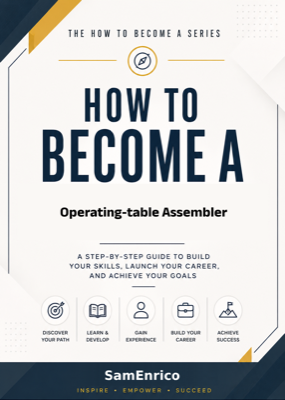
How to Become a Operating-table Assembler eBook
How to Become a Operating-table Assembler
How to Become a Operating-table Assembler
Formats
Free sample
Chapter 1: The Unseen Scalpel--–- The first time I watched an operating table collapse during a routine knee arthroscopy, I was standing twenty feet away in the observation gallery, coffee in hand, utterly unprepared for what gravity sounds like when it wins. The table didn't just drop—it sighed first, a long hydraulic hiss like a dying animal, then lurched left, then surrendered. The patient, already prepped and draped, slid six inches toward the floor before two nurses and a resident caught the limp body by sheer instinct. The surgeon, mid-incision, made a sound I will never forget: not a scream, but a low, horrified groan. No one died that day.
But the scrub tech later told me that the surgeon's hands shook for twenty minutes before he could finish the case. The cause? A single missing locking pin in the table's column assembly. A pin that someone—someone like you, or someone who should have known better—had forgotten to install.This is not a book about furniture. This is not a book about wrenches and screws and following picture diagrams from a flat-pack box.
This is a book about the invisible line between a functioning surgical suite and a lawsuit, between a successful operation and a root-cause analysis that ends with a funeral. If you are here because you think assembling operating tables is just another trade job—a step up from assembling office chairs or gym equipment—you need to stop reading and recalibrate your understanding of the word "assembler." In the medical device world, the assembler is the last line of defense before a patient's life is suspended over a mechanical system. You are not building a table. You are building a platform for human vulnerability.This chapter exists to tear down the naive assumption that this work is simple, repetitive, or low-stakes. By the time you finish reading, you will understand exactly why operating table assembly demands a different mindset than any other assembly job.
You will meet the people who depend on your work—surgeons, anesthesiologists, OR nurses—and you will learn what failure looks like when it happens at the worst possible moment. You will also see the career landscape: where you might work, how much you might earn, and which path aligns with your temperament. And you will make a decision: whether to continue reading this book as a curious observer or as someone who understands that the scalpel is not the only sharp object in the OR. Sometimes, the sharpest edge is a missed torque spec.The Furniture Fallacy: Why Your IKEA Experience Doesn't Count Let us begin with a confession. I have assembled IKEA furniture.
I have wrestled with cam locks that refused to seat, puzzled over instruction sheets that resembled abstract art, and celebrated the final click of a bookshelf that did not immediately tip over. That work requires patience, spatial reasoning, and a certain tolerance for frustration. It does not, however, require liability insurance. It does not require FDA oversight. And it certainly does not require certification from the Association for the Advancement of Medical Instrumentation.The furniture fallacy is the mistaken belief that all assembly work exists on the same continuum, with cheaper products at one end and more expensive products at the other.
This is false. Operating table assembly exists on a different continuum entirely—the continuum of medical risk. A wobbly bookshelf collapses onto a rug. A wobbly operating table collapses onto a patient with an open abdominal incision. One damages property.
The other damages a person, a family, a surgeon's career, and a hospital's reputation.Consider the engineering tolerances. A typical flat-pack desk might specify torque values within a range of plus or minus twenty percent, because it does not matter much if a screw is a little loose. An operating table's column mounting bolts, by contrast, require torque precision within plus or minus five percent, because uneven clamping force can create micro-fractures in the aluminum casting over time. Those micro-fractures propagate. Months later, under load, the column snaps.
No one hears it coming.Consider the materials. Consumer furniture uses particle board, medium-density fiberboard, and cheap steel alloys. Operating tables use anodized aluminum (for corrosion resistance and weight reduction), 300-series stainless steel (for load-bearing rails and fasteners), and medical-grade polymers (for chemical resistance against hospital-grade disinfectants like bleach and peracetic acid). These materials are not merely "better." They are different in kind, requiring different tools, different handling procedures, and different inspection criteria. A scratch on a particle board desk is cosmetic.
A scratch on an anodized aluminum table surface is a potential biofilm reservoir—a place where bacteria can hide from cleaning agents and later infect a surgical patient.Consider the documentation. When you assemble a desk, you throw away the manual. When you assemble an operating table, the manual becomes a legal document. You must follow its procedures exactly, record any deviations, and sign off on every step. If a patient is injured and your assembly documentation is incomplete, you become a named defendant in a deposition.
I have sat in those depositions. The plaintiff's attorney does not ask about your feelings. They ask about your torque wrench calibration date. They ask about your training records. They ask whether you read Technical Service Bulletin 2023-07, which updated the column bolt torque specification from 14 Nm to 15 Nm after three field failures.
If you did not read it, if you did not document it, you are the reason the table failed.This is not hyperbole. This is the regulatory reality of medical device assembly. The furniture fallacy ends here. If you cannot accept that your work will be scrutinized, audited, and potentially litigated, close this book now and find another trade. But if you are ready to take responsibility for human life in a way that most assemblers never will, read on.The Stakeholders: Three People You Will Never Meet But Will Constantly Serve One of the strangest aspects of operating table assembly is that you will almost never meet the end users of your work.
You will not stand in the OR while a surgeon positions a patient on a table you built. You will not watch an anesthesiologist check the table's brakes before induction. You will not hear a nurse say, "This table feels solid." Your work will be invisible when it succeeds and infamous when it fails. To motivate yourself through the monotony of torque sequences and cable routing, you need to develop a mental model of the three people whose safety depends on your precision.The Surgeon. The surgeon is the most visible stakeholder, the one who commands the OR and directs the procedure.
But what does the surgeon actually need from your table? Three things, primarily. First, absolute stability during fine motor tasks—when the surgeon is dissecting near a nerve or placing a screw in a vertebral pedicle, any table movement of even one millimeter can translate into catastrophic tissue damage. Second, precise positioning on demand. A surgeon performing a total hip replacement needs to flex the table's leg section to a specific angle, then lock it instantly.
If the lock slips, the surgical approach is compromised. Third, unobstructed access. Your table's side rails, column, and base must…
This is the end of the free sample. Get the eBook to keep going. Buy now
About this book
Details
- Author
- Galindo Donte
- Publisher
- SamEnrico
- Language
- English
- ISBN
- 9781505757279
- Genre
- Non-Fiction, Informative, Educational
- Released
- 2026-06-02
- Pages (approx.)
- 144
- Available as
- eBook, Paperback, Audiobook

Read better in the ZLOADR app
Your eBooks on your phone or tablet. Sign in with your SamEnrico account and start reading.
More by Galindo Donte
 Scented Product Toxicity GuideGalindo Donte$11.99
 Partner Addiction Self EsteemGalindo Donte$11.99
 Cape Town Data Driven GuideGalindo Donte$11.99
 Body Scan For PregnancyGalindo Donte$11.99
 The Financial Accountability Partner GuideGalindo Donte$11.99
 Wolf of Quebec: Montcalm's Last StandGalindo Donte$11.99
 Elearning DesignerGalindo Donte$11.99
 Salary History Ban TrapGalindo Donte$12.99
 Excel Seasonal Adjustment EconomicsGalindo Donte$12.99
 Understanding Pseudomonas Aeruginosa InfectionGalindo Donte$17.99
You may also like
 Hong Kong Handover 1997Dunn Johnnie$11.99
 Zumba For Postnatal Recovery CourseNeal Christian$11.99
 Zumba for BeginnersLadner Nikia$11.99
 YouTube Comment Mining GuideHumes Pandora$12.99
 Worry Box MeditationCarlin Rudy$11.99
 Workplace Stress MeditationNguyen Lynn$11.99
 Workplace Stress and Sleep RepairHawley Ivory$11.99
 Workplace Perfectionism CureDelaney Jeffry$11.99
 Workplace Injustice Anger GuideWallen Isabelle$11.99
 Work Addiction and Burnout LinkGreenwood Ester$11.99
 Women in Yoga and WellnessBeattie Galina$11.99
 Women in Stand Up ComedyChun Evangeline$11.99