
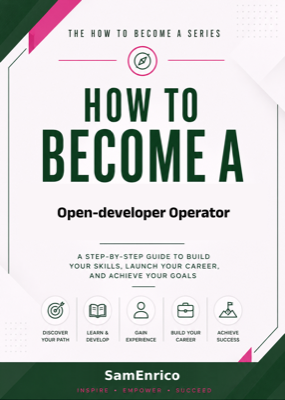
How to Become a Open-developer Operator Paperback
How to Become a Open-developer Operator
by Ho Ali
How to Become a Open-developer Operator
Formats
Free sample
Chapter 1: The Cathedral's Ghost--–- In the winter of 1997, a programmer named Eric S. Raymond published an essay that would split the world of software development into two warring tribes. He called the first tribe the Cathedral builders—architects of grand, centralized systems like the early Linux kernel (which, ironically, was open source) and proprietary giants like Microsoft Windows. These builders worked in quiet reverence, following blueprints handed down by a small group of elite architects. Their cathedrals took years to rise, stone by stone, but when they stood complete, they were magnificent—unmovable, unbreakable, and seemingly immune to the chaos of the outside world.The second tribe, Raymond argued, built Bazaars.
The bazaar was noisy, messy, and apparently disorganized. Thousands of strangers shouted over each other, haggled over details, and built things in plain view of anyone who cared to watch. The most famous example was Linux itself—a project that had somehow grown from a student's hobby into an operating system that powered a growing portion of the internet. Raymond's thesis, which he titled "The Cathedral and the Bazaar," was that the bazaar model—open, chaotic, democratic—could outperform the cathedral in ways no one had predicted.What Raymond did not anticipate was that twenty-five years later, a new myth would take root in the Dev Ops community. The myth sounds reasonable at first: Open source is messy, so it requires less discipline.
After all, if you are building software in public, with volunteers who come and go, why bother with rigorous monitoring, automated testing, or formal incident response? The bazaar is supposed to be chaotic, right?This myth is wrong. And it is dangerously wrong because it confuses emergence with negligence.The Myth That Kills Projects I have watched this myth kill open source projects. Not with a single dramatic blow, but with a thousand small cuts delivered over months and years. A maintainer stops responding to pull requests because they are exhausted by the emotional labor of unpaid work.
A contributor submits a brilliant patch, but no one reviews it for three weeks, so they leave and never return. A security vulnerability goes unnoticed because no one thought to set up automated dependency scanning—after all, the bazaar is supposed to be self-healing, right?The self-healing property of open source is real, but it is not magic. It emerges from infrastructure, not from good intentions. It emerges from automated tests that run on every commit, from documentation that welcomes strangers, from observability that surfaces problems before they become crises. Without that infrastructure, the bazaar is not a self-healing organism.
It is a shouting match in a crowded square.Consider the story of Open SSL, the cryptographic library that secured a significant portion of the web in the early 2010s. In 2014, the world discovered Heartbleed—a catastrophic vulnerability that had existed for two years. The post-mortem revealed something surprising: Open SSL had all the hallmarks of a successful bazaar. It was open source, widely used, and theoretically supported by thousands of developers. But in practice, it was maintained by a handful of unpaid volunteers who had no monitoring, no automated testing for memory safety, and no formal process for reviewing contributions.
The bazaar had become a ghost town.The problem was not that the bazaar model failed. The problem was that the maintainers believed the bazaar required less operational rigor. They thought that "many eyes" would make all bugs shallow, as Raymond had written. But many eyes only work when those eyes have the infrastructure to see clearly. Without observability, without automated testing, without a pipeline that turns…
This is the end of the free sample. Get the Paperback to keep going. Buy now
About this book
Details
- Author
- Ho Ali
- Publisher
- SamEnrico
- Language
- English
- ISBN
- 9781505757194
- Genre
- Non-Fiction, Informative, Educational
- Released
- 2026-04-26
- Pages (approx.)
- 138
- Available as
- eBook, Paperback, Audiobook

Read better in the ZLOADR app
Your eBooks on your phone or tablet. Sign in with your SamEnrico account and start reading.
More by Ho Ali
 Partner Illness Self EsteemHo Ali$11.99
 Lewis Graphic Novel MemoirHo Ali$11.99
 Kigali Lean Product LaunchHo Ali$11.99
 The Retail Reward Dopamine GuideHo Ali$11.99
 Five Minute Body Scan BreaksHo Ali$11.99
 The Torso in the Suitcase: Australia's Most Baffling Dismemberment CaseHo Ali$11.99
 Understanding PseudohypoparathyroidismHo Ali$17.99
 Genetic Information GINA TrapHo Ali$12.99
 Excel Economic Forecasting ErrorsHo Ali$12.99
 Educational SpecialistHo Ali$11.99