
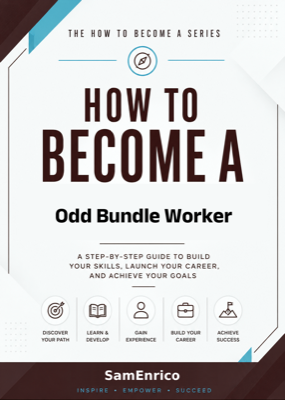
How to Become a Odd Bundle Worker eBook
How to Become a Odd Bundle Worker
by Jameson Kina
How to Become a Odd Bundle Worker
Formats
Free sample
Chapter 1: The Obituary You Didn't Write--–- On a cold Tuesday morning in March, a forty-three-year-old marketing director named Sarah packed her belongings into a cardboard box, walked past the security desk for the last time, and realized something she could not say out loud: she had spent seventeen years becoming an expert in a job that no longer needed her. The company did not fail. The economy did not crash. She was simply... redundant.
A combination of automation, offshoring, and a younger colleague who cost half her salary had erased her position as neatly as a pencil eraser removing a mistake. Sarah had done everything right. She got the degree. She took the promotions. She stayed loyal.
And on that Tuesday morning, she discovered that loyalty is a one-way street that corporations paved in the opposite direction.This chapter is not about Sarah, though you will meet several versions of her throughout this book. This chapter is about the funeral you have not yet attended—the slow, quiet death of the linear career. The path that your parents walked, that your teachers promised, that every movie and newspaper and well-meaning relative assured you was the definition of success: school, college, one company, thirty years, pension, gold watch, retirement. That path is gone. It did not vanish in a dramatic explosion.
It eroded, like a coastline slowly claimed by a rising tide. And if you are reading this book, you already feel the water lapping at your ankles.Let us begin with an uncomfortable truth. The term "career" once meant a journey with a destination. You started as an apprentice, became a journeyman, and ended as a master. The company provided the track.
You provided the obedience. In exchange, they offered something that today sounds almost mythical: predictability. You knew what you would earn next year. You knew where you would sit. You knew that if you did not commit fraud or insult the boss's wife, you would have a job until your retirement dinner.
That contract, written in invisible ink, was the foundation of the middle class for nearly seventy years.It is now null and void.The data is relentless and unforgiving. According to the United States Bureau of Labor Statistics, the average worker today holds more than twelve jobs before the age of fifty. Not twelve positions within the same company—twelve distinct employers. The notion of a "tenure track" now applies only to academics and the delusional. A study from the Federal Reserve Bank of New York found that nearly half of all recent college graduates are working in jobs that do not require their degree.
They are underemployed, overeducated, and increasingly aware that the promise of "get a degree, get a job" was never a promise—it was a marketing campaign.The gig economy, that strange and often-maligned creature, now accounts for more than thirty-six percent of the US workforce according to a 2023 report from Mc Kinsey. That is nearly sixty million people. And here is the detail that the television news anchors always get wrong: most of these people did not choose the gig economy because they wanted to drive for Uber or deliver groceries. They chose it because the traditional economy stopped choosing them first. They are not digital nomads sipping coconut water in Bali.
They are mothers working overnight data entry after putting their children to bed. They are former factory supervisors running three different Etsy shops. They are retired teachers tutoring on four different platforms. They are, in the language of this book, Odd Bundle Workers who never had a name for what they were doing.The phrase "Odd Bundle Worker" has a strange and humble origin. In the Dictionary of Occupational Titles, a dusty government publication that reads like a graveyard of forgotten labor, an "odd bundle worker" is defined as a person who aligns tobacco leaves in a factory.
That is it. A single task. A single role. A single point of failure. The tobacco odd bundle worker had one job, one skill, one purpose.
When the tobacco factory closed—and they all eventually closed—the odd bundle worker had nothing. No transferable skills. No second income stream. No backup plan. They were the original victims of a system that rewards narrow specialization and punishes breadth.This book intends to steal that phrase and rescue it from the graveyard.An Odd Bundle Worker, in the definition we will use throughout these twelve chapters, is not a person with one job.
An Odd Bundle Worker is an architect of diversified income. They build a bundle of skills—often unrelated, sometimes strange, always deliberate—and then sell that bundle to multiple clients across multiple platforms. They do not ask "What is my job title?" because job titles are cages. They ask "What problems can I solve?" because problems are the raw currency of the new economy. They are not freelancers scrambling for scraps.
They are portfolio managers, and their portfolio is their own labor.Let me pause here to define two terms that will appear in every chapter that follows. These definitions are the grammar of this book, and misunderstanding them will create the kind of confusion that leads people to quit before they start.First: a bundle is a set of related skills that you offer as a package. If you are a graphic designer who also writes copy, your bundle might be "visual identity plus brand voice." If you are a former administrative assistant who learned basic bookkeeping, your bundle might be "calendar management plus expense tracking." A bundle is not a random collection of every skill you possess. A bundle is curated. It has internal logic.
The skills inside a bundle talk to each other. A good bundle is like a good toolbox: every tool has a purpose, and the tools work better together than alone.Second: a portfolio is the collection of income streams you maintain. If you have one bundle and you sell it to three different clients, your portfolio contains three streams. If you have two bundles—perhaps graphic design plus copywriting for one bundle, and data entry plus transcription for another—and you sell each to different clients, your portfolio might contain six or seven or ten streams. Here is the key insight that most career advice books get backward: you do not need ten bundles.
You need one or two or three strong bundles. But you want as many portfolio streams as you can reasonably manage. The bundle is what you do. The portfolio is who pays you. One is skill.
The other is resilience.Most people fail at the gig economy because they confuse these two concepts. They chase ten different skills (writing, coding, dog walking, tutoring, delivery driving) without any organizing logic, and then they wonder why they feel exhausted and unfocused. They have ten skills but no bundle. The skills are scattered, not stacked. The portfolio is wide but shallow.
The opposite approach—one strong bundle sold to many clients—creates depth, efficiency, and eventually, peace.Now let us return to the funeral.The linear career died for several reasons, and understanding these reasons is not an academic exercise. It is a survival manual.…
This is the end of the free sample. Get the eBook to keep going. Buy now
About this book
Details
- Author
- Jameson Kina
- Publisher
- SamEnrico
- Language
- English
- ISBN
- 9781505756326
- Genre
- Non-Fiction, Informative, Educational
- Released
- 2026-04-26
- Pages (approx.)
- 158
- Available as
- eBook, Paperback, Audiobook

Read better in the ZLOADR app
Your eBooks on your phone or tablet. Sign in with your SamEnrico account and start reading.
More by Jameson Kina
 Sales Pressure Anger GuideJameson Kina$11.99
 Safe Container PracticeJameson Kina$11.99
 The Constraint ManifestoJameson Kina$11.99
 Konga Ecommerce ExitJameson Kina$11.99
 The Thirty Nine Articles GuideJameson Kina$11.99
 The Lioness of Dahomey: The Warrior Queens Who Shaped an EmpireJameson Kina$11.99
 Understanding Pibi(D)s SyndromeJameson Kina$17.99
 JEE Mathematics Problem SolverJameson Kina$12.99
 Payment Methods for VAs GuideJameson Kina$12.99
 AI-Powered Mobile App Development BusinessJameson Kina$11.99