
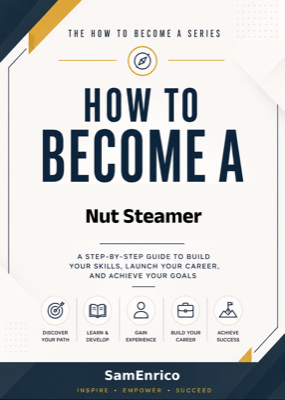
How to Become a Nut Steamer
How to Become a Nut Steamer
How to Become a Nut Steamer
Formats
About this book
Free sample
Chapter 1: The Hidden Fortune--–- In the summer of 1887, a pecan sheller named Beatrice Crumpton lost three fingernails before her first coffee break. The shells were stubborn that year—drought-hardened, vengeful, and sharp as broken glass. By noon, she had bled through two rags. By the end of her shift, she had cracked exactly fourteen pounds of nuts. Her supervisor fired her for low output.
The factory replaced her with a steam vat the following week, and Beatrice spent the rest of her life telling anyone who would listen that she had been ahead of her time. She wasn't wrong, but she was also not entirely right. The steam vat did not replace her skill. It transformed it.This book is not about Beatrice, but she is worth remembering because her story contains the central secret that most people never learn about the nut industry. The secret is not about machinery, although machinery matters.
It is not about temperatures, although temperatures are critical. The secret is this: the difference between a nut that shatters and a nut that opens cleanly is not the nut itself. It is the invisible hand of moisture applied with precision.Almost nobody understands this. Walk into any grocery store, and you will see bins of roasted almonds, bags of salted cashews, and cans of mixed nuts with a picture of a smiling farmer on the label. What you will not see is any acknowledgment of the quiet, hot, essential work that happens before those nuts reach the shelf.
Roasting gets the glory. Roasting produces the aroma that wafts through airport kiosks and holiday kitchens. Roasting is the thing that food bloggers romanticize. Steaming, by contrast, is the thing that makes roasting possible in the first place.Consider a raw almond freshly harvested from an orchard in California’s Central Valley. It arrives at the processing plant wearing two suits of armor: an outer shell that is woody, fibrous, and designed by evolution to resist cracking, and an inner skin (the pellicle) that clings to the kernel like a second layer of bark.
A roaster cannot work with this almond in its natural state. The shell is too hard for mechanical crackers; they…
This is the end of the free sample. Get the eBook to keep going. Buy now
Contents
- Chapter 1
- Chapter 2
- Chapter 3
- Chapter 4
- Chapter 5
- Chapter 6
- Chapter 7
- Chapter 8
- Chapter 9
- Chapter 10
- Chapter 11
- Chapter 12
Details
- Author
- Grubb Lucienne
- Publisher
- SamEnrico
- Language
- English
- ISBN
- 9781505756173
- Genre
- Non-Fiction, Informative, Educational
- Released
- 2026-04-26
- Pages (approx.)
- 129
- Available as
- eBook, Paperback, Audiobook

Read better in the ZLOADR app
Your eBooks on your phone or tablet. Sign in with your SamEnrico account and start reading.
More by Grubb Lucienne
 Breakup Grief WorkbookGrubb Lucienne$11.99
 Imposter Syndrome Pre Talk FixGrubb Lucienne$11.99
 The Zinc Magnesium Testosterone GuideGrubb Lucienne$11.99
 MAT for Pregnant Opioid UsersGrubb Lucienne$11.99
 Anger Management Training for ManagersGrubb Lucienne$11.99
 Firestorm: The Day the Sky Blew UpGrubb Lucienne$11.99
 YouTube Comment Moderation GuideGrubb Lucienne$12.99
 Urban vs Rural Travel SpendingGrubb Lucienne$12.99
 Understanding Polydactyly Cleft Lip Palate Psychomotor RetardationGrubb Lucienne$17.99