
Non-FictionInformativeEducational
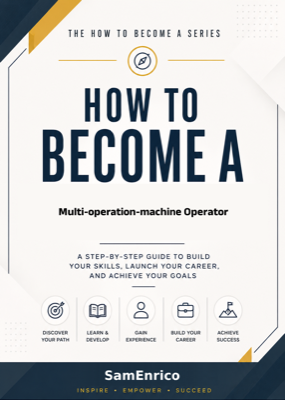
How to Become a Multi-operation-machine Operator Paperback
How to Become a Multi-operation-machine Operator
by Beall Celena
How to Become a Multi-operation-machine Operator
Formats
Free sample
Chapter 1: The Cognitive Jigsaw--– The first time Marcus watched a veteran operator run three machines at once, he thought it was a magic trick. The woman—fifty-two years old, high school education, wearing safety glasses fogged from three decades of factory air—stood in the center of a triangle formed by a CNC mill, a hydraulic press, and an automated lathe. She moved like a dancer who had rehearsed the same choreography ten thousand times. Left three steps to the press. Unload.
Load. Press green. Turn. Four steps to the mill. Wipe the chip guard.
Check the readout. Load. Press green. Turn. Two steps to the lathe.
Catch the part as it dropped. Inspect. Measure. Stack. Reset.
Turn. Repeat. Every thirty-eight seconds, a completed assembly landed in a yellow bin. Every thirty-eight seconds, she earned another fraction of her $38 per hour.Marcus, twenty-three years old, fresh from a warehouse job that paid $17.50 to stack boxes until his shoulders ached, stood with his arms crossed and his jaw slightly open. "How do you keep all of that in your head?" he asked.She didn't stop moving.
"I don't," she said. "That's the secret. You don't keep it in your head. You build a system so your body knows before your brain asks."That conversation, more than any training manual or certification course, planted the seed of what this book will teach you. The multi-operation-machine operator does not possess superhuman memory or impossible focus.
She possesses something far more practical: cognitive flexibility—the trained ability to switch between different machine logics, workflow patterns, and problem-solving modes without losing rhythm or introducing errors. This chapter will dismantle the myth that multi-op operation requires rare talent and replace it with a teachable, repeatable mindset. You will learn why technical skill alone fails, how to see your factory as a system of moving constraints, and the non-negotiable hierarchy that keeps you safe, employed, and promotable. By the end, you will take a self-assessment that reveals exactly where you stand on the spectrum from single-machine thinker to multi-machine system designer. And you will discover, as Marcus did, that you are probably already closer than you think.The Failure of Technical Purity Walk onto any factory floor in America, and you will find them: the operators who know every offset, every G-code, every alarm code for their assigned machine.
They can diagnose a spindle bearing by sound. They can feel a dull tool before the parts show visible marks. They are wizards of their single domain. And they are, increasingly, the first to be laid off when production schedules change.This is not a paradox. It is the logical consequence of how manufacturing has transformed over the past fifteen years.
High-volume, long-run production—the kind where a single machine stamped the same bracket for six months straight—has migrated to low-labor-cost countries or become fully automated. What remains in domestic factories is high-mix, low-volume work. A single cell might run five different part numbers in one shift. A customer might change an order with twenty-four hours' notice. A machine that was milling aluminum brackets at 8:00 AM might need to run stainless steel housings by 2:00 PM.In this environment, the specialist is a liability.
The factory does not need someone who knows everything about one machine. It needs someone who knows the essential 80 percent of five machines.Consider the data. According to the National Association of Manufacturers, the average U.S. factory now changes over its machines 3.7 times per day—up from 1.8 times per day a decade ago. Each changeover is an opportunity for error, delay, and quality…
This is the end of the free sample. Get the Paperback to keep going. Buy now
About this book
Details
- Author
- Beall Celena
- Publisher
- SamEnrico
- Language
- English
- ISBN
- 9781505748628
- Genre
- Non-Fiction, Informative, Educational
- Released
- 2026-05-06
- Pages (approx.)
- 143
- Available as
- eBook, Paperback, Audiobook

Read better in the ZLOADR app
Your eBooks on your phone or tablet. Sign in with your SamEnrico account and start reading.
More by Beall Celena
 Workplace Rejection ResilienceBeall Celena$11.99
 Pancho Gonzales Fierce CompetitorBeall Celena$11.99
 Menopause Low Carb GuideBeall Celena$11.99
 Equifax Free Credit MonitoringBeall Celena$11.99
 Green Beret Survival SchoolBeall Celena$11.99
 The Vanishing Act of the Great Pyramid’s Missing StoneBeall Celena$11.99
 The White Queen of Medellín: Griselda Blanco's Rise and FallBeall Celena$11.99
 Freelance Skill Stacking HandbookBeall Celena$12.99
 Business Travel Rebound AnalysisBeall Celena$12.99Business Travel Rebound AnalysisBeall Celena$12.99
 Understanding Gastroenteritis, EosinophilicBeall Celena$17.99
 Customer Onboarding ManagerBeall Celena$11.99
You may also like
 Hong Kong Handover 1997Dunn Johnnie$11.99
 Zumba For Postnatal Recovery CourseNeal Christian$11.99
 Zumba for BeginnersLadner Nikia$11.99
 YouTube Comment Mining GuideHumes Pandora$12.99
 Worry Box MeditationCarlin Rudy$11.99
 Workplace Stress MeditationNguyen Lynn$11.99
 Workplace Stress and Sleep RepairHawley Ivory$11.99
 Workplace Perfectionism CureDelaney Jeffry$11.99
 Workplace Injustice Anger GuideWallen Isabelle$11.99
 Work Addiction and Burnout LinkGreenwood Ester$11.99
 Women in Yoga and WellnessBeattie Galina$11.99
 Women in Stand Up ComedyChun Evangeline$11.99