
Non-FictionInformativeEducational
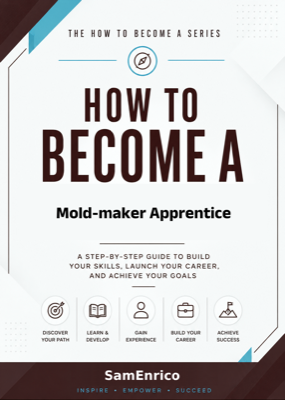
How to Become a Mold-maker Apprentice eBook
How to Become a Mold-maker Apprentice
How to Become a Mold-maker Apprentice
Formats
Free sample
Chapter 1: The Invisible Foundation--–- Every object you have touched today – your smartphone case, the coffee cup lid, the dashboard of your car, the plastic housing around your computer monitor, even the syringe that delivered a vaccine – began its life inside a mold. Not a mold like the fuzzy penicillin growing on bread, but a precision-engineered block of steel, often weighing several tons, machined to tolerances thinner than a human hair. This is the invisible foundation of modern manufacturing, and the people who create these molds are among the most sought-after, well-compensated, and rapidly-aging skilled trades in the world. Welcome to mold-making.If you are reading this book, you have likely heard whispers about the trade – perhaps from a high school shop teacher, a relative who works in manufacturing, or a You Tube video of a CNC machine carving intricate contours into a block of tool steel. But what you probably haven't heard is the full scope of the opportunity sitting in front of you.
Right now, in cities like Cleveland, Milwaukee, and Grand Rapids, mold shops are desperate for apprentices. Not because the work is disappearing – quite the opposite. The demand for plastic and metal components has never been higher. The problem is that the average mold-maker in the United States is 56 years old. Within the next decade, nearly half of all master mold-makers will retire, taking decades of knowledge with them unless a new generation steps forward.This chapter is not designed to romanticize the trade or gloss over its difficulties.
Mold-making is hard work. It is dirty, precise, frustrating, and occasionally dangerous. You will stand on concrete for ten hours. You will splash coolant on your arms. You will scrap a part after fifty hours of work because you misread a decimal point.
And then you will start over. But if you have the right temperament – a blend of obsessive precision, mechanical curiosity, and stubborn patience – you will find a career that offers something almost extinct in the twenty-first century: a genuine middle-class life without a four-year college degree. Journeyman mold-makers in many regions earn between 70,000and70,000 and 70,000and120,000 per year, with full benefits, overtime, and pensions. Master mold-makers who specialize in complex fields like medical devices or hot runner systems can exceed $150,000. And unlike many white-collar jobs threatened by artificial intelligence and offshoring, mold-making requires physical presence.
You cannot outsource the final fitting of a core and cavity to a call center in Manila.The Hidden Backbone of Manufacturing Let us step back and understand exactly what a mold is and why it matters. A mold is a hollowed-out block of metal – usually steel or aluminum – into which molten plastic, rubber, or metal is injected under high pressure. The material cools and solidifies into the shape of the cavity, and then the mold opens to eject the finished part. This process, called injection molding, repeats every few seconds to minutes, producing thousands or millions of identical parts. A single mold for an automotive dashboard can cost $500,000 and take 2,000 hours to build.
But that mold might produce 2 million parts over ten years, amortizing the cost to pennies per dash.Without mold-makers, there would be no LEGO bricks, no hypodermic syringes, no automotive bumpers, no disposable coffee lids, no electrical outlet covers, no keyboard keys, no bottle caps, no plastic hangers, no hearing aid shells, no pill bottles, and virtually none of the consumer goods that define modern life. Even metal parts like gears, brackets, and handles are often produced through die casting – a related process using permanent molds. Mold-making is the quiet engine under the hood of global manufacturing.But here is what most people do not understand: a mold is not just a block with a hole in it. A production mold is a complex machine composed of dozens or hundreds of precisely-fitted components. It includes cores (the male protrusions that form internal features), cavities (the female recesses that form external shapes), ejector pins that push the finished part out, slides that move sideways to create undercuts, cooling channels that circulate water to control temperature, and venting channels that allow trapped air to escape.
All of these components must fit together with clearances measured in ten-thousandths of an inch. A gap of 0.0005 inches – about one-seventh the thickness of a human hair – can cause plastic flash (thin fins of unwanted material) that ruins every part.The Mold-Maker vs. The Tool & Die Maker vs. The Machinist One of the first points of confusion for newcomers is the distinction between mold-makers, tool and die makers, and machinists. These trades overlap but are not interchangeable.
A thorough understanding of the differences will help you target your job search and apprenticeship applications correctly.A machinist is the broadest category. Machinists operate lathes, milling machines, grinders, and CNC equipment to produce metal parts from raw stock. They read blueprints, calculate speeds and feeds, select cutting tools, and measure finished work. A machinist might produce a replacement shaft for a pump, a bracket for a conveyor system, or a prototype component. The work is precise, often to ±0.001 inches, but the parts are typically used as-is within a larger assembly.
Machinists are the general practitioners of the metalworking world.A tool and die maker builds tools that stamp, form, or blank sheet metal. A stamping die is essentially a giant metal punch and die set that cuts and shapes flat metal into parts like car door panels, appliance housings, or washer lids. Tool and die makers work with sheet metal and focus on shearing, bending, and forming. Their tolerances are tight, and their tools experience tremendous impact forces. Tool and die is a proud and ancient trade, but it is distinct from mold-making.A mold-maker specifically builds injection molds, compression molds, or transfer molds for plastics, rubber, or die-cast metals.
The fundamental difference is that molds receive material in a fluid state (melted plastic or molten metal) and solidify it inside a cavity, whereas dies mechanically shape solid material. Mold-making requires additional knowledge of plastic flow, shrinkage rates (different plastics shrink by 0.004 to 0.025 inches per inch as they cool), cooling channel design, venting, ejection systems, and surface finishes ranging from a mirror polish to a fine texture. Mold-makers must also understand the behavior of different polymers – polypropylene flows differently than ABS, which flows differently than nylon – and adjust their mold designs accordingly.In practice, many tradespeople cross over. A journeyman mold-maker can often operate a manual lathe as well as any machinist, and a tool and die maker might build simple molds. But for apprenticeship purposes, you should focus your search on shops that explicitly identify as mold-making, injection molding, or tooling for plastics.A Typical Day: Reality vs.
Expectation Let us walk through a typical day for a first-year mold-maker apprentice and contrast it with a journeyman’s experience. This will help you set realistic expectations and understand the progression ahead.A first-year apprentice arrives at the shop at 6:30 AM, fifteen minutes before the shift starts. You change into steel-toed boots, safety glasses, and a shop apron. The morning ritual includes checking the coolant levels on your assigned manual mill, sweeping your work area, and reviewing the work orders for the day. Your journeyworker…
This is the end of the free sample. Get the eBook to keep going. Buy now
About this book
Details
- Author
- Martell Sharri
- Publisher
- SamEnrico
- Language
- English
- ISBN
- 9781505746266
- Genre
- Non-Fiction, Informative, Educational
- Released
- 2026-05-04
- Pages (approx.)
- 138
- Available as
- eBook, Paperback, Audiobook

Read better in the ZLOADR app
Your eBooks on your phone or tablet. Sign in with your SamEnrico account and start reading.
More by Martell Sharri
 TMJ Pain MeditationMartell Sharri$11.99
 Downsize to Manufactured HomeMartell Sharri$11.99
 Creative Thinking For Engineers GuideMartell Sharri$11.99
 The Government Relations GuideMartell Sharri$11.99
 Self Esteem and Past Abuse HistoryMartell Sharri$11.99
 Whispers of the Forgotten: The Last Ballad of the Silk RoadMartell Sharri$11.99
 The Spice Wars: Dutch Courage in the Indian OceanMartell Sharri$11.99
 Understanding Facial Asymmetry Temporal SeizuresMartell Sharri$17.99
 Executive Summary Cheat Sheet for Product LaunchesMartell Sharri$12.99
 Procurement Technology StackMartell Sharri$12.99
 Outbound LeadMartell Sharri$11.99
You may also like
 Hong Kong Handover 1997Dunn Johnnie$11.99
 Zumba For Postnatal Recovery CourseNeal Christian$11.99
 Zumba for BeginnersLadner Nikia$11.99
 YouTube Comment Mining GuideHumes Pandora$12.99
 Worry Box MeditationCarlin Rudy$11.99
 Workplace Stress MeditationNguyen Lynn$11.99
 Workplace Stress and Sleep RepairHawley Ivory$11.99
 Workplace Perfectionism CureDelaney Jeffry$11.99
 Workplace Injustice Anger GuideWallen Isabelle$11.99
 Work Addiction and Burnout LinkGreenwood Ester$11.99
 Women in Yoga and WellnessBeattie Galina$11.99
 Women in Stand Up ComedyChun Evangeline$11.99