
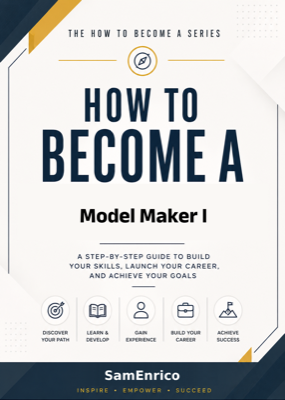
How to Become a Model Maker I eBook
How to Become a Model Maker I
How to Become a Model Maker I
Formats
Free sample
Chapter 1: The Broken Toaster...--–- The toaster sat on my workbench like a judgment. It was a $19.99 discount-store special, white plastic with fake chrome trim, and it had killed itself one Tuesday morning by refusing to latch closed. My girlfriend at the time said, "Just buy a new one." My roommate said, "Throw it out." My father, who had once fixed a 1972 Ford Pinto with a coat hanger and pure stubbornness, said nothing because he had died three years earlier. So I did what any reasonable 26-year-old with no mechanical aptitude and a burning need to prove something to a ghost would do: I took the toaster apart.That was the first model I ever made.I didn't know that's what I was doing at the time. I thought I was fixing an appliance.
But when I laid out the springs, the bimetal strip, the crumb tray, and the heating elements across a newspaper on my kitchen table, I realized I was looking at a different kind of thing altogether. I was looking at a machine that someone had designed—someone who had made choices about gauge thickness, about screw placement, about the exact tension required to make a piece of bread descend and ascend at the precise moment of golden-brown perfection. I couldn't fix it. I didn't have a replacement latch. But I could study it.
I could trace the path of electricity from the wall to the heating coils. I could understand why the designer had put a thermal fuse where they did (a safety feature I only understood after Googling "toaster fire statistics"). And when I finally gave up and threw the toaster away, I kept the springs.I kept the springs because they felt like something. Like a secret. Like a language I had just begun to decipher.That was fifteen years ago.
Since then, I have built prototypes for automotive companies, architectural models for billion-dollar real estate developments, and stop-motion puppets for Netflix. I have failed more times than I can count—glued my fingers to a resin part, sanded through a detail I spent six hours sculpting, watched a client's expression fall when I presented something I thought was brilliant but was actually wrong. And I have learned that model making is not about being good with your hands. It is not about having expensive tools. It is not about being an artist or an engineer or a craftsman, though it contains elements of all three.Model making is about one thing: seeing the world as a set of decisions that someone made, and then making better ones yourself.This book is for anyone who has ever taken something apart and felt a thrill of discovery.
It is for the burned-out graphic designer who spends fourteen hours a day staring at a screen and wants to feel something real under their fingertips. It is for the engineer who can calculate stress loads but cannot build a thing that doesn't look like a brick. It is for the hobbyist who has built a hundred model airplanes and wonders, quietly, if they could do this for money. And it is for the person who has never made anything in their life but who looks at a beautifully machined piece of brass and thinks, I want to learn how to do that.This is not a book that will teach you everything. That would be impossible.
Model making is an iceberg trade—the visible tip is the finished model, beautiful and complete, but beneath the waterline lie decades of accumulated knowledge about materials, tools, geometry, mechanics, lighting, painting, and the invisible art of knowing when to stop. What this book will do is give you the first thousand feet of that iceberg. It will give you the fundamental frameworks, the decision matrices, the safety protocols, and the career roadmaps that I had to learn through years of expensive mistakes. It will teach you how to think like a model maker before you ever pick up a knife.And it will start, as all things in this trade must start, with a single question: What kind of model maker do you want to be?The Three Pillars of Professional Model Making If you walk into a professional model-making studio—the kind that builds prototypes for Dyson or architectural models for Foster + Partners or puppets for Laika—you will find people who have come from radically different backgrounds. Some studied industrial design.
Some studied sculpture. Some studied engineering. Some studied nothing at all and learned everything in a garage. But they all belong to one of three tribes, and understanding these tribes is the first step in understanding where you belong.Pillar One: The Product Design Prototyper The product design prototyper builds things that are meant to become other things. Their models are not the final product; they are questions asked in physical form.
Does this handle feel good in the hand? Does this latch release cleanly? Does this vacuum cleaner's center of gravity make it tip over when you pull it backward? The prototyper answers these questions by building a thing that is deliberately incomplete—rough in some places, refined in others—so that the engineers and stakeholders can learn without falling in love.What they make: Functional prototypes (click wheels, folding mechanisms, snap fits), "look's like" models (aesthetic mockups in monochrome resin), test rigs (ugly but informative), and occasionally production-ready masters for mold-making.Where they work: In-house prototype shops at companies like Tesla, Apple, Dyson, or Herman Miller; independent prototype bureaus that serve multiple clients; or as freelancers working from home studios.The mindset: Pragmatic and iterative. "This prototype is wrong, but now we know why" is a victory.
Perfection is the enemy of learning. The best prototype is the one that answers the most important question with the least amount of effort.The skills you need: Basic CAD (Fusion 360 or Solid Works), 3D printing (both FDM and resin), hand-finishing (sanding, priming, painting), and basic electronics (wiring LEDs, soldering, simple Arduino). Mechanical engineering intuition—how gears mesh, how springs compress, how snap fits flex—is enormously valuable but can be learned on the job.The case study that changed my career: Early in my freelance life, I was hired to build a prototype of a redesigned drill handle for a power tool company. The client had CAD files and renderings that looked beautiful. I built the model exactly to spec—every curve, every fillet, every texture.
I delivered it. The client put it in a test rig and discovered that the handle, despite looking perfect, was 2mm too narrow for the average male hand. They had to redesign the entire tool. They were not angry; they were grateful. My ugly, perfect, wrong prototype had saved them millions in retooling costs.
That was the day I understood what prototyping actually means. It is not about being right. It is about being wrong in a way that teaches you something.Pillar Two: The Architectural Model Maker The architectural model maker builds miniature buildings that are not meant to be lived in, but are meant to be believed. Their work is presented to clients, city planning boards, investors, and the…
This is the end of the free sample. Get the eBook to keep going. Buy now
About this book
Details
- Author
- Montague Teddy
- Publisher
- SamEnrico
- Language
- English
- ISBN
- 9781505745139
- Genre
- Non-Fiction, Informative, Educational
- Released
- 2026-04-26
- Pages (approx.)
- 133
- Available as
- eBook, Paperback, Audiobook

Read better in the ZLOADR app
Your eBooks on your phone or tablet. Sign in with your SamEnrico account and start reading.
More by Montague Teddy
 Sleep Protocol Before Big TalksMontague Teddy$11.99
 Prioritization for Social LifeMontague Teddy$11.99
 Emotional Regulation for Jealousy GuideMontague Teddy$11.99
 Hearst Editorial InfluenceMontague Teddy$11.99
 The Laundromat LawyerMontague Teddy$11.99
 Whispers from the Ashes: The Black Death’s Silent ReapersMontague Teddy$11.99
 The Last Broadcast: The Night Radio Saved LivesMontague Teddy$11.99
 Wire StrippingMontague Teddy$11.99
 Understanding Bone Dysplasia Lethal Holmgren TypeMontague Teddy$17.99
 EOR Services Kenya ComparisonMontague Teddy$12.99
 Amazon Returns Minimization GuideMontague Teddy$12.99