
Non-FictionInformativeEducational
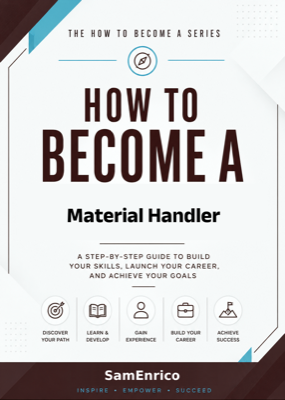
How to Become a Material Handler eBook
How to Become a Material Handler
How to Become a Material Handler
Formats
Free sample
Chapter 1: The Box You Carry--You have already carried a thousand boxes before opening this book. Some were light—envelopes, coffee cups, a child’s backpack. Others strained your back—a moving box full of books, a suitcase lifted from the car trunk, a bag of concrete mix from the hardware store. You probably never thought about those lifts. You just bent, grabbed, and straightened.
And you survived.But survival is not the same as mastery.The material handling industry—the invisible circulatory system of the global economy—processes trillions of pounds of goods every year. Every sneaker, every smartphone, every bag of frozen vegetables, every vial of medicine, every bolt, every book, every box you have ever touched in a store arrived there because of a chain of human movements. Someone loaded it onto a truck. Someone slid it off a conveyor. Someone lifted it from a pallet.
Someone scanned its barcode. Someone placed it on a shelf.That someone could be you. But not the version of you who lifts carelessly. Not the version who thinks this is just “moving boxes.” The version who understands the physics, the technology, the unspoken rules, and the career ladder hidden inside every warehouse.This chapter is not an introduction. It is a reorientation.You are about to learn that material handling is not a fallback job for people who couldn’t find anything better.
It is a 2trillionindustrythatemploysover6millionpeopleinthe United Statesalone,withaprojectedgrowthrateof72 trillion industry that employs over 6 million people in the United States alone, with a projected growth rate of 7% over the next decade—faster than the national average for all occupations. It is an industry where a 22-year-old with the right certifications can earn 2trillionindustrythatemploysover6millionpeopleinthe United Statesalone,withaprojectedgrowthrateof728 per hour and a 35-year-old warehouse manager can earn six figures without a college degree. It is an industry where robots are not replacing humans but creating new roles for humans who understand how to talk to robots.But none of that matters if you don’t understand the first truth: you are not a mule.The First Truth: You Are Not a Mule Let me tell you about my first week in a warehouse.I was twenty-three, freshly fired from a retail job where I had spent three years folding sweaters and unlocking fitting rooms. I needed money. The temp agency sent me to a distribution center outside of Atlanta—a massive gray building with forty loading docks, the constant growl of diesel engines, and air thick with cardboard dust and the smell of propane from forklifts.My trainer, a man named Dwight who had been there for seventeen years, handed me a pallet jack and pointed at a stack of boxes.
Each one weighed about forty pounds. “You pick from that aisle,” he said. “Put the boxes on these pallets. Don’t crush anything. Don’t hurt yourself.
See you at lunch.”No explanation of load moment. No demonstration of the stability triangle. No discussion of rest allowances or ergonomics. Just a pallet jack and a prayer.By noon, my lower back was a dull throb. By three o’clock, it was a sharp stabbing sensation that radiated down my left leg.
By five, I could barely stand. I drove home hunched over the steering wheel, took four ibuprofen, and lay on the floor of my apartment staring at the ceiling, wondering if I would be able to walk in the morning.Dwight found me the next day. “You’re lifting with your back,” he said. “Stop that.”“How?” I asked.He shrugged. “Just lift with your legs.”That was the entirety of my safety training.
“Lift with your legs.” Five words. No explanation of what that actually meant. No demonstration of hip hinge or bracing. No discussion of how to handle a box in a tight trailer where you couldn’t squat even if you wanted to.I lasted six weeks before the pain became unbearable. I quit, found another job, and forgot about warehouses for three years.Then I came back.
But this time, I came back with books. I read Mital’s Guide to Manual Materials Handling. I studied NCCER’s Core Curriculum. I learned the biomechanics that Dwight could not teach me. I learned why “lift with your legs” is not just incomplete but actively misleading.
And I learned that most material handlers—millions of them—are hurting themselves not because they are lazy or stupid but because no one ever taught them the actual science.This book is what I wish Dwight had handed me on that first morning.The Strategic Importance of the Box You Carry Before we talk about how to lift, let us talk about why.Every box you handle in a warehouse is not an isolated object. It is a node in a global supply chain that stretches from a factory in Vietnam to a port in Los Angeles to a rail yard in Chicago to a distribution center in Ohio to a delivery truck in your neighborhood to a doorstep in Des Moines. That chain involves hundreds of human touches. Each touch is an opportunity for accuracy, efficiency, or error.Let us trace a single box—a pair of running shoes—through that chain.The shoes are manufactured in a facility outside Ho Chi Minh City. A handler there places them into a carton.
That handler’s accuracy determines whether the box contains the correct size, color, and model. Another handler stacks that carton onto a pallet. That handler’s technique determines whether the pallet will collapse during transit. A third handler loads that pallet into a shipping container. That handler’s forklift operation determines whether the container can be filled to its maximum weight without exceeding axle limits.The container crosses the Pacific Ocean.
At the Port of Los Angeles, longshoremen remove the container from the ship. A handler drives a reach stacker to move the container to a staging area. Another handler uses a handheld scanner to log its arrival. A warehouse management system—the digital brain we will explore in depth in Chapter 6—updates the inventory in real time. If that scan is missed, the shoes become “lost” in the system, triggering a costly manual search.The container is loaded onto a train.
At a rail yard in Chicago, handlers transfer it to a truck. The truck driver—who is also a material handler, because driving is part of handling—transports it to a regional distribution center.Inside that distribution center, the real complexity begins. The shoes are removed from the container. A handler uses a voice-directed picking system—a headset that speaks location and quantity instructions—to find the correct carton among ten thousand others. Another handler operates a reach truck to place the carton on a high rack, twelve feet in the air.
An autonomous mobile robot (AMR) might carry the carton to a packing station. A pick-to-light system might flash a button to confirm the pick. A cycle count—a small, targeted inventory verification—might flag a discrepancy that a handler must resolve.Finally, the shoes are loaded onto a delivery van. The driver—the last handler in the chain—carries them to a doorstep, completes a final scan…
This is the end of the free sample. Get the eBook to keep going. Buy now
About this book
Details
- Author
- Dexter Kirsten
- Publisher
- SamEnrico
- Language
- English
- ISBN
- 9781505772449
- Genre
- Non-Fiction, Informative, Educational
- Released
- 2026-05-04
- Pages (approx.)
- 148
- Available as
- eBook, Paperback, Audiobook

Read better in the ZLOADR app
Your eBooks on your phone or tablet. Sign in with your SamEnrico account and start reading.
More by Dexter Kirsten
 Teen Comparison Trap GuideDexter Kirsten$11.99
 Physical Abuse RecoveryDexter Kirsten$11.99
 Minoxidil GuideDexter Kirsten$11.99
 Immigrant Digital Marketing AgencyDexter Kirsten$11.99
 Mexico Salary Negotiation StyleDexter Kirsten$11.99
 Green Beret Master SergeantDexter Kirsten$11.99
 New Year Two Dates CelebrationsDexter Kirsten$11.99
 Dream Scar RecordingDexter Kirsten$11.99
 Voltaire and Émilie: Love, Letters, and the EnlightenmentDexter Kirsten$11.99
 The Invisible Hand: Graffiti’s First Rebels in the Age of EnlightenmentDexter Kirsten$11.99
 How to Produce Cloth and WipeDexter Kirsten$11.99
 How to Produce Office Furniture AccessoriesDexter Kirsten$11.99
You may also like
 Hong Kong Handover 1997Dunn Johnnie$11.99
 Zumba For Postnatal Recovery CourseNeal Christian$11.99
 Zumba for BeginnersLadner Nikia$11.99
 YouTube Comment Mining GuideHumes Pandora$12.99
 Worry Box MeditationCarlin Rudy$11.99
 Workplace Stress MeditationNguyen Lynn$11.99
 Workplace Stress and Sleep RepairHawley Ivory$11.99
 Workplace Perfectionism CureDelaney Jeffry$11.99
 Workplace Injustice Anger GuideWallen Isabelle$11.99
 Work Addiction and Burnout LinkGreenwood Ester$11.99
 Women in Yoga and WellnessBeattie Galina$11.99
 Women in Stand Up ComedyChun Evangeline$11.99