
Non-FictionInformativeEducational
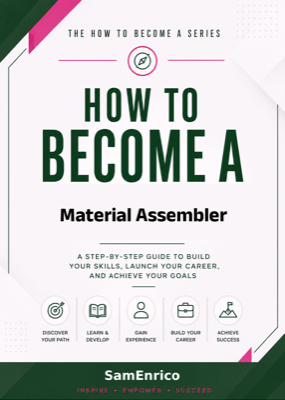
How to Become a Material Assembler eBook
How to Become a Material Assembler
by Raney Lewis
How to Become a Material Assembler
Formats
Free sample
Chapter 1: Beyond the Bolt...–- The first time Maria held a torque wrench, her hands shook. Not from weakness—from the weight of knowing that a single miscalculation could send 247 people to the bottom of the Atlantic. She was 22 years old, three months out of a community college welding program, and standing in a Boeing supplier’s assembly bay in Wichita, Kansas. The part in front of her was a flight control actuator bracket for a 737. The blueprint said 42 newton-meters.
Her supervisor, a 58-year-old veteran named Gene who smelled like coffee and safety glasses, said nothing. He just watched. Maria turned the wrench. It clicked. Gene nodded.
“Now you’re an assembler,” he said. “Don’t ever forget what that means.”That was fourteen years ago. Today, Maria trains new hires at a medical device plant in Minnesota. She tells them the same story, but she adds a twist. “That bracket probably landed in a scrapyard five years ago,” she says.
“But the habit I learned that day—the discipline of the click—followed me into every pacemaker lead and spinal implant I’ve ever touched. You’re not learning a job. You’re learning a relationship with responsibility.”This book is not about tightening bolts. It is about becoming the kind of person who can be trusted with things that matter. Whether you are assembling a drone motor, a dialysis machine, a fighter jet’s landing gear, or a solar inverter, the principles are the same.
But before you can master the tools, the materials, or the certifications, you must first understand one uncomfortable truth: the world does not need more assemblers. It needs more masters.The Stereotype That Refuses to Die Walk into any high school career fair, and you will see it. The manufacturing table is tucked between the military recruiters and the community college booths. The brochures show smiling people in hard hats holding clipboards. The word “technician” appears in font size 14.
The word “assembler” appears in font size 8, if at all. There is a reason for this. For forty years, American culture has treated assembly work as the consolation prize—what you do if you can’t afford college, if you don’t have the test scores, if you need a paycheck yesterday.That stereotype is not just wrong. It is dangerous.Modern material assembly bears almost no resemblance to the Henry Ford era of repetitive grunt work. The factories of 2026 are climate-controlled, computer-monitored, and staffed by workers who need to understand everything from GD&T symbols to electrostatic discharge protocols to FDA traceability requirements.
A typical aerospace assembler today needs more technical knowledge than a general practitioner doctor needed in 1950. No exaggeration: the doctor had a stethoscope and a prescription pad. The assembler has a torque analyzer, a coordinate measuring machine, a barcode scanner, a cleanroom gown, and a 147-page work instruction written in three languages.Yet the pay gap persists. The respect gap persists. And the most damaging gap of all—the information gap—means that millions of capable people never consider this career because no one has told them what it actually is.This chapter is the door.
Walk through it.What “Material Assembler” Actually Means Let us start with the title itself, because most job postings get it wrong. A “Material Assembler” is not a general laborer. The word “material” is not decorative. It signals that this role requires understanding the physical properties of what you are joining. A general assembler might put Part A into Part B without knowing why the parts are made of aluminum instead of plastic.
A material assembler knows that aluminum has a galvanic corrosion potential when paired with stainless steel, that certain plastics outgas in vacuum environments, that ceramic coatings crack if torqued too fast.In practice, “Material Assembler” is an umbrella term covering four distinct sub-specialties. Understanding which path fits you will determine which chapters of this book matter most.Path One: Electronics Assembler You work with printed circuit boards, wire harnesses, sensors, and connectors. Your tools include soldering irons, multimeters, ESD-safe tweezers, and magnifying visors. Your materials include solder paste, flux, conformal coating, and copper traces. Your enemies are static electricity (one invisible zap can destroy a $10,000 board), cold solder joints (they look fine but fail under vibration), and tin whiskers (microscopic metal growths that cause shorts).
You will likely work in a cleanroom or ESD-safe zone. Your certifications might include IPC-A-610 (acceptability of electronics assemblies) and J-STD-001 (soldering). Your industries include consumer electronics, automotive sensors, medical devices, and defense communications.Path Two: Heavy Industrial Assembler You work with large metal structures, hydraulic systems, engines, and heavy equipment. Your tools include torque wrenches (some as long as your arm), pneumatic impact drivers, overhead hoists, and laser alignment tools. Your materials include steel alloys, cast iron, rubber seals, and industrial adhesives.
Your enemies are cross-threaded fasteners (they feel tight but have zero clamping force), over-torqued bolts (they stretch and fail later), and contamination (dirt in a hydraulic system destroys pumps). You will likely work on a shop floor with forklifts and cranes nearby. Your certifications might include OSHA forklift operation, overhead crane rigging, and perhaps a welding endorsement. Your industries include agriculture equipment, mining machinery, wind turbines, and shipbuilding.Path Three: Medical Device Assembler You work with implantable devices, surgical instruments, diagnostic equipment, and drug-delivery systems. Your tools include precision torque drivers (measured in inch-ounces, not foot-pounds), go/no-go gauges, optical comparators, and cleanroom-certified hand tools.
Your materials include titanium (biocompatible), PEEK polymer (radiotranslucent), silicone (flexible seals), and shape-memory alloys (they return to a predetermined shape at body temperature). Your enemies are biological contamination (a single hair in a sterile field scraps the batch), lot mix-ups (implanting the wrong size kills patients), and documentation errors (the FDA audits every signature). You will work in an ISO Class 7 or Class 8 cleanroom. Your certifications might include ISO 13485 awareness, cleanroom behavior, and medical device traceability. Your industries include orthopedics, cardiovascular devices, drug pumps, and surgical robotics.Path Four: Aerospace Assembler You work with flight-critical components—wing structures, engine mounts, landing gear, avionics enclosures, and control surfaces.
Your tools include calibrated torque wrenches (with certification stickers renewed every 90 days), rivet guns, precision micrometers, and borescopes for internal inspection. Your materials include carbon fiber composites (delamination is invisible and deadly), titanium (expensive and unforgiving), Inconel (a superalloy that work-hardens if machined wrong), and aerospace-grade aluminum (treated with corrosion inhibitors). Your enemies are foreign object debris (a dropped washer inside a wing can jam controls), fastener fatigue (every screw has a finite life in cycles), and paperwork errors (the FAA requires traceability back to the raw material lot). You will work in a controlled environment, sometimes a cleanroom for composite layup. Your certifications might include NADCAP (aerospace quality system), FOD awareness, and composite repair.
Your industries include commercial aircraft, military aviation, space launch vehicles, and satellites.The Role Matrix: Find Your Path If you are still reading, you have already done more homework than 90% of people who apply for assembly jobs. That puts you ahead. But before you go further, take sixty seconds to complete this self-assessment. It will tell you which chapters to prioritize.Question 1: Do you prefer working…
This is the end of the free sample. Get the eBook to keep going. Buy now
About this book
Details
- Author
- Raney Lewis
- Publisher
- SamEnrico
- Language
- English
- ISBN
- 9781505772333
- Genre
- Non-Fiction, Informative, Educational
- Released
- 2026-06-02
- Pages (approx.)
- 129
- Available as
- eBook, Paperback, Audiobook

Read better in the ZLOADR app
Your eBooks on your phone or tablet. Sign in with your SamEnrico account and start reading.
More by Raney Lewis
 Weight Shift UneaseRaney Lewis$11.99
 Self Hypnosis for Tendonitis PainRaney Lewis$11.99
 Resume Overhaul After TerminationRaney Lewis$11.99
 Design Thinking for Customer ServiceRaney Lewis$11.99
 Lego Serious Play GuideRaney Lewis$11.99
 Self Esteem for AccountantsRaney Lewis$11.99
 Explaining Anger to ChildrenRaney Lewis$11.99
 Small Talk for Hardware StoresRaney Lewis$11.99
 The Great British Bank Heist: The First Digital RansomRaney Lewis$11.99
 Maracanazo to Glory: Argentina's 1986 World Cup RedemptionRaney Lewis$11.99
 A Collector's Handbook to the Steyr 40Raney Lewis$11.99
 X-ray Bag Scanner OperationRaney Lewis$11.99
You may also like
 Hong Kong Handover 1997Dunn Johnnie$11.99
 Zumba For Postnatal Recovery CourseNeal Christian$11.99
 Zumba for BeginnersLadner Nikia$11.99
 YouTube Comment Mining GuideHumes Pandora$12.99
 Worry Box MeditationCarlin Rudy$11.99
 Workplace Stress MeditationNguyen Lynn$11.99
 Workplace Stress and Sleep RepairHawley Ivory$11.99
 Workplace Perfectionism CureDelaney Jeffry$11.99
 Workplace Injustice Anger GuideWallen Isabelle$11.99
 Work Addiction and Burnout LinkGreenwood Ester$11.99
 Women in Yoga and WellnessBeattie Galina$11.99
 Women in Stand Up ComedyChun Evangeline$11.99