
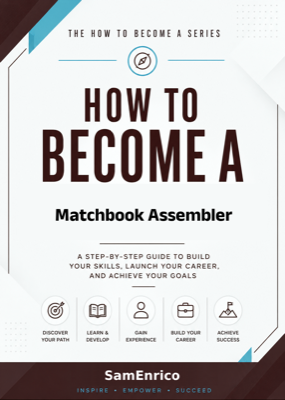
How to Become a Matchbook Assembler eBook
How to Become a Matchbook Assembler
How to Become a Matchbook Assembler
Formats
Free sample
Chapter 1: The Striking Surface--The first matchbook I ever assembled was not assembled at all. It was a failure. A crumpled, misaligned, un-strikeable disappointment that belonged more in the trash than on any workshop table. I had spent forty-five minutes watching a grainy You Tube video from 2009, paused at every step, replayed every fold. I had bought the wrong cardstock—too thin, the kind you use for printer paper, the kind that buckles under the slightest pressure.
I had cut the striker plate from a sheet of sandpaper meant for drywall, not phosphorus. The match heads, salvaged from a box of kitchen matches I had pulled apart with tweezers, were glued on crooked. When I struck the first match, nothing happened. No spark. No flame.
Just the sad, scraping sound of wood against grit, like a chalkboard being played by a toddler.I sat there in my garage, surrounded by shredded paper and broken matchsticks, and I laughed. Not because it was funny—it was not. I laughed because I had finally found something I could not do fast. I had spent my entire professional life learning things quickly. Spreadsheets, sales scripts, software frameworks, management buzzwords—I could absorb them overnight, deploy them the next morning, and look like I had known them for years.
But matchbook assembly refused to be rushed. It demanded patience. It demanded failure. It demanded that I sit with my mistakes and figure out, slowly and without shortcuts, why they were mistakes.This chapter is about that process. It is about the strange, magnetic pull of a nearly extinct craft.
It is about the history of a tiny object that changed the world and then almost disappeared from it. And it is about you—about why you are here, reading a book on how to become a matchbook assembler, and what that decision says about the kind of person you are becoming.Before we fold a single cover, before we load a single staple, we need to understand what we are actually doing. We need to understand the matchbook not as a product but as a teacher. Because if you are willing to learn from it, the matchbook will teach you things that no online course, no corporate training, and no motivational influencer can offer. It will teach you how to see small details before they become big problems.
It will teach you how to find rhythm in repetition. It will teach you that perfection is not a destination but a process of removing imperfection, one fold at a time.Let us begin at the beginning. Not with tools or techniques, but with the question that started everything for me, and that probably started everything for you: what is a matchbook, and why does it still exist?The Object That Refused to Die A matchbook is, on its surface, an absurd object. It is a disposable fire starter made from paper, wood, and a smear of chemicals. It costs pennies to manufacture.
It is designed to be used once and thrown away. In a world of Bic lighters, Zippo windproofs, and electric arc lighters with USB charging ports, the matchbook is a technological anachronism—a horse-drawn carriage on a highway of electric vehicles.And yet, the matchbook persists.There are probably matchbooks within fifty feet of you right now. Maybe in a junk drawer. Maybe in a bowl on a coffee table. Maybe in the glove compartment of a car you have not driven since last summer.
They accumulate like the small, magnetic shavings of a world that has not yet decided to let them go. Restaurants still print their logos on them. Hotels still leave them on nightstands. Wedding planners still order them as favors, embossed with the couple's names and a date that will soon be nostalgic.Why? Why does this object refuse to vanish?The answer is not practical.
Lighters are objectively better at lighting things. They are reusable, wind-resistant, and work in the rain. The answer is emotional. A matchbook is not just a tool. It is a handshake.
It is a memory. It is a small, physical piece of a moment that you can carry in your pocket and rediscover months later, faded and frayed, still holding the faint smell of the bar where you celebrated a birthday, the restaurant where you had a first date, the hotel where you spent a night that changed your life.When you hand someone a matchbook, you are not just handing them a way to light a candle. You are handing them permission to remember. That is why matchbooks survived the decline of smoking. That is why cannabis brands print their logos on matchbook covers, even though most cannabis users own lighters.
That is why you are holding this book.The matchbook is not a product. It is a vessel for meaning. And as a matchbook assembler, you are not just a manufacturer. You are a curator of small, portable memories. You are the person who makes the vessel, who folds the cardboard, who aligns the striker plate, who ensures that when someone strikes that match six months from now, in a kitchen on a rainy Tuesday, it lights on the first try.
That is not a job. That is a responsibility.A Brief History of Fire in Your Pocket The story of the matchbook begins, as many stories do, with a man who was annoyed by his own pockets.Joshua Pusey was a lawyer in Lima, Ohio, in the late 1880s. He smoked cigars—everyone smoked in the 1880s—and he was tired of carrying matches in bulky cardboard boxes that fell apart in his coat. He wanted a match that was flat, portable, and protected from accidental ignition. So he invented one.Pusey’s first matchbook prototype was not the matchbook we know today.
It was a piece of cardboard folded in half, with matches glued directly to the inside. The striking surface was a separate strip of sandpaper glued to the outside. It was crude, but it worked. Pusey patented his invention in 1892 and took it to the Diamond Match Company, the largest match manufacturer in America.Diamond Match said no.The company’s executives were not impressed. Matches were already cheap.
Matchboxes were already functional. Why would anyone pay for a newfangled match folder? Pusey left Diamond Match’s offices with his patent and his prototype, and for a brief moment, the matchbook seemed destined for obscurity.But Pusey did not give up. He improved his design. He replaced the glue with a folded paper comb that held the matches without adhesive.
He integrated the striking surface directly into the cardboard cover. He added a protective flap to prevent the matches from lighting accidentally. By 1894, his matchbook was elegant, reliable, and unmistakably modern. He went back to Diamond Match. This time, they bought the patent for one hundred thousand dollars—about three million dollars in today's money.What Diamond Match realized, and what Pusey had missed, was that the matchbook was not just a better match holder.
It was an advertising platform. The cover was a blank billboard that could be printed with logos, slogans, and addresses. Every time someone…
This is the end of the free sample. Get the eBook to keep going. Buy now
About this book
Details
- Author
- Briscoe Devon
- Publisher
- SamEnrico
- Language
- English
- ISBN
- 9781505772272
- Genre
- Non-Fiction, Informative, Educational
- Released
- 2026-05-02
- Pages (approx.)
- 152
- Available as
- eBook, Paperback, Audiobook

Read better in the ZLOADR app
Your eBooks on your phone or tablet. Sign in with your SamEnrico account and start reading.
More by Briscoe Devon
 Giving Feedback CreativelyBriscoe Devon$11.99
 Pandemic Job Loss RecoveryBriscoe Devon$11.99
 Self Hypnosis for Crohn's PainBriscoe Devon$11.99
 Gratitude Journal CourseBriscoe Devon$11.99
 X2 Short Term Visa ProcessBriscoe Devon$11.99
 Self Esteem for Nonprofit WorkersBriscoe Devon$11.99
 Chicago Velma And RoxieBriscoe Devon$11.99
 Design Thinking for DataBriscoe Devon$11.99
 The Last Stand at Dien Bien Phu: How a Jungle Fortress FellBriscoe Devon$11.99
 The Great Unraveling: How a 19th-Century Political Scandal Split a NationBriscoe Devon$11.99
 How to Produce Origami PaperBriscoe Devon$11.99
 How to Produce Collectible GunsBriscoe Devon$11.99