
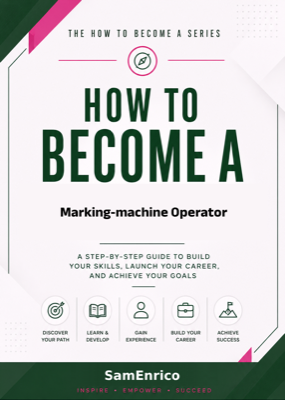
How to Become a Marking-machine Operator eBook
How to Become a Marking-machine Operator
by Baugh Jung
How to Become a Marking-machine Operator
Formats
Free sample
Chapter 1: The Seventy-Thousand-Dollar Secret--–- Let me tell you something that your high school guidance counselor never mentioned, that never appears in glossy career brochures, and that most factory workers themselves don't fully understand. There is a job in manufacturing that pays seventy thousand dollars a year, requires no college degree, can be learned in ninety days, and is currently so short of qualified people that companies are offering signing bonuses just to get someone in the door. You have probably never heard of it. That is not your fault. It is the best-kept secret in the blue-collar economy.The job is marking-machine operator.
The title sounds obscure, even boring. But here is what it actually means: you are the person who makes sure every product leaving a factory has the right expiration date, the correct serial number, a scannable barcode, and a legible lot code. You are the last guard against a recall. When a baby formula company misprints a date and has to destroy forty-seven million dollars' worth of product, that is a marking mistake. When an automotive supplier loses track of which brake calipers went into which cars because the serial numbers were unreadable, that is a marking mistake.
When your Amazon package shows up with the wrong shipping label and ends up in Ohio instead of Oregon, that is a marking mistake. You are the solution to those problems.I have spent the last decade training people to run these machines. I have trained nineteen-year-olds who never held a wrench and fifty-five-year-olds who were laid off from industries that don't exist anymore. I have trained women leaving retail, men leaving construction, and immigrants who learned English while learning to read a pressure gauge. The ones who succeed share one thing: they treat this job as a craft, not just a paycheck.
The ones who fail treat it as a punishment. This book exists to make sure you succeed.Before you learn a single technical skill—before you touch a sensor, a peel plate, or a lockout tag—you need to understand three things. First, what this job actually pays and why. Second, why nobody has told you about it before. Third, whether you are the right kind of person to do it.
Chapter One gives you that foundation. The rest of the book gives you the keys to the machine.The Numbers That Will Make You Rethink Every Career Advice You Have Ever Received Let us talk about money, because money is not shallow. Money is freedom from bad bosses. Money is health insurance when your kid gets sick. Money is not checking your bank account before you buy groceries.
I am not going to pretend this job makes you rich. It does not. But it makes you solidly, reliably, boringly middle class in a country where middle class is getting harder to reach.According to the Bureau of Labor Statistics, the median annual wage for all production workers in the United States is thirty-eight thousand dollars. That includes everybody who works on a factory floor—assemblers, packers, inspectors, sorters. Thirty-eight thousand is barely survival money in most cities.
After taxes, rent, and a car payment, there is nothing left.Marking-machine operators are not average production workers. They are specialized. And specialization pays. The latest industry surveys, cross-referenced with job postings from Indeed, Monster, and manufacturing associations, show three distinct salary tiers.Tier one: Entry level, zero experience. You have never touched a marking machine.
You cannot tell a laser from an inkjet. You do not know what a peel plate does. But you show up on time, you can lift fifty pounds, and you passed a drug test. Starting pay: forty-five to fifty-five thousand dollars per year. In high-cost areas like California, Massachusetts, or New Jersey, add five to ten thousand.
That is more than the average teacher makes in some states. That is more than most retail managers. That is more than your cousin with a communications degree working as a "marketing coordinator."Tier two: Eighteen to twenty-four months of experience. You have learned changeovers. You can calibrate a sensor without calling a technician.
You know which jam to fix yourself and which one needs maintenance. You have never caused a recall. At this level, you are making sixty-five to seventy-eight thousand dollars per year. You are now earning more than many police officers, more than most firefighters, and more than the median household income in thirty states. You are a single person making what two people used to make.Tier three: Lead operator or senior technician.
You have been doing this for three to five years. You have manufacturer certifications. You can troubleshoot blind. You train new hires. You take call-in shifts when the night operator calls in sick.
Your pay: eighty-five thousand to one hundred five thousand dollars per year. At the top end, you are earning more than registered nurses, more than electricians, and more than most assistant managers at Walmart. You are in the top twenty percent of American earners. You did it without a student loan. You did it in five years.I want you to sit with those numbers.
Then I want you to ask yourself: when was the last time you saw a high school career fair booth for marking-machine operators? When was the last time a guidance counselor pulled a student aside and said, "You know what, Timmy, you should really look into laser coding"? Never. It does not happen. This job exists in a blind spot of the American workforce.
That blind spot is your opportunity.Why You Have Never Heard of This Job (And Why That Is About to Change)The invisibility of marking-machine operation comes from three forces working together. Once you understand them, you will stop being frustrated that nobody told you sooner and start being grateful that the secret is still mostly intact.Force one: The fragmentation of manufacturing. When people think of factory work, they think of assembly lines—row after row of workers doing the same task on every product that passes. That image is fifty years out of date. Modern manufacturing is a series of tightly specialized processes.
One person fills the bottle. Another caps it. Another labels it. Another boxes it. Another shrink-wraps the pallet.
Marking is just one of these steps, but it is the step that happens last. Before the product goes into the box, it gets marked. That means marking is the final quality gate before shipping. It is also the step that most people never see, because it is buried inside a bigger machine or tucked between two conveyors. Out of sight, out of career consideration.Force two: The equipment manufacturers' training model.
Companies like Videojet, Domino, Markem-Imaje, and Hitachi make marking machines. They also sell training. Their business model depends on customers buying new machines and paying for authorized service. They have no financial incentive to create a huge pool of independent, highly skilled operators. In fact, their incentive is the opposite.
If every operator could troubleshoot and repair without calling a manufacturer technician, those companies would lose millions in service revenue. So they keep their training expensive and their certification programs…
This is the end of the free sample. Get the eBook to keep going. Buy now
About this book
Details
- Author
- Baugh Jung
- Publisher
- SamEnrico
- Language
- English
- ISBN
- 9781505771602
- Genre
- Non-Fiction, Informative, Educational
- Released
- 2026-05-02
- Pages (approx.)
- 142
- Available as
- eBook, Paperback, Audiobook

Read better in the ZLOADR app
Your eBooks on your phone or tablet. Sign in with your SamEnrico account and start reading.
More by Baugh Jung
 Pelvic Floor After C SectionBaugh Jung$11.99
 Outsourcing Customer ServiceBaugh Jung$11.99
 Myths About Emotions GuideBaugh Jung$11.99
 Eisenhower Matrix for Business LeadersBaugh Jung$11.99
 Breath Meditation For PTSDBaugh Jung$11.99
 Edgar Cayce Sleeping ProphetBaugh Jung$11.99
 Pomodoro For ProgrammersBaugh Jung$11.99
 John Mack HarvardBaugh Jung$11.99
 The Lion of the Atlantic: Prince Henry the Navigator’s Black CaptainsBaugh Jung$11.99
 The Siege of Calais: England's Bloody PrizeBaugh Jung$11.99
 How to Produce Hair Styling Tool SetsBaugh Jung$11.99
 Chinese Supplier Quality NegotiationsBaugh Jung$12.99