
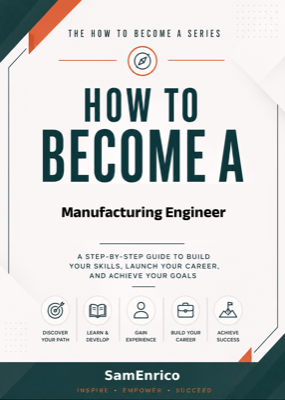
How to Become a Manufacturing Engineer Paperback
How to Become a Manufacturing Engineer
How to Become a Manufacturing Engineer
Formats
Free sample
Chapter 1: The Broken Bolt--–- The bolt sheared at 2:17 on a Tuesday afternoon.Not with a dramatic explosion, not with shrapnel and fire, but with a quiet, almost apologetic snap that was immediately swallowed by the thrum of the assembly line. The line kept moving. Conveyor belts rolled. Robots articulated their programmed arcs. But one station—Station 7—went silent.
An operator named Marcus raised his hand, not in alarm but in frustration. He’d seen this before.Within ninety seconds, a pile of unfinished assemblies began to accumulate. Within five minutes, a supervisor was on the phone. Within an hour, the plant manager was standing over the broken machine, asking a question that would cost the company $47,000 to answer: “Who do we call to fix this?”Nobody asked: “Why did this happen in the first place?”That question—the why question—is the difference between a mechanic and a manufacturing engineer. This book is about learning to ask that question before the bolt breaks, before the line stops, before the $47,000 invoice arrives.
It is about becoming the person who designs systems that prevent the bolt from ever being in a position to fail.The Myth of the Wrench If you tell someone you are studying to become a manufacturing engineer, you will hear some version of the same response: “Oh, so you fix machines?” Or, even more reductive: “Like a mechanic, but with a degree?”These responses are wrong in ways that matter.A mechanic diagnoses and repairs individual machines. A manufacturing engineer designs and optimizes the system in which those machines operate. The mechanic asks, “What broke?” The manufacturing engineer asks, “Why did the process allow that component to reach its failure point?” The mechanic replaces the bolt. The manufacturing engineer recalculates the torque spec, revises the maintenance schedule, redesigns the access panel so future replacements take two minutes instead of two hours, and updates the training manual so operators can recognize early warning signs.This chapter demolishes the “glorified mechanic” myth. It defines the modern manufacturing engineer as a systems thinker, orchestrating the entire journey from raw material to finished product.
It maps the career landscape across industries. And it introduces a framework—the Operating System of Production—that will structure every subsequent chapter.By the end of this chapter, you will know not just what a manufacturing engineer does, but how they think. And you will have taken the first step toward becoming one.The Four Responsibilities: What a Manufacturing Engineer Actually Does Every manufacturing engineer’s job description can be reduced to four core responsibilities. These are not sequential steps but overlapping domains of attention. A typical day might involve all four before lunch.1.
Process Design Process design is the act of planning, step by step, how a raw material becomes a finished product. This includes selecting equipment, specifying tooling, sequencing operations, designing workstations, and establishing cycle times.A process designer thinks in flowcharts and value streams. They ask: What happens first? What happens next? Where does the part sit while waiting?
How does it move? Where is the risk of error? Where is the opportunity for speed?In the broken bolt example, process design would have specified not just the bolt’s size and grade but the torque tool’s calibration schedule, the access clearance for replacement, and the inspection frequency for early detection of wear.2. Quality Assurance Quality assurance is not inspection. Inspection finds defects after they have already been created.
Quality assurance builds checkpoints, feedback loops, and error-proofing mechanisms into the process so defects cannot occur—or, if they do, they cannot travel far…
This is the end of the free sample. Get the Paperback to keep going. Buy now
About this book
Details
- Author
- Dickens Sandi
- Publisher
- SamEnrico
- Language
- English
- ISBN
- 9781505770964
- Genre
- Non-Fiction, Informative, Educational
- Released
- 2026-04-25
- Pages (approx.)
- 158
- Available as
- eBook, Paperback, Audiobook

Read better in the ZLOADR app
Your eBooks on your phone or tablet. Sign in with your SamEnrico account and start reading.
More by Dickens Sandi
 Luxury Goods Consumption DivideDickens Sandi$11.99
 Hotel Guest Anger GuideDickens Sandi$11.99
 Gacy Execution DayDickens Sandi$11.99
 Dubai Student Environmental ClubDickens Sandi$11.99
 Sudanese Darfur SurvivalDickens Sandi$11.99
 Seasonal Affective Disorder GuideDickens Sandi$11.99
 IBS Constipation DrugsDickens Sandi$11.99
 Bipolar Social Rhythm GuideDickens Sandi$11.99
 The Forgotten Lovers of Petra: A Royal Architect’s Dream in StoneDickens Sandi$11.99
 Rhythm of the Forgotten: The Lost Dance of the MinoansDickens Sandi$11.99
 A Collector's Handbook to the Citroën Citroën 2cv6Dickens Sandi$11.99
 How to Produce Socket DriversDickens Sandi$11.99