
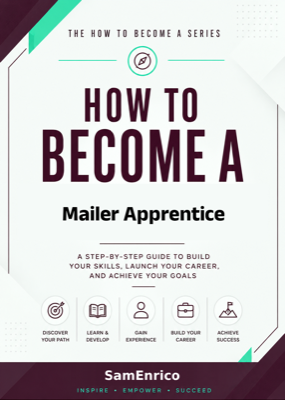
How to Become a Mailer Apprentice eBook
How to Become a Mailer Apprentice
How to Become a Mailer Apprentice
Formats
Free sample
Chapter 1: The Robot Ate Your Mailman--–- The first thing you need to understand is that the mailman you imagine—the cheerful soul whistling while hand-stamping letters, pushing a squeaky cart, and taking a two-hour lunch—has been dead for at least a decade. What replaced him doesn’t whistle, doesn’t take lunch, and definitely doesn’t squeak. It hums at 22,000 RPM, weighs as much as a small car, and sorts 300 parcels per minute without breaking a sweat. Your future isn’t behind a postal counter. It’s inside a machine the size of a football field, surrounded by robots, lasers, and more computing power than the Apollo missions had combined.This chapter is going to shatter every peaceful, slow-paced, “government job” fantasy you’ve ever had about postal work.
And then it’s going to give you something better: a picture of a career that pays like tech, feels like engineering, and requires zero university debt. But first, we need to kill the myth. Because if you walk into an interview talking about how much you love “helping people receive their mail,” you will lose to someone who can explain why a photoelectric sensor keeps false-triggering at 3:00 AM every Tuesday.Welcome to the real world of the modern mailer. It’s loud. It’s fast.
It’s automated. And it’s desperate for people like you.The Funeral of the Mailman Let’s start with a story. In 2015, a major European postal service processed 85% of its letter mail using automated sorting. By 2025, that number exceeded 98%. The remaining 2%?
Odd-sized items, live animals (yes, postal services ship day-old chicks), and things that genuinely cannot fit through a machine. The human mail sorter—the person who once stood at a bin and manually separated envelopes—now operates a diagnostic terminal. Their job isn’t touching mail. It’s touching a screen that tells them why Machine 4 keeps jamming on glossy magazine pages.The United States Postal Service (USPS) processes over 425 million pieces of mail per day. That’s not a typo.
Four hundred and twenty-five million. To put that in perspective: if you lined up those envelopes end to end, they would circle the Earth nearly three times. Every. Single. Day.
There is no army of human hands capable of that volume. There are, however, thousands of machines. And those machines break.Every major postal operator on the planet—Royal Mail, USPS, Deutsche Post DHL, La Poste, Canada Post—has undergone the same transformation. Sortation is now fully automated. Parcel tracking is real-time and AI-predicted.
Delivery routes are optimized by algorithms that account for traffic, weather, and even the time it takes for a carrier to walk to a tenth-floor apartment. The postal service of 2026 is not a logistics company that dabbles in automation. It is an automation company that happens to deliver mail.And here is the most important sentence you will read in this entire book: Every single one of those machines needs a human technician to keep it alive. The robots didn’t eat the mailman. They ate the manual labor.
Then they created a new job—the mailer apprentice—that pays better, requires more brain power, and offers a real career ladder instead of a dead-end route.Three Case Studies: Your Future in Three Buildings To understand what a modern mailer actually does, you need to walk through three very different buildings. Each one represents a major category of apprenticeship work. Pay close attention to which one makes your pulse quicken.Case Study One: The Letter Sorter You’re standing in a climate-controlled room the size of an aircraft hangar. The dominant sound is a low, rhythmic thrumming, like a heartbeat made of machinery. In the center of the room is a CULL (Culling and Facing Canceller) machine—a 50-foot-long behemoth that takes mixed letters, flips them right-side up, faces the stamps in the same direction, cancels them with a spray-on ink mark, and sorts them into 300 different bins by postal code.
It does all of this at a rate of 40,000 letters per hour.Your job as an apprentice is not to feed letters into the machine. That job has been automated by a hopper feeder that uses air jets to separate envelopes one at a time. Your job is to monitor the diagnostic panel, respond to alarms, and perform preventive maintenance. Today, the CULL threw a “False Feed” error. That means the sensor that detects whether an envelope has entered the transport path is triggering when there’s no envelope present.You grab your multimeter—a handheld device that measures voltage, resistance, and continuity—and walk to Sensor Bank 4.
You disconnect the sensor, test its resistance, and find that it’s reading 0 ohms when it should read 1,200. A dead short. You replace the sensor, recalibrate the sensitivity, clear the alarm, and the machine roars back to life. Total time: twelve minutes. The mail never stopped flowing; it just redirected to a backup conveyor while you worked.
That’s the difference between a mail center from 1995 and one from 2025. In 1995, a breakdown stopped the line. In 2025, redundancy means the system routes around the fault while you fix it. You are not an emergency responder. You are a preventive care physician for a machine.Key takeaway for the letter sorter apprentice: You will become an expert in sensors, conveyor belts, optical cameras (that read handwritten addresses), and pneumatics.
Most of your work will be diagnostic, not physical. You will spend more time looking at a laptop running PLC diagnostic software than you will lifting boxes.Case Study Two: The Parcel Hub Now walk half a mile down the road to the parcel hub. Same company, completely different world. The letter sorter is quiet and precise. The parcel hub is loud, aggressive, and violent.
Parcels don’t slide neatly like envelopes. They tumble. They bounce. They get stuck. They arrive in every shape imaginable—soft poly bags, rigid cardboard boxes, plastic-wrapped furniture, and the occasional tire (yes, people mail tires).The machine here is an automated sortation system called a “loop sorter.” It’s a continuous chain of small trays that circulate like a giant overhead roller coaster.
Each tray receives a single parcel. As the tray passes under a gantry of cameras, a laser reads the barcode, and the computer decides which of 200 chutes the parcel should drop into. At the right moment, the tray tilts, and the parcel slides into a bin or a mailbag. This happens 10,000 times per hour.Today’s fault: intermittent jamming at Chute 87. The jam sensor triggers, the machine stops, a technician clears the jam, and the machine restarts.
But the jam keeps coming back every 20 minutes. The manual fix (pulling out the stuck parcel) isn’t solving the root cause.You, the apprentice, start asking questions. Is Chute 87 receiving oversized parcels? You check the upstream camera logs and see that Parcel 4,287 was 18 inches long. The chute is rated for 16 inches.
But why did the system send an oversized parcel to a chute that can’t accept it? You trace the problem upstream. The dimensioning system—a set of lasers that measure each parcel—calibrated itself incorrectly at 3:00 AM. It’s been underestimating parcel lengths by…
This is the end of the free sample. Get the eBook to keep going. Buy now
About this book
Details
- Author
- Hutchens Elicia
- Publisher
- SamEnrico
- Language
- English
- ISBN
- 9781505767568
- Genre
- Non-Fiction, Informative, Educational
- Released
- 2026-05-02
- Pages (approx.)
- 152
- Available as
- eBook, Paperback, Audiobook

Read better in the ZLOADR app
Your eBooks on your phone or tablet. Sign in with your SamEnrico account and start reading.
More by Hutchens Elicia
 The Envy and Social Media GuideHutchens Elicia$11.99
 Remote Work Desk ErgonomicsHutchens Elicia$11.99
 Financial Stress Credit Score AnxietyHutchens Elicia$11.99
 The India Vendor Management GuideHutchens Elicia$11.99
 The Deep Blue Inventors: How Black Engineers Revolutionized Underwater ExplorationHutchens Elicia$11.99
 Learn to Play the VielleHutchens Elicia$11.99
 Remote Team Conflict ScriptsHutchens Elicia$12.99
 Patent ParalegalHutchens Elicia$11.99